Introduction to the Currency Markets
The Bank for International Settlements reports daily foreign exchange volume exceeds $7.5 trillion. Retail traders account for a growing percentage of this massive liquidity pool. Executing your first forex trade: step-by-step requires mechanical precision and strict adherence to established rules. This comprehensive guide breaks down the exact process of entering the currency market safely and effectively.
Table of Contents
- What Is Your First Forex Trade: Step-by-Step?
- Why Your First Forex Trade: Step-by-Step Matters
- How Your First Forex Trade: Step-by-Step Works
- Key Concepts and Terminology
- Practical Examples of a First Forex Trade
- Common Mistakes to Avoid in Forex for Beginners
- Advanced Techniques for Your First Forex Trade: Step-by-Step
- Tools and Resources for How to Trade Forex
- Frequently Asked Questions
What Is Your First Forex Trade: Step-by-Step?
A foreign exchange trade involves buying one currency while simultaneously selling another. Currencies always trade in pairs. When you execute a trade, you speculate on the fluctuating exchange rate between these two national currencies. Your first forex trade: step-by-step is the foundational action of participating in this global financial network.
Every currency pair consists of a base currency and a quote currency. The base currency appears first in the pair. The quote currency appears second. The exchange rate tells you exactly how much of the quote currency you need to purchase one unit of the base currency.
Understanding Major Currency Pairs
The forex market categorizes pairs into majors, minors, and exotics. Beginners should focus exclusively on major pairs. Major pairs always include the US Dollar (USD) and offer the highest liquidity, lowest trading costs, and most predictable price action. Mastering forex trading basics begins with understanding these specific assets.
| Currency Pair | Currencies Involved | Common Nickname | Average Daily Volatility |
|---|---|---|---|
| EUR/USD | Euro / US Dollar | Fiber | 60 - 80 pips |
| GBP/USD | British Pound / US Dollar | Cable | 80 - 100 pips |
| USD/JPY | US Dollar / Japanese Yen | Ninja | 70 - 90 pips |
| USD/CHF | US Dollar / Swiss Franc | Swissy | 50 - 70 pips |
Why Your First Forex Trade: Step-by-Step Matters
The initial execution of a live trade sets the psychological foundation for your entire trading career. Retail trading carries immense risk. The Financial Conduct Authority (FCA) requires regulated brokers to display risk warnings. These warnings consistently show 70% to 80% of retail accounts lose money. Proper preparation prevents you from joining this statistic.
Executing your first trade with a rigid, predefined plan builds discipline. Discipline separates profitable professionals from gambling amateurs. When you follow a mechanical process, you remove emotion from financial decisions. Fear and greed cause the majority of trading failures. A step-by-step approach neutralizes these psychological threats.
How Your First Forex Trade: Step-by-Step Works
Entering the market requires a sequence of deliberate actions. Skipping any of these steps introduces unnecessary risk. Follow this exact progression to execute your first position.
Step 1: Broker Selection and Account Setup
You need an intermediary to access the interbank market. This intermediary is your broker. Selecting a reliable forex broker dictates your trading costs, execution speed, and fund security. Look for brokers regulated by top-tier authorities like the FCA in the UK, the CFTC in the US, or ASIC in Australia. Open a demo account first to practice without financial risk.
Step 2: Market Analysis
Never enter a trade blindly. You must identify a logical reason to buy or sell. Traders use two primary methods to analyze the market. Fundamental analysis examines economic indicators, interest rates, and geopolitical events. Technical analysis for forex traders studies historical price charts to identify recurring patterns and trends. Your first trade requires a clear signal from one of these analytical methods.
Step 3: Risk Calculation
Determine exactly how much capital you accept losing before you place the order. Professional traders risk exactly 1% to 2% of their total account balance per trade. If your account holds $1,000, your maximum risk per trade equals $10. This calculation dictates your position size and your stop-loss placement.
Step 4: Order Execution
Trading platforms offer multiple ways to enter the market. Understanding these order types ensures you enter at your desired price level.
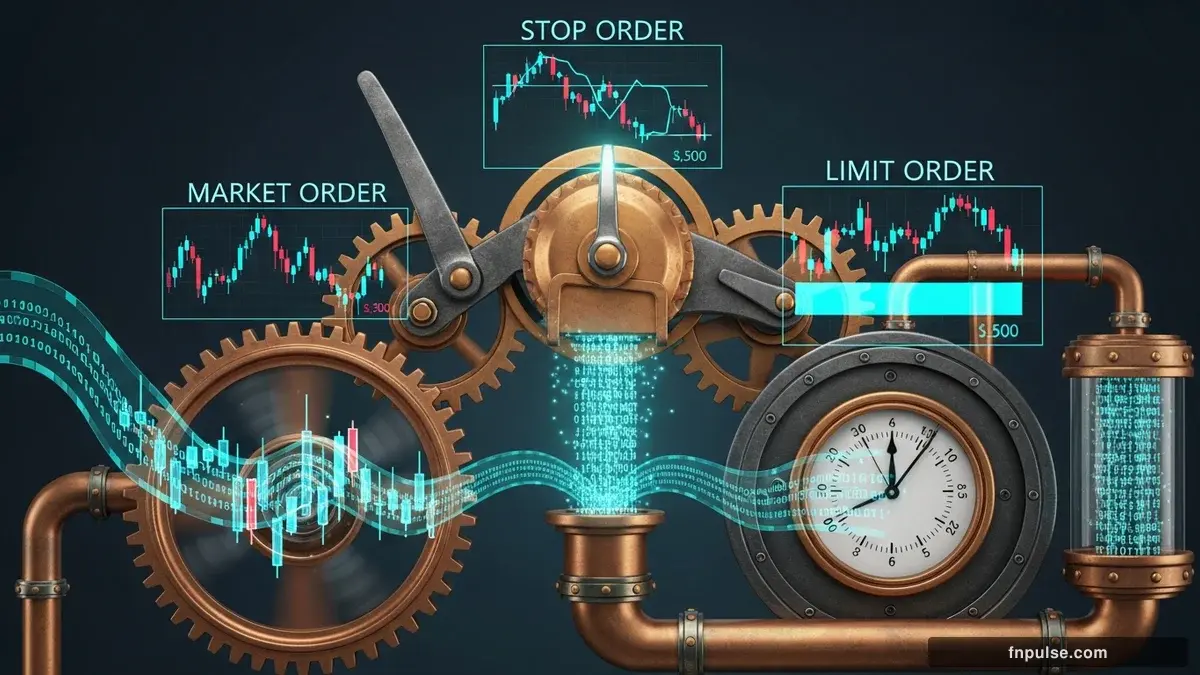
| Order Type | Definition | Best Use Case |
|---|---|---|
| Market Order | Executes immediately at the current available price. | Entering the market instantly during high momentum. |
| Limit Order | Executes only at a specific price or better. | Buying at a lower price or selling at a higher price than current market value. |
| Stop Order | Becomes a market order once price reaches a specified level. | Entering a trade only after price breaks through a key support or resistance level. |
Key Concepts and Terminology
The foreign exchange market uses specific jargon. You must understand these terms fluently before risking real capital. Misunderstanding these concepts leads directly to mathematical errors and financial loss.
Pip
A pip stands for "Percentage in Point." It represents the smallest standard price movement in an exchange rate. For most currency pairs, a pip equals the fourth decimal place. If EUR/USD moves from 1.0850 to 1.0851, the price moved one pip. Yen pairs are the exception. For USD/JPY, the pip represents the second decimal place.
Lot Size
Forex trades in specific volume increments called lots. A standard lot equals 100,000 units of the base currency. A mini lot equals 10,000 units. A micro lot equals 1,000 units. Your lot size directly determines the monetary value of each pip movement.
Leverage and Margin
Brokers allow you to control large positions with small amounts of capital. This system relies on leverage and margin. Leverage represents the ratio of borrowed funds to your actual deposit. A 100:1 leverage ratio allows you to control $100,000 with a $1,000 deposit. Margin represents the actual cash deposit required to open the position. Understanding leverage and margin prevents catastrophic account blowouts.
Bid, Ask, and Spread
Every currency pair shows two prices. The bid price is the price the broker pays you to sell the base currency. The ask price is the price you pay the broker to buy the base currency. The difference between these two prices is the spread. The spread represents the broker's primary fee for executing your trade.
Practical Examples of a First Forex Trade
Theory requires practical application. Let us walk through a complete mathematical example of a first forex trade using realistic market data. We will execute a long (buy) position on the EUR/USD currency pair.
The Scenario
- Account Balance: $5,000
- Risk Percentage: 1%
- Maximum Risk Amount: $50
- Currency Pair: EUR/USD
- Current Ask Price: 1.0950
The Strategy and Calculation
Your technical analysis indicates EUR/USD will rise. You decide to enter a market order at 1.0950. You look at the chart and identify a logical area for your stop-loss order below recent support at 1.0900. Your stop-loss distance equals 50 pips (1.0950 minus 1.0900).
You must calculate your exact position size based on your $50 maximum risk and your 50-pip stop-loss distance.
Formula: Maximum Risk Amount / Stop Loss Pips = Required Pip Value
Calculation: $50 / 50 pips = $1.00 per pip.
You need a position size yielding exactly $1.00 per pip. In EUR/USD, one micro lot (1,000 units) equals $0.10 per pip. One mini lot (10,000 units) equals $1.00 per pip. Therefore, your correct position size is exactly 1 mini lot (0.10 in standard lot notation).
The Execution and Outcome
You open your trading platform, set the volume to 0.10, enter your stop-loss at 1.0900, and click "Buy." You also set a take-profit order at 1.1050. This gives you a 100-pip profit target.
Scenario A: The Trade Wins
The price rises to 1.1050. Your take-profit order executes automatically. You capture 100 pips. At $1.00 per pip, you earn a $100 profit. Your account balance grows to $5,100.
Scenario B: The Trade Loses
The price drops to 1.0900. Your stop-loss order executes automatically. You lose 50 pips. At $1.00 per pip, you lose exactly $50. Your account balance drops to $4,950. You survived the loss because you followed strict mathematical rules.
Common Mistakes to Avoid in Forex for Beginners
New traders consistently repeat the same destructive behaviors. Recognizing these errors before you place your first order protects your capital.
Trading Without a Stop-Loss
A stop-loss order acts as your ultimate financial safety net. It automatically closes your position when the market moves against you by a specified amount. Operating without a stop-loss exposes your entire account balance to a single market movement. Unexpected news events cause massive price spikes. A stop-loss prevents these spikes from destroying your portfolio.
Overleveraging Your Account
Retail brokers advertise high leverage ratios to attract clients. High leverage amplifies both profits and losses. Using maximum leverage means a tiny price fluctuation triggers a margin call, forcing the broker to liquidate your position. Professional traders rarely exceed 10:1 true leverage, regardless of the maximum limit offered by their broker.
Ignoring Macroeconomic Data
Currency prices react violently to economic data releases. Central bank interest rate decisions, inflation reports, and employment data drive massive institutional volume. Entering a trade minutes before a major announcement turns trading into gambling. Smart traders monitor platforms like Federal Reserve Economic Data (FRED) to track macroeconomic trends and avoid trading during volatile data releases.
Advanced Techniques for Your First Forex Trade: Step-by-Step
Once you understand the basic mechanics, you must implement advanced structural rules to ensure long-term survival. Implementing strict risk management requires understanding expectancy and probability.
Trading foreign exchange carries a high level of risk and is not suitable for all investors. Past performance does not guarantee future results. Always trade with capital you afford to lose.
Risk-Reward Ratios
Your risk-reward ratio compares your potential loss to your potential profit on every trade. If you risk $50 to make $100, you operate with a 1:2 risk-reward ratio. This metric dictates your required win rate to remain profitable. A trader using a 1:2 ratio needs to win only 34% of their trades to break even. A trader using a 1:3 ratio needs to win only 26% of their trades to break even.
| Risk-Reward Ratio | Required Break-Even Win Rate | Outcome of 10 Trades (3 Wins, 7 Losses) risking $100 |
|---|---|---|
| 1:1 | 50% | -$400 (Net Loss) |
| 1:2 | 33.3% | -$100 (Net Loss) |
| 1:3 | 25% | +$200 (Net Profit) |
| 1:4 | 20% | +$500 (Net Profit) |
Position Scaling
Advanced traders rarely enter or exit their entire position at a single price point. Scaling in involves entering a fraction of your intended position size initially, then adding to the position as the market proves your analysis correct. Scaling out involves closing portions of your trade as price hits intermediate profit targets. This technique secures partial profits while allowing the remainder of the position to capture larger trend movements.
Correlation Analysis
Currencies do not move in isolation. The global economy links specific pairs together. Positive correlation means two pairs move in the same direction. Negative correlation means they move in opposite directions. For example, EUR/USD and USD/CHF typically exhibit strong negative correlation. Buying both pairs simultaneously often results in the trades canceling each other out. Understanding these relationships prevents you from accidentally doubling your risk exposure.
Tools and Resources for How to Trade Forex
Professional execution requires professional tools. Do not attempt to analyze the market or calculate risk using guesswork. Rely on established software and data feeds.
Trading Platforms
Your charting and execution software serves as your primary workstation. MetaTrader 4 (MT4) remains the industry standard due to its reliability and massive library of custom indicators. MetaTrader 5 (MT5) offers deeper market depth and more timeframes. cTrader provides advanced order execution capabilities and a highly intuitive interface for scalpers.
Economic Calendars
An economic calendar lists all scheduled government data releases, central bank speeches, and monetary policy announcements. These calendars grade events by expected market impact. You must check an economic calendar every morning before looking at price charts. If a high-impact event is scheduled for your traded currency, adjust your stop-loss or avoid entering new positions.
Position Size Calculators
Manual risk calculation leaves room for mathematical errors. Free online position size calculators require you to input your account balance, risk percentage, stop-loss distance in pips, and the currency pair. The calculator instantly provides the exact lot size required. Use this tool before every single execution.
Trading Journals
A trading journal tracks your performance metrics over time. Record the date, time, currency pair, entry price, exit price, position size, and the logical reason for the trade. Reviewing your journal reveals patterns in your behavior. You will quickly identify which currency pairs yield your best results and which times of day cause your biggest losses.
Frequently Asked Questions
What is the best currency pair for a first forex trade?
The EUR/USD pair represents the best choice for beginners. It offers the highest global liquidity, the tightest broker spreads, and the most consistent reaction to technical analysis. Avoiding exotic pairs protects you from erratic price spikes and expensive transaction costs.
How much money do you need to start trading forex?
Many brokers allow account openings with as little as $10. Operating with such small capital forces traders into bad risk management habits. A starting balance of $500 to $1,000 allows you to trade micro lots while strictly adhering to the 1% maximum risk rule per trade.
How do you calculate pip value accurately?
Pip value depends entirely on your lot size and the quote currency of the pair. For pairs where the US Dollar is the quote currency (like GBP/USD), one standard lot equals $10 per pip, one mini lot equals $1 per pip, and one micro lot equals $0.10 per pip. Pairs with different quote currencies require conversion back to your account currency.
What happens if a forex trade goes negative?
When a trade moves against your position, your account shows a floating loss. This loss reduces your available equity. If the floating loss hits your predefined stop-loss level, the broker closes the trade automatically. If you trade without a stop-loss and the floating loss consumes your required margin, the broker issues a margin call and liquidates the position to protect themselves from negative balances.
How long should you hold a forex trade?
Trade duration depends entirely on your specific strategy timeframe. Scalpers hold positions for seconds or minutes to capture tiny price movements. Day traders close all positions before the New York trading session ends to avoid overnight swap fees. Swing traders hold positions for days or weeks to capture major macroeconomic trends.