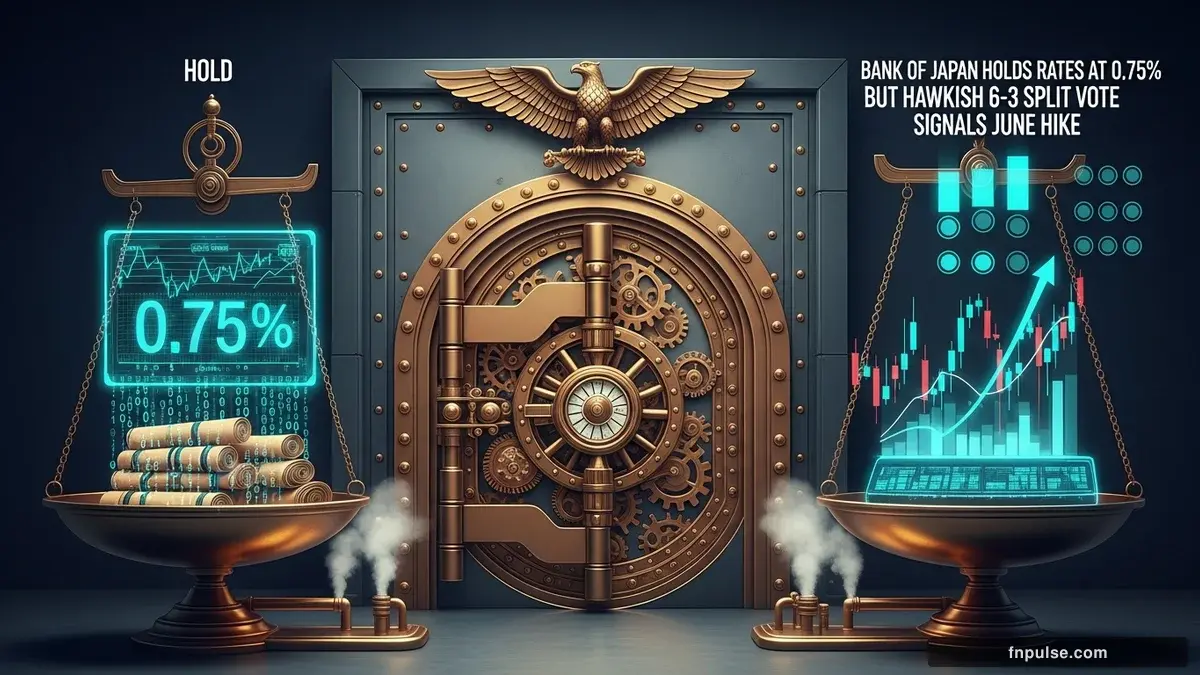
Bank of Japan Holds Rates at 0.75% But Hawkish 6-3 Split Vote Signals June Hike
Three dissenting board members vote for immediate hike as BoJ sharply raises inflation forecast to 2.8% on Iran war energy shock

The Bank of Japan kept interest rates unchanged at 0.75% on April 28, but a highly unusual 6-3 split vote revealed deep internal divisions over inflation risks. Three board members pushed for an immediate hike to 1.0%, while Governor Ueda's revised forecasts and hawkish messaging strongly point to a June rate increase.
The Bank of Japan (BoJ) held its key short-term interest rate at 0.75% on Tuesday, April 28, 2026, but delivered one of the most hawkish policy decisions of Governor Kazuo Ueda's tenure. The hold came via a contentious 6-3 vote, with three board members dissenting in favor of an immediate rate hike to 1.0% — the largest split since the Ueda era began.
The decision marks a critical inflection point for Japanese monetary policy. While the BoJ opted to wait amid elevated uncertainty from the ongoing Iran war and resulting energy price shock, the central bank sharply revised its cpi" title="Understanding inflation and CPI in forex">inflation forecast upward and signaled a strong likelihood of tightening at the June 19-20 meeting.
Unprecedented Three-Way Dissent Reveals Internal Hawkish Pressure
Board members Hajime Takata, Naoki Tamura, and Junko Nakagawa all voted to raise the policy rate to 1.0%, arguing that the Middle East conflict has skewed inflation risks to the upside. This represents the most significant internal division within the BoJ's nine-member board in over a decade.
"The three dissenters send a signal that the Bank of Japan could have hiked this time if not for the war," said analysts quoted by Reuters. "It looks like June could be the next live date in terms of rate hikes."
The USD/JPY pair traded at 159.49 following the announcement — dangerously close to the 160.00 level that triggered government intervention in 2024. The split vote briefly strengthened the yen as traders repriced June hike odds, but the currency gave back gains after Governor Ueda's press conference failed to provide a clear timeline.
Inflation Forecast Revised Sharply Higher on Energy Shock
The BoJ dramatically revised its core inflation forecast for fiscal year 2026 to 2.8%, up from 1.9% in the January outlook. The central bank now expects consumer price index (CPI) inflation to run in the 2.5%-3.0% range through March 2027, driven primarily by surging crude oil costs.
Brent crude prices remain elevated above $108 per barrel as the effective closure of the Strait of Hormuz continues to disrupt global energy flows. The BoJ acknowledged that energy-driven inflation is already feeding through to goods prices and that wage growth momentum remains strong.
"CPI is likely to rise in the range of 2.5%-3.0% in fiscal 2026, as the rise in crude oil prices is expected to push up prices," the BoJ stated in its outlook report. Inflation is then forecast to moderate to 2.0%-2.5% in fiscal 2027 and stabilize around 2% by fiscal 2028 as energy effects fade.
Critically, the BoJ maintained its assessment that underlying inflation will reach levels consistent with its 2% price stability target between the latter half of fiscal 2026 and fiscal 2027 — a timeframe that supports further rate normalization.
Growth Forecasts Slashed as Stagflation Risks Mount
Alongside higher inflation projections, the BoJ cut its GDP growth forecast for fiscal 2026 to just 0.5%, down from 1.0% in the January outlook. The fiscal 2027 growth estimate was trimmed to 0.7% from 0.8%.
"Japan's economic growth is likely to decelerate in fiscal 2026, since the rise in crude oil prices is expected to push down corporate profits and households' real income through a deterioration in the terms of trade," the central bank warned.
The BoJ now faces a classic stagflation dilemma: slowing growth paired with elevated inflation. However, policymakers believe Japan's economy will remain supported by government fiscal measures, accommodative financial conditions, and still-strong corporate profit levels.
Ueda: "We Will Not Fall Behind the Curve"
In his post-decision press conference, Governor Kazuo Ueda walked a fine line between acknowledging uncertainty and signaling hawkish intent.
"Given high uncertainty surrounding the Middle East conflict, the likelihood of achieving our forecasts has diminished," Ueda told reporters. "On the other hand, there is both big downside risk to growth and upside risk to inflation, mainly for fiscal 2026."
Crucially, Ueda pledged that the BoJ "will manage monetary policy appropriately so that it is not too late to raise interest rates." This language strongly suggests the central bank is preparing to hike at the June meeting if inflation data continues to run hot and energy prices remain elevated.
Market strategists noted that while the split vote was hawkish, Ueda's refusal to commit to a specific timeline tempered yen strength. "Ueda refraining from giving a decisive signal about the timing of a rate hike indicated that the BoJ may not be as hawkish as its split vote suggested," Bloomberg reported.
Market Implications: June Meeting Now "Live" for Hike
Following the decision, forex analysts upgraded their expectations for a June rate increase. A Reuters poll conducted April 7-14 had shown two-thirds of economists expecting a hike by end-June, with sentiment split between April and June. The April hold has now concentrated expectations on the June 19-20 meeting.
Key levels to watch for USD/JPY:
- 160.00 — psychological level and suspected intervention zone based on 2024 precedent
- 159.00-159.50 — current trading range following BoJ decision
- 155.00 — downside target if June hike expectations solidify and yen strengthens
Japanese Finance Minister Satsuki Katayama reiterated on Tuesday that the government stands "ready 24 hours" to intervene against excessive yen volatility, though no action was taken following the BoJ announcement.
Context: BoJ's Tightening Cycle Continues Amid Global Central Bank Super Week
The BoJ decision kicks off a historic week for global monetary policy, with the Federal Reserve announcing its decision on Wednesday, April 29 (2:00 PM ET), followed by the European Central Bank on April 30 and the Bank of England shortly after. All seven G7 central banks will have met within a 48-hour window — an unprecedented concentration of policy decisions.
The BoJ began its current tightening cycle in March 2024, ending 17 years of near-zero rates. Subsequent hikes followed in July 2024, January 2025, and December 2025, bringing the policy rate to the current 0.75% — the highest since September 1995.
If the BoJ hikes in June as markets now expect, the policy rate will reach 1.0%, a level not seen since the late 1990s. This would further narrow the interest rate differential with the US and potentially support yen strength, particularly if the Federal Reserve maintains its "higher for longer" stance amid its own energy-driven inflation concerns.
What Traders Should Watch
Between now and the June 19-20 BoJ meeting, several data points will be critical:
- May CPI data (released late May) — any acceleration above 2.0% core will strengthen June hike odds
- Crude oil prices — sustained Brent above $110 would force the BoJ's hand on tightening
- USD/JPY levels — a move toward or through 160 could trigger intervention and/or emergency policy action
- Wage negotiations — spring wage round results and whether companies continue passing costs to consumers
- US-Iran conflict developments — any ceasefire or escalation will directly impact energy markets and BoJ calculus
The April 28 decision was labeled a "hawkish hold" by most analysts. The June meeting now carries significant weight — and with three board members already on record supporting 1.0%, the bar for further tightening appears relatively low.
For forex traders, the takeaway is clear: the BoJ's tightening cycle is not over. Barring a dramatic reversal in energy markets or a sharp deterioration in Japanese growth, a June hike to 1.0% is now the base case scenario.
Jesus Guzman
Founder & Lead Analyst
Jesus is the founder of FN Pulse and a veteran trader with over 15 years of experience in financial markets. He specializes in quantitative analysis and is passionate about bringing transparency and data-driven insights to the retail trading industry.