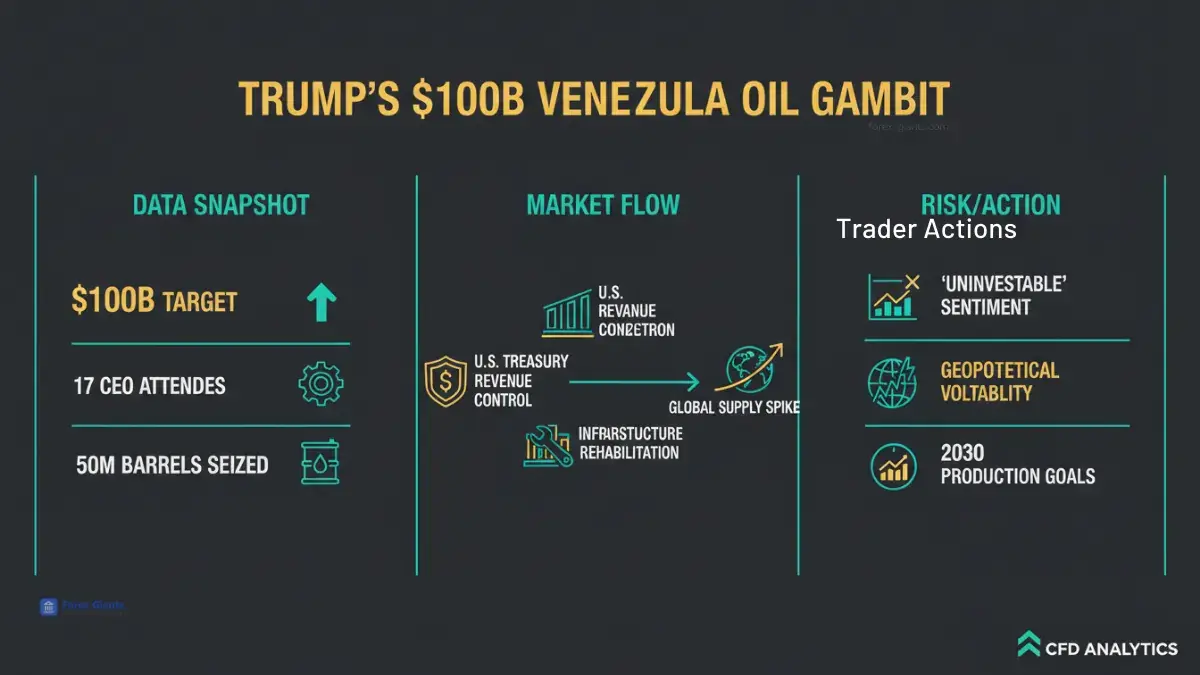
Trump's $100 Billion Venezuela Energy Plan Faces Implementation Hurdles After Tense White House Summit
Administration signals potential exclusion of ExxonMobil as industry giants weigh 'uninvestable' risks against $100B reconstruction targets.

President Trump’s drive to secure $100 billion in private capital for Venezuela's oil sector has moved into a critical implementation phase this weekend. While the White House promises 'total safety,' industry leaders remain divided over the geopolitical stability required for a decade-long $10 billion annual commitment.
The $100 Billion 'Big Oil' Mandate
Following a high-stakes meeting at the White House on Friday, January 9, 2026, the Trump administration has intensified its push for a $100 billion private-sector investment to revitalize Venezuela's energy infrastructure. As of Saturday, January 17, internal policy documents and analyst reports from major outlets including Reuters and Bloomberg indicate that the administration is now moving to establish asset control and execute initial crude sales.
President Trump hosted executives from 17 major energy firms—including Chevron, ExxonMobil, ConocoPhillips, and Shell—requesting a cumulative commitment of $100 billion over the next decade. The President framed the initiative as a 'no-risk' opportunity, asserting that the U.S. government would provide 'total safety' and directly manage the sale of Venezuelan crude to ensure investor returns.
Industry Skepticism and the 'Exxon Friction'
Despite the administration's bullish outlook, the energy sector remains cautious. ExxonMobil CEO Darren Woods notably described the current Venezuelan landscape as 'uninvestable' during the summit, citing the need for significant legal and regulatory overhauls.
In a sharp response delivered via social media and subsequent press briefings over the last week, President Trump suggested that skeptical firms could be 'kept out' of future deals. 'I didn’t like Exxon’s response,' the President noted. 'I have 25 other people ready to take your place.'
In contrast, Chevron—which has maintained a continuous presence in the region—has signaled a more collaborative stance, though it has yet to commit to a specific multi-billion dollar figure. The industry is currently demanding concrete contractual guarantees that protect against future expropriation or political shifts.
Policy Maneuvers: Executive Orders and Revenue Control
To bridge the trust gap, the White House has executed several strategic moves:
Revenue Protection: A recent executive order protects Venezuelan oil revenue held in U.S. Treasury accounts from international creditors.
Naval Interdiction: U.S. forces have seized five tankers linked to the former regime over the past month to consolidate control over supply chains.
Interim Governance: The administration is coordinating with interim President Delcy Rodríguez to draft a new regulatory framework tailored for U.S. operators.
Market Outlook: Target $50 per Barrel
The ultimate goal of the 'Venezuela Gambit' is to surge global supply to lower domestic gasoline prices, with the President targeting a long-term oil price of $50 per barrel. Analysts at the Baker Institute estimate that restoring production to historical peaks would require roughly $10 billion in annual capital expenditure over the next ten years.
While the plan offers a potential windfall for service providers like Halliburton and Schlumberger, the market remains in a 'wait-and-see' mode. The transition from military raid to economic reconstruction is fraught with logistical complexities, and the $100 billion investment target remains the most ambitious energy project of the 21st century.
Jesus Guzman
Founder & Lead Analyst
Jesus is the founder of FN Pulse and a veteran trader with over 15 years of experience in financial markets. He specializes in quantitative analysis and is passionate about bringing transparency and data-driven insights to the retail trading industry.