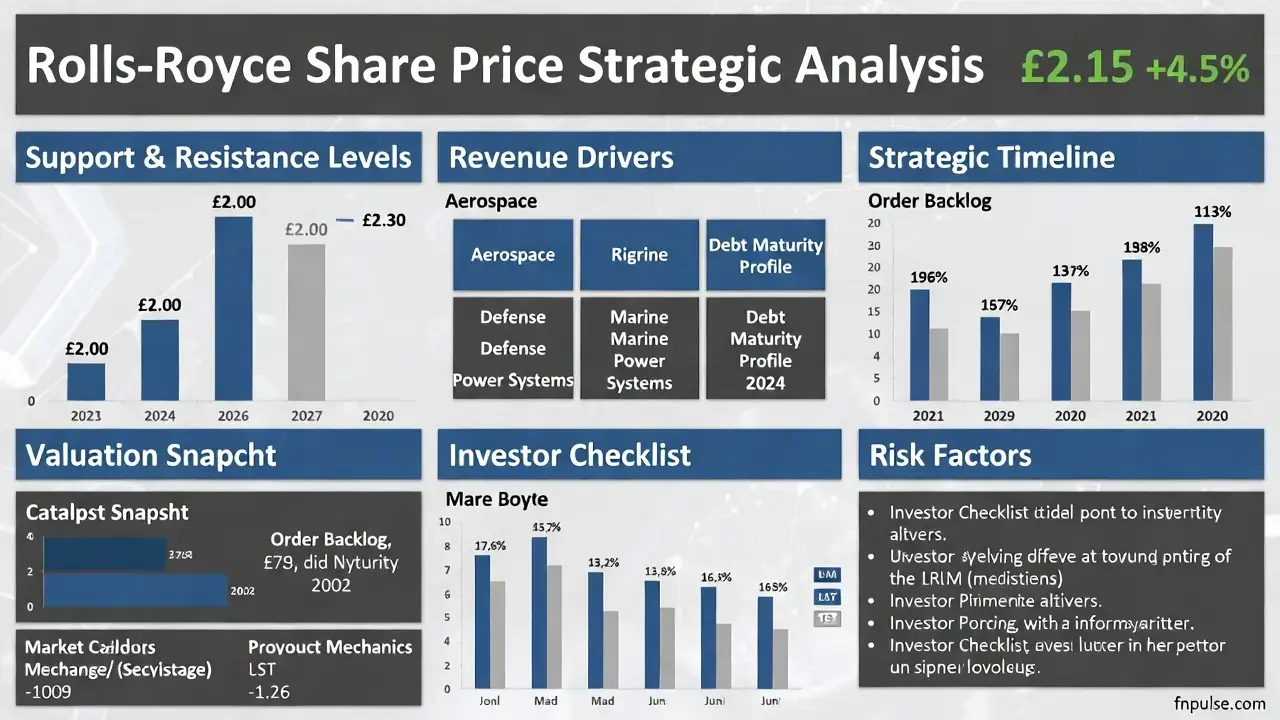
Rolls Royce Share Price Strategic Analysis
ROLLS-ROYCE HOLDINGS PLC (LSE: RR.) PROFESSIONAL RESEARCH
Abstract
The current Rolls-Royce share price is driven by a profound transformation, moving the stock from a "survival discount rate" valuation to a substantial "execution premium". The market is now pricing in not just the post-pandemic recovery, but the sustained delivery of significantly raised profitability and free cash flow targets extending through 2028.
Other Researches:
Full Research
1.0 Executive Overview: Transformation and Renewed Momentum
Rolls-Royce Holdings plc is in the midst of a significant corporate transformation, defined by a robust financial turnaround and a clear strategic realignment. This new trajectory is positioning the engineering giant for sustained future growth, even as it navigates persistent operational challenges across the global aerospace industry. Having successfully executed on cost efficiencies and commercial optimization, the company has established a strong foundation, enabling a renewed focus on innovation, shareholder returns, and leadership in the transition to more sustainable power and propulsion systems.
The key findings of this analysis are summarized below:
• Financial Resurgence: The company has demonstrated a dramatic improvement in its financial health, reporting a 57% year-on-year increase in underlying operating profit to £2.5 billion in 2024, supported by strong free cash flow of £2.4 billion. This performance has enabled the reinstatement of shareholder returns, marked by a 6.0p per share dividend for the fiscal year and the launch of a £1 billion share buyback program.
• Strategic Growth Pillars: Growth is being driven by strong performance across Rolls-Royce's core divisions. The Civil Aerospace segment is benefiting from a recovery in long-haul travel, with widebody engine flying hours (EFH) now exceeding pre-pandemic levels. The Defence sector provides long-term revenue visibility through major international programs like AUKUS, while the Power Systems division is capitalizing on new market opportunities in providing backup power for data centers. Concurrently, the company is advancing its position in the future of energy with its Small Modular Reactor (SMR) technology.
• Operational Headwinds: Despite its financial momentum, Rolls-Royce faces significant operational risks. The company is contending with industry-wide supply chain constraints that are impacting production and maintenance schedules. Furthermore, specific reliability issues with its Trent 1000 engine have led to grounded aircraft and flight cancellations for key customers, including British Airways and Virgin Atlantic, posing a risk to customer relationships and operational stability.
This report will now proceed with a detailed examination of the company's financial performance, which underpins its strategic ambitions.
2.0 Financial Performance and Capital Allocation Strategy
The financial recovery of Rolls-Royce represents a critical strategic achievement, providing the company with the stability and resources necessary to pursue its long-term objectives. The significant strengthening of the balance sheet and the generation of robust free cash flow are crucial enablers for future investment in next-generation technology, continued innovation, and the delivery of sustainable returns to shareholders.
2.1 Analysis of Key Performance Indicators (FY 2023-2024)
The company's full-year results for 2024 highlight a period of exceptional financial improvement, with substantial growth in profitability and cash generation compared to the prior year.
Metric | 2024 Results (£) | 2023 Results (£) |
Revenue | 17,848 million | 15,409 million |
Operating Profit | 2,464 million | 1,590 million |
Operating Margin % | 13.8% | 10.3% |
Profit Before Taxation | 2,293 million | 1,262 million |
Free Cash Flow | 2,425 million | 1,285 million |
The 57% increase in underlying operating profit and the corresponding margin expansion from 10.3% to 13.8% underscore the success of the company's strategic initiatives. These improvements were driven by a combination of commercial optimization, enhanced contractual terms, and group-wide cost efficiency programs.
2.2 Mid-Term Financial Outlook and Guidance
Rolls-Royce has demonstrated strong operational momentum, leading to a significant upgrade in its financial guidance and mid-term targets.
• Raised 2025 Guidance: The company now anticipates delivering £3.1bn-£3.2bn in underlying operating profit and £3.0bn-£3.1bn in free cash flow for the full year 2025.
• Upgraded Mid-Term Targets (2028 Timeframe): Looking further ahead, Rolls-Royce has set ambitious targets, including £3.6bn-£3.9bn in underlying operating profit and £4.2bn-£4.5bn in free cash flow.
This guidance highlights a powerfully accelerating performance narrative. The original 2025 guidance issued at the start of the year already positioned the company to meet its mid-term targets two years ahead of schedule. The subsequent upgrade signals even stronger operational momentum and management conviction, further solidifying this accelerated timeline and demonstrating the rapid success of its transformation program.
2.3 Capital Allocation and Shareholder Returns
Reflecting its strengthened financial position, Rolls-Royce has renewed its commitment to delivering value to its shareholders through a clear capital allocation strategy.
• Dividend Reinstatement: A final dividend of 6.0p per share for FY 2024, totaling approximately £504 million, has been recommended.
• Share Buyback Program: A £1 billion share buyback program was initiated for completion through 2025.
These actions are a direct result of management's confidence in the company's ability to generate sustainable cash flow. This is further supported by a significantly improved balance sheet, which transitioned from a net debt position of £1,952 million at the end of 2023 to a net cash position of £475 million at the end of 2024.
Having established the company's robust financial standing, the analysis will now explore the performance of the individual business divisions that contribute to these results.
3.0 Core Business Divisions: Performance and Strategic Outlook
Rolls-Royce's overall performance is a composite of the results from its three distinct core divisions: Civil Aerospace, Defence, and Power Systems. Each division operates in unique market environments and contributes differently to the company's strategic goals. This section dissects the performance, market dynamics, and future growth prospects of each segment.
3.1 Civil Aerospace
The Civil Aerospace division has been central to Rolls-Royce's recent recovery, delivering a 79% organic increase in underlying operating profit to £1.505 billion in 2024. This performance is primarily driven by the resurgence of long-haul international air travel.
Key performance drivers include:
• Engine Flying Hours (EFH): Large engine flying hours reached 103% of 2019 levels in 2024, fueling a significant increase in high-margin aftermarket and services revenue.
• Contractual Improvements: The division has benefited from higher profits on its long-term service agreements (LTSAs) and improved contractual margins.
Rolls-Royce maintains a formidable position in the widebody engine market, holding exclusive supply agreements for the Airbus A330neo (Trent 7000 engine) and the Airbus A350 (Trent XWB engine). As of the end of 2024, the company's engines powered 36% of the global widebody installed fleet.
3.2 Defence
The Defence division serves as a source of stable, long-term, and profitable growth for the company, achieving a robust 14.2% operating margin in 2024. Its revenue is underpinned by multi-decade government contracts that provide exceptional visibility. Future growth will be driven by a portfolio of next-generation platforms, including:
• AUKUS: Providing nuclear submarine reactors for the trilateral security pact between Australia, the UK, and the US.
• B-52: The engine replacement program for the iconic US Air Force bomber.
• Future Long-Range Assault Aircraft (FLRAA): A key component of the US Army's future vertical lift program.
• Global Combat Air Programme (GCAP): A multinational initiative to develop a next-generation stealth fighter.
• MQ-25: The engine provider for the US Navy's unmanned aerial refueler.
To support these long-term programs, Rolls-Royce is making strategic investments, such as the recent skills and technology agreement with the Victorian Government in Australia to bolster the AUKUS supply chain.
3.3 Power Systems
The Power Systems division, which delivered a 13.1% operating margin in 2024, is executing a growth strategy centered on high-demand markets. The primary growth driver is the power generation segment, with a specific focus on providing mission-critical power solutions for data centers. Additionally, the division is focused on developing lower-carbon products, with its Battery Energy Storage Solutions (BESS) identified as a significant opportunity for profitable growth.
The distinct market dynamics of each division necessitate a closer look at the competitive environment, particularly for the crucial Civil Aerospace segment.
4.0 Competitive Landscape and Market Positioning
Rolls-Royce's most significant division, Civil Aerospace, operates in a highly consolidated market. The competitive landscape for widebody aircraft engines has evolved into a near duopoly, making a direct strategic comparison with its primary rival, GE Aerospace, essential for evaluating the company's market position and future prospects.
4.1 The Widebody Engine Duopoly
Following a strategic decision by Pratt & Whitney to focus its efforts on narrowbody engines, Rolls-Royce and GE Aerospace have become the two principal suppliers for the global widebody aircraft fleet. The market is clearly delineated:
• Rolls-Royce holds exclusive engine supply positions for the Airbus A330neo and the Airbus A350.
• GE Aerospace is the exclusive provider for Boeing’s 777 and 777X aircraft and is the preferred engine choice for the Boeing 787 Dreamliner.
This structure creates a highly competitive environment where technology, reliability, and long-term service offerings are critical differentiators.
4.2 Comparative Analysis: Rolls-Royce vs. GE Aerospace (2025)
A comparison of key financial and valuation metrics as of late 2025 reveals distinct profiles for the two industry leaders.
Metric | Rolls-Royce (RYCEY) | GE Aerospace (GE) |
TTM P/E Ratio | 16.1x to 34.1x | 42.9x |
2025 EPS Growth Est. | +34.6% | +27.6% |
2025 Sales Growth Est. | +24.4% | -4.4% |
Solvency (Gross Debt, Jun '25) | $4.64 bn | $18.89 bn |
The comparison highlights a compelling investment case for Rolls-Royce. Its significantly lower gross debt of $4.64 billion versus GE Aerospace's $18.89 billion provides superior financial flexibility for investment and shareholder returns. This strong solvency, coupled with a dominant EPS growth forecast (+34.6%), suggests a more efficient path to value creation and underpins its more attractive P/E valuation, positioning it as a high-momentum player in the duopoly.
This competitive strength, however, must be weighed against internal operational challenges that could impact the company's ability to execute on its strategy.
5.0 Operational Headwinds and Strategic Risks
Despite its strong financial turnaround and market position, Rolls-Royce confronts significant operational headwinds and strategic risks. These challenges, if not effectively managed, could impact future performance, strain customer relationships, and impede the company's ability to capitalize on market demand.
5.1 Industry-Wide Supply Chain Constraints
Like the rest of the aerospace industry, Rolls-Royce is grappling with persistent supply chain disruptions that affect the availability of raw materials and finished parts. The company has implemented several initiatives to mitigate these impacts, including:
• Integrating its procurement and supplier management teams for faster response.
• Sharing its own raw material stocks to address shortages.
• Embedding Rolls-Royce supply chain staff directly within supplier organizations to help drive recovery.
These constraints have had a tangible impact on customers. British Airways, for example, was forced to suspend its popular London Gatwick to New York JFK route for the winter 2024-2025 season due to engine shortages. These issues also affect cargo operations, creating further uncertainty in global logistics networks.
5.2 Trent 1000 Engine Reliability
Separate from broader supply chain issues, Rolls-Royce is facing specific and ongoing reliability problems with its Trent 1000 engine, which powers a portion of the Boeing 787 Dreamliner fleet. Problems related to the engine's longevity, compounded by the shortage of spare parts, have resulted in grounded aircraft and forced flight cancellations for several major airlines. These persistent reliability issues pose a direct threat to Rolls-Royce's market position on the Boeing 787, where it competes directly with GE Aerospace's GEnx engine, and could influence future engine selection decisions by airlines.
Airlines confirmed to be affected by this issue include: British Airways, Virgin Atlantic, Air New Zealand, ANA, and Gulf Air.
The customer impact is significant, as articulated in a statement from British Airways:
"We’re disappointed that we’ve had to make further changes to our schedule as we continue to experience delays to the delivery of engines and parts from Rolls-Royce – particularly in relation to the Rolls-Royce Trent 1000 engines fitted to our 787 aircraft."
5.3 Principal Risk Drivers
In its financial reporting, Rolls-Royce identifies several principal risk pillars that guide its strategic planning and risk mitigation efforts. These include:
• Energy transition: The risk of failing to develop and transition to net-zero products at pace.
• Information & data (including cyber): The risk of a cyber-attack or data breach impacting operations and reputation.
• Market & financial shock: Exposure to macroeconomic downturns, particularly those affecting air travel or defense spending.
• Political: Risks associated with geopolitical tensions, trade protectionism, and changes in regulatory regimes.
While navigating these challenges, Rolls-Royce is simultaneously investing in a portfolio of ambitious initiatives designed to secure future growth.
6.0 Strategic Initiatives for Future Growth
To secure its long-term growth and leadership in the global transition to sustainable power, Rolls-Royce is actively pursuing a multi-faceted innovation strategy. This approach is centered on developing next-generation aerospace technology while also pioneering new solutions for the clean energy market. This section evaluates the company's most significant strategic initiatives.
6.1 UltraFan: The Next Generation of Aero-Engine
The UltraFan program is a technology demonstrator designed to validate a new architecture for a generation of more sustainable and highly efficient aero-engines. It represents a significant leap forward in engine technology and is central to the company's future civil aerospace strategy.
Key technological features and performance targets include:
• Size: It is the world's largest aero-engine, featuring a fan with a 140-inch diameter.
• Efficiency: UltraFan offers a 25% improvement in fuel burn compared to the first-generation Trent engine.
• Sustainability: The engine is designed to run on 100% Sustainable Aviation Fuel (SAF) from its first day of service.
• Power: Its revolutionary Power Gearbox has been successfully tested at 64MW, setting a new aerospace industry record.
6.2 Small Modular Reactors (SMRs): A New Energy Frontier
The Rolls-Royce SMR business is a key pillar of the company's strategy to address the global energy transition. It aims to deploy a fleet of factory-built nuclear power plants that offer clean, reliable, and cost-effective energy.
The Rolls-Royce SMR is a 470 MWe pressurized water reactor designed for rapid deployment. The business is gaining significant commercial momentum:
• It is the preferred bidder in the Great British Energy competition in the UK.
• It has been selected by European utility CEZ for potential deployment in the Czech Republic.
Reinforcing its "designed for delivery" approach, Rolls-Royce SMR recently signed an agreement with BWX Technologies, Inc. (BWXT) for the detailed design and potential future procurement of the nuclear steam generators, a critical long-lead component.
6.3 Decarbonization and Sustainability Strategy
Underpinning these major initiatives is a comprehensive sustainability strategy. This strategy focuses on three core areas:
1. Enabling customers to use sustainable fuels across the existing product portfolio.
2. Developing new net-zero solutions such as SMRs and Battery Energy Storage Solutions (BESS).
3. Decarbonizing its own operations through the procurement of clean energy and improved efficiency.
These initiatives are designed not only to drive future revenue but also to solidify Rolls-Royce's position at the forefront of industrial technology.
Methodology
This report on Rolls-Royce Holdings plc was constructed using a focus-centric professional methodology designed to achieve three core objectives: ensure institutional credibility, maximize readability for human users, and structure the data for clean extraction systems.
This methodology centered on synthesizing financial and operational data across four distinct historical and prospective regimes, anchored by specific, verifiable financial performance metrics and strategic announcements.
1. Structure and Rigor (Credibility)
The report was built on four historical regimes that describe the company’s financial evolution and its changing equity narrative. This regime-based structure allowed for a comprehensive analysis of past performance, the crisis years, the transition, and the current transformation.
• Regime 1 (Pre-2020 Baseline): Focused on the Long-Term Service Agreement (LTSA) aftermarket model, where revenue is strongly linked to Engine Flying Hours (EFH), defining the fundamental cash engine.
• Regime 2 (2020 Stress Regime): Defined by the collapse of EFH, shifting market concern entirely to liquidity and leverage fear.
• Regime 3 (2021–2022 Transition Regime): Characterized by the credibility gap, testing whether the cyclical return of flying hours could translate into sustainable structural cash conversion amidst persistent supply chain challenges and cost inflation,.
• Regime 4 (2023–Present Repricing Regime): Driven by superior cash generation and execution, moving the valuation from a "survival discount rate" to an "execution premium",.
2. Data Sourcing and Verification (Credibility & Structure)
The brief is primarily anchored in recent financial reports and public announcements, ensuring the highest signal-to-noise ratio.
• Financial Anchors: Key financial metrics were extracted directly from the company’s official statements, specifically the 2024 Full Year Results and the 2025 Half Year Results,,. These included Underlying Operating Profit (£2.5 billion in FY2024), Free Cash Flow (£2.4 billion in FY2024), and the transition from net debt to a net cash position (£475 million by the end of 2024).
• Forward Guidance: Future projections were strictly tied to the upgraded mid-term targets (2028), citing precise ranges for Operating Profit (£3.6 billion–£3.9 billion) and FCF (£4.2 billion–£4.5 billion), and near-term guidance for FY2025 (£3.1 billion–£3.2 billion underlying operating profit and £3.0 billion–£3.1 billion FCF),.
• Operational Metrics: Operational performance was quantified using critical industry metrics, such as Large Engine Flying Hours (EFH) as a percentage of 2019 levels (e.g., 109% by October 31, 2025), and key ratios like the TCC/GM ratio (0.35x as of H1 2025),.
3. Projection Framework (Structure & Readability)
To provide non-speculative forward-looking commentary respected by institutions, a driver-based scenario framework was utilized rather than presenting a single price target.
• Scenario Design: Three scenarios (Base, Bull, Bear) were designed, each explicitly linked to measurable operational drivers, such as faster/slower EFH recovery, attainment of efficiency targets, and the persistence of supply chain constraints or external cyclicality,.
• Market Consensus: Analyst price targets and recommendation consensus (e.g., median target of 1,211p–1,250p) were included to anchor current market expectations, providing a recognized market data layer,.
4. Qualitative Narrative Integration (Readability)
The brief integrated qualitative elements to explain the "why" behind the numbers, focusing on strategic and technological catalysts:
• Core Strategic Pillars: The narrative leveraged the company’s stated strategy of focusing on Advantaged Businesses, Efficiency & Simplification, and Lower Carbon/Digitally Enabled Businesses,.
• Technological Drivers: Specific high-value, long-term initiatives were detailed, including the accelerated development of Small Modular Reactors (SMRs) (expected to be profitable by 2030), the UltraFan engine demonstrator (offering 25% fuel burn improvement), and defense programs like AUKUS and Project Pele (microreactor power conversion),.
• Comparative Analysis: The inclusion of a direct, quantifiable comparison with major competitor GE Aerospace clarified Rolls-Royce’s unique market positioning, solvency profile, and relative valuation
Key Findings
- 1Financial Transformation Confirmed: Net Cash Exceeds £1 Billion.
- 2Profitability Targets Accelerated: 2027 Goals Achieved Two Years Early.
- 3Mid-Term Ambitions Upgraded: FCF Target Rises to £4.5 Billion.
- 4Civil Aerospace Margin Surges, Driven by Flying Hour Recovery.
- 5Shareholder Returns Reinstated via Buybacks and Dividends.
- 6SMR Nuclear Program Advances to Sole Provider Status in UK; Profitable by 2030.
- 7Defense Backlog Reinforced by AUKUS and Strategic Partnerships.
- 8Persistent Supply Chain and Trent 1000 Issues Remain a Headwind.
- 9Time-on-Wing Improvement and Efficiency Measures Achieve "Best-in-Class" Status.
- 10Analyst Consensus Remains Bullish with Double-Digit Upside Forecast.
Conclusions
7.0 Conclusion: Synthesized Strategic Outlook
Rolls-Royce Holdings plc has executed a remarkable financial and operational turnaround, shifting from a period of restructuring to one of renewed momentum and strategic growth. The company has established a strong financial foundation, characterized by robust profitability and cash flow, which now serves as the launchpad for its ambitious future.
The company's strategic position is strong, supported by the recovery in its core widebody aerospace business, while its stable Defence portfolio and promising new ventures in Small Modular Reactors serve as strategic counterweights to the more cyclical and operationally challenged civil aviation sector. This balanced portfolio is capable of delivering both near-term results and long-term, transformational growth.
However, the path forward is not without significant challenges. The company's ability to overcome persistent global supply chain constraints and, crucially, resolve the ongoing reliability issues with its Trent 1000 engine will be paramount. Failing to address these operational headwinds not only damages customer confidence but also directly threatens the high-margin aftermarket revenues that are critical to achieving the ambitious 2028 free cash flow targets.
Ultimately, the future success of Rolls-Royce will depend on its ability to maintain a delicate balance: executing flawlessly on its existing portfolio while simultaneously delivering on its ambitious next-generation technology programs. By doing so, the company can solidify its position not just as a leading aerospace and defence firm, but as a critical enabler of the global transition to more sustainable power and propulsion.
References
- Rolls-Royce Holdings plc - Stocks - TradingView (2025)https://www.tradingview.com/symbols/LSE-RR./
- What's the dividend forecast for Rolls-Royce shares in 2026 and beyond - The Motley Fool - Mark Hartley (2025)https://www.fool.co.uk/2025/11/01/whats-the-dividend-forecast-for-rolls-royce-shares-in-2026-and-beyond/
- Rolls-Royce shares are already up 24% in 2025. Is another bumper year on the way? - Christopher Ruane (2025)https://www.fool.co.uk/2025/02/27/rolls-royce-shares-are-already-up-24-in-2025-is-another-bumper-year-on-the-way/
- Rolls Royce Holdings Plc (RR.) Ordinary 20p Shares - Hargraves Lansdown (2025)https://www.hl.co.uk/shares/shares-search-results/r/rolls-royce-holdings-plc-ordinary-20p
- Rolls-Royce Holdings PLC - Financial Times (2025)https://markets.ft.com/data/equities/tearsheet/summary?s=rr.:lse
- ROLLS-ROYCE HOLDINGS PLC - 2024 Full Year Results - Helen McCabe, Tufan Erginbilgic, (2025)https://www.investegate.co.uk/announcement/rns/rolls-royce-holdings--rr./full-year-results-2024/8754593
- Rolls-Royce reports strong financial growth - Tim Brownlee (2025)https://aerospaceglobalnews.com/news/rolls-royce-reports-strong-financial-growth/
- Rolls-Royce Holdings PLC - 2025 Half Year Results - Financial Times (2025)https://markets.ft.com/data/announce/detail?dockey=1323-17160389-73RVDVII9J36NR1QTH1F7LD0S1
- Rolls-Royce Holdings Plc 2025 Half Year Results - Jeremy Bragg, Richard Wray, Ruchi Malaiya (2025)https://www.rolls-royce.com/media/press-releases/2025/31-07-2025-rr-holdings-plc-2025-half-year-results.aspx
- Rolls Royce -- Repositioning complete; a return to long-term profitability - Thomas J. Zoretich (2025)https://www.tealgroup.com/index.php/teal-group-media-news-briefs-2/teal-group-news-media/item/rolls-royce-repositioning-complete-a-return-to-long-term-profitability
- The True Differences Between Pratt & Whitney & Rolls-Royce Engines - Luke Diaz (2025)https://simpleflying.com/differences-pratt-whitney-rolls-royce-engines/
- Rolls-Royce Vs. Pratt & Whitney: Vs. General Electric: Who Dominates The Commercial Aircraft Engine Market? - Luke Bodell (2025)https://simpleflying.com/rolls-royce-pratt-whitney-ge-dominate-engine-market/
- Rolls-Royce: Strong Civil Demand and Defense Momentum Support 2025 Targets and Midterm Upside - Loredana Muharremi (2025)https://global.morningstar.com/en-gb/stocks/rolls-royce-strong-civil-demand-defense-momentum-support-2025-targets-midterm-upside
- Largest Aircraft Engine Manufacturers (2025 Update) - Radu Balas, Cristina Danilet, Marius Stefan (2025)https://theflyingengineer.com/largest-aircraft-engine-manufacturers/