Revenge Trading: Stop Losses & Protect Your Capital
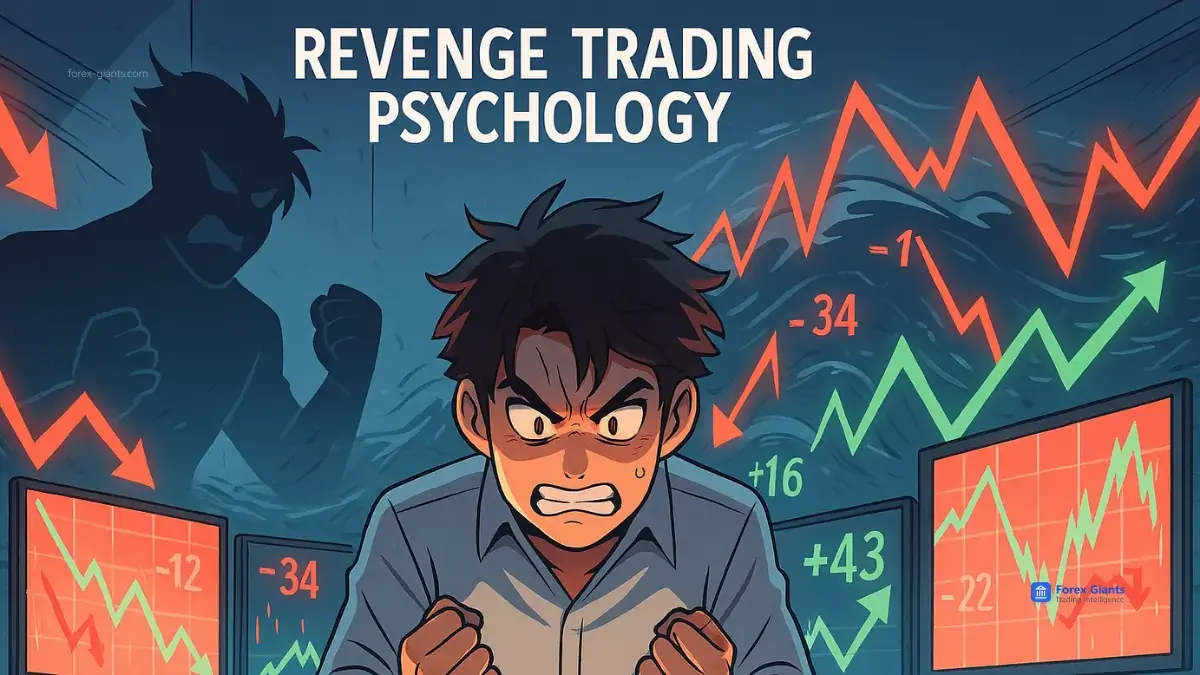
A profitable trade feels good. A losing trade stings. But what happens when that sting turns into a desperate, account-draining hunt to "win it back" from the market? You have entered the world of revenge trading, the single most destructive behavior for a trader's capital and confidence.
My name is Jesus Guzman, Head of Broker Analysis at FN Pulse. For over 20 years, my work has focused on quantitative analysis of broker performance and trader behavior. I have seen countless equity curves, and the sharpest, most catastrophic drops almost always have one thing in common: a series of impulsive, oversized trades that completely deviate from a sound strategy. This is revenge trading in action.
This is not another article about just "controlling your emotions". This is a data-driven guide to understanding the psychological triggers that hardwire your brain for this behavior. More importantly, it provides a clear framework of actionable, mechanical rules to stop it. We will look at how to use data, not willpower, to build the discipline required for long-term success.
What Is Revenge Trading? A Data-First Definition
Revenge trading is a pattern of emotional decision-making following a financial loss, characterized by abandoning a pre-defined trading plan to try and recoup losses quickly. It is an emotional response, not a strategic one. It replaces calculated risk with impulsive action.
The motivation is simple. You feel the market has taken something from you, and you want it back immediately. This transforms your trading from a business of probabilities into a personal fight you are statistically destined to lose.
Beyond Anger: Defining Revenge Trading by Its Metrics
We can define revenge trading not just by the feeling of anger, but by clear, measurable deviations from a baseline trading plan. When we analyze trading data, revenge trading appears as statistical anomalies.
At Forex-Giants.com, our proprietary analysis tools flag accounts for potential revenge trading when we see a sudden, sharp correlation between a loss and the following metrics:
Increased Position Size: A trader who normally risks 1% of their account suddenly risks 3%, 5%, or even 10% on the next trade.
Increased Trade Frequency: A trader who typically places 3-5 trades a day suddenly places 15-20 trades in a single hour.
Strategy Abandonment: A trader who follows a specific set of technical indicators suddenly starts taking trades based on "gut feel" or price action alone.
Ignoring Stop-Loss Rules: Removing a stop-loss on a losing trade in the hope that "it will come back."
These are not strategic adjustments. They are data points that signal a loss of discipline and the onset of emotional decision-making.
The Slippery Slope: From One Bad Trade to a Blown Account
Revenge trading is dangerous because it compounds errors. The cycle often looks like this:
The Initial Loss: A trader takes a well-planned trade that results in an unexpected or larger-than-average loss.
The Emotional Trigger: The trader feels frustrated and a need to immediately erase the loss. The logical part of the brain is overridden.
The First Revenge Trade: The trader enters a new position, often with a larger size and a less-than-ideal setup, to "win back" the initial loss.
The Compounding Loss: This impulsive trade also results in a loss, digging the hole deeper and amplifying the negative emotions.
The Spiral: The cycle repeats with increasing desperation, larger position sizes, and complete disregard for risk management until a significant portion of the account is lost.
What starts as a manageable 1% loss can easily become a 10% or 20% drawdown in a single session.
Real-World Example: How a Minor Loss Spiraled into Catastrophe
Consider a disciplined day trader with a $10,000 account. His plan is clear: risk a maximum of 1% ($100) per trade and stop trading for the day if losses exceed 3% ($300).
9:45 AM: He takes a valid short trade on EUR/USD. The trade goes against him and hits his stop-loss for a $100 loss. This is a normal, acceptable part of his strategy.
10:10 AM: Feeling annoyed, he sees another potential short setup. It does not meet all his criteria, but he feels the "market owes him". He enters the trade, but this time he doubles his position size to $200, hoping to recover the first loss and make a profit.
10:30 AM: This second trade also fails, resulting in a $200 loss. His total drawdown for the day is now $300, his "hard stop" limit.
10:35 AM: Panic sets in. He completely ignores his daily loss limit. He goes "all-in" on a highly speculative options trade with a $1,000 position, convinced he can make it all back in one move.
11:00 AM: The options trade expires worthless. He has now lost $1,300, or 13% of his account, in just over an hour.
This sequence shows how a single, acceptable $100 loss cascaded into a catastrophic $1,300 drawdown because of emotional reactions.
The Psychological Triggers: Why Your Brain is Wired to Revenge Trade
Understanding why you revenge trade is the first step toward preventing it. These are not character flaws. They are predictable cognitive biases that affect nearly everyone involved in high-stakes decision-making.
Trigger 1: Ego and the Inability to Accept a Loss
For many, a losing trade feels like a personal failure. Your analysis was "wrong," and the market proved it. This can be a significant blow to the ego, especially for intelligent and successful individuals.
Revenge trading becomes an attempt to reassert control and prove you were right all along. You are no longer trading your plan. You are trading to protect your ego, which is a battle the market will always win.
Trigger 2: Loss Aversion Bias and Its Financial Impact
Cognitive science has proven that humans feel the pain of a loss approximately twice as powerfully as the pleasure of an equivalent gain. This is known as loss aversion. Losing $100 feels far worse than winning $100 feels good.
💡 Pro Tip
This powerful bias creates an urgent, irrational desire to erase the pain of a loss. Your brain tells you that the fastest way to stop the pain is to win the money back immediately, pushing you toward impulsive, high-risk trades. The primary source for this concept is found in the groundbreaking work on Prospect Theory. For further reading, see the original paper by Daniel Kahneman and Amos Tversky in *Econometrica*.
This psychological imbalance makes it difficult to accept a loss and move on. Instead, your focus narrows to undoing the negative feeling, often at the expense of sound judgment.
Trigger 3: The Dopamine Trap of 'Winning It Back' Fast
When you trade, your brain releases dopamine, a neurotransmitter associated with reward and pleasure. Winning a trade provides a positive dopamine hit. The possibility of quickly reversing a loss and getting that reward creates a powerful chemical incentive.
This hunt for a quick dopamine fix is what makes revenge trading feel addictive. It closely mimics the psychological patterns of gambling. You are chasing the "high" of a win to overwrite the pain of a loss.
Trigger 4: FOMO After a Significant or Unexpected Loss
Fear of Missing Out (FOMO) is another powerful driver. After a loss, you might see the market continue to move and feel you are being left behind. You believe you need to get back in immediately or you will miss the opportunity to recoup your funds.
This creates a sense of urgency that is toxic to disciplined trading. It forces you to take suboptimal entries and ignore your risk parameters because the fear of missing a potential winning trade becomes greater than the fear of losing more capital.
Are You a Revenge Trader? Key Behavioral Warning Signs
Self-awareness is critical. You must be able to identify the warning signs in your own behavior before the damage becomes severe. If you recognize any of the following patterns, you are likely engaging in revenge trading.
Sign 1: Ignoring Your Pre-Defined Trading Plan
This is the most fundamental sign. Your trading plan contains your rules for entry, exit, position sizing, and risk management. When you start making exceptions like "just this one time" after a loss, you have begun to revenge trade.
Sign 2: Increasing Position Size to Recover Losses
A core tenet of risk management is consistent position sizing. If you find yourself calculating how large your next trade needs to be to cover the loss from your last one, you are in a dangerous mindset. Each trade should be evaluated on its own merit, with risk determined by your plan, not by your previous outcome.
Sign 3: Trading Outside Your Optimal Hours or Strategy
Perhaps your strategy works best during the London session, but you took a loss and continue trading into the less volatile Asian session. Or maybe you are a swing trader who starts scalping frantically after a losing trade. These are clear signs that emotion, not strategy, is dictating your actions.
A Quick Self-Assessment Checklist for Traders
Ask yourself these questions honestly after a losing session. Answering "yes" to any of them is a strong indicator of revenge trading.
Question | Yes / No |
|---|---|
Did I increase my trade size immediately after a loss? | |
Did I enter a trade that did not meet all my plan's criteria? | |
Did I remove or widen my stop-loss to avoid another loss? | |
Did I feel an urgent need to make the money back on the next trade? | |
Did I continue trading after hitting my pre-defined daily loss limit? | |
Did I place trades on markets or timeframes I do not normally trade? |
How to Stop Revenge Trading: 7 Actionable, Data-Driven Strategies
Willpower alone is not enough to defeat powerful cognitive biases. You need to build a system of hard, non-negotiable rules that protect you from your own emotional responses. These strategies are designed to be mechanical, removing subjective decision-making when you are most vulnerable.
Strategy 1: The 'Hard Stop' Rule — Your Daily Loss Limit
This is the most important rule in your trading arsenal. Before the trading day begins, you must define the maximum percentage of your account you are willing to lose in that single day. A common figure for active traders is 2-3% of the account balance.
If your account is $10,000 and your daily loss limit is 2%, your hard stop is $200. The moment your net loss for the day hits $200, you are done. You close all platforms, walk away from the screen, and do not place another trade until the next session. No exceptions.
This rule acts as a circuit breaker. It physically prevents a manageable loss from spiraling into a disaster.
Strategy 2: Pre-Defining Your Maximum Risk Per Trade
Just as you have a daily loss limit, you must have a per-trade risk limit. The industry standard is 1% of your account capital per trade. This ensures that no single trade can inflict enough emotional or financial damage to trigger a revenge trading spiral.
✅ Key Takeaway
If you risk only 1% per trade, you would need to lose 20 consecutive trades to suffer a 20% drawdown. This statistical buffer makes it much harder for a short losing streak to create panic and irrational behavior.
Strategy 3: The Power of a Quantitative Trading Journal
A professional trading journal is more than just a record of wins and losses. You must also log your emotional state and your adherence to your plan for every single trade.
Create columns for:
Setup Quality (1-5): How well did the trade align with your plan?
Emotional State (Calm, Anxious, Eager): What was your mindset upon entry?
Plan Adherence (Yes/No): Did you follow every single rule for this trade?
Reviewing this data will reveal patterns. You will see objectively that trades taken during an "anxious" state with low "plan adherence" consistently lose money. This data provides irrefutable proof that emotional trading is unprofitable.
Strategy 4: The 24-Hour Cool-Down Period After a Major Loss
Implement a mandatory "cool-down" rule. If you hit your daily loss limit, you are forbidden from even looking at the charts for the next 24 hours.
This forced break allows the emotional and chemical responses in your brain to subside. It breaks the feedback loop of loss-anxiety-impulsive action. When you return to the market the next day, you will do so with a calmer and more analytical mindset.
Strategy 5: Using Broker Tools to Your Advantage — Setting Max Loss Limits
Many modern trading platforms offer tools that help enforce discipline. My team at Forex-Giants.com always evaluates brokers on the quality of their risk management features. Look for platforms that allow you to:
Set a daily loss limit directly in the platform. Some software will automatically liquidate your positions and lock you out of trading if you hit this limit.
Set maximum position sizes. This prevents you from impulsively entering an oversized trade.
Require stop-losses on every order.
These tools automate your discipline, acting as a final line of defense when your emotions try to take over.
Strategy 6: Mindfulness and Detachment Techniques for Traders
Treat trading as a business of executing a probabilistic edge, not a personal battle. You must detach your self-worth from the outcome of any single trade.
Before each session, remind yourself:
My strategy has a positive expectancy over a large sample of trades.
Losses are a normal and expected part of this business.
This one trade does not define me as a trader.
This mental reframing helps reduce the ego's role and lessens the emotional impact of a loss, making you less susceptible to revenge trading.
Strategy 7: The Weekly Performance Review to Turn Data into Discipline
At the end of each week, sit down and analyze your trading journal. Do not focus on the money. Focus on the data and your behavior.
Ask questions like:
Which days did I follow my plan perfectly? What were the results?
Which trades were impulsive? What triggered them?
Is there a correlation between my losing streaks and a specific time of day or market condition?
This process turns your past performance, including your mistakes, into a data set for improving your future discipline.
Using AI & Data to Beat Revenge Trading: The Forex-Giants.com Edge
At Forex-Giants.com, we believe the solution to emotional trading lies in objective data analysis. We are developing institutional-grade AI tools to give retail traders the same analytical capabilities used by professional trading firms to monitor and improve performance.
How Our Tools Can Identify Your Revenge Trading Patterns
Our platform connects to your trading history and runs a diagnostic analysis. The system is designed to detect the statistical fingerprints of emotional trading. It can send you an alert in real-time.
Example Alert: "Warning: Your average trade frequency in the last hour is 300% higher than your 30-day average. Your average risk per trade has increased by 150% following two consecutive losses. This pattern is consistent with revenge trading behavior."
This objective feedback acts as an immediate, unbiased check on your emotional state.
Analyzing Your Equity Curve for Signs of Emotional Volatility
A disciplined trader's equity curve should have a steady, upward slope with small, controlled drawdowns. An equity curve plagued by revenge trading looks very different. It is characterized by sharp, deep V-shaped drops where a trader loses a significant amount of capital in a short period.
Our tools visualize your equity curve and highlight these periods of high volatility, correlating them with the specific trades that caused them. This visual evidence makes the destructive impact of revenge trading impossible to ignore.
Correlating Losing Streaks with Increased Trade Frequency and Risk
The core of our AI is pattern recognition. The software learns your baseline trading behavior: your average risk, your typical number of trades per day, and the hours you are most active. It then actively scans for deviations from this baseline, especially after a losing trade.
By showing you a clear chart that plots your losses against a spike in trading activity or risk, we give you the hard data you need to recognize your triggers and enforce your rules.
⚠️ Risk Warning
All trading involves substantial risk of loss and is not suitable for every investor. Past performance is not indicative of future results. The tools and strategies discussed are for educational purposes and do not constitute financial advice. Always perform your own due diligence.
The Bottom Line: From Emotional Reactor to Disciplined Trader
Revenge trading is not a sign of a bad trader. It is a sign of a human trader who has not yet built the necessary systems to manage innate psychological biases. Overcoming it is the critical transition from being a hobbyist to operating like a professional.
Discipline is not something you have. It is something you build through a consistent process and a framework of non-negotiable rules. By using data, not emotion, as your guide, you can protect your capital, learn from your mistakes, and create the foundation for a long and sustainable trading career.
Your Action Plan: Key Takeaways for Immediate Implementation
To start fighting revenge trading today, implement the following steps:
Define Your Rules: Write down your maximum risk per trade (e.g., 1%) and your maximum daily loss (e.g., 2%).
Set Up a Journal: Start logging every trade with an emphasis on your emotional state and adherence to your plan.
Walk Away: The moment you hit your daily loss limit, shut everything down. No exceptions.
Review Your Data: Conduct a weekly review to find your emotional triggers and behavioral patterns.
Automate Your Discipline: Use your broker's platform tools to set hard loss limits and risk parameters.
Summary/TL;DR
What is Revenge Trading? It is abandoning your trading plan after a loss to impulsively win money back. It is defined by metrics like increased position size, higher trade frequency, and ignoring rules.
Why Does It Happen? It is caused by powerful psychological triggers like ego, loss aversion (the pain of loss is twice the pleasure of gain), and the brain's desire for a dopamine reward.
How to Identify It: Warning signs include ignoring your plan, increasing risk to cover losses, and trading outside your strategy or optimal hours.
How to Stop It: Use hard, data-driven rules. These include a non-negotiable daily loss limit, a strict 1% risk-per-trade rule, a 24-hour cool-down period after hitting your loss limit, and keeping a detailed trading journal to track your behavior.
The Professional Approach: Use data and technology to analyze your trading patterns. Identify the statistical fingerprints of your emotional decisions to build self-awareness and enforce discipline.
Frequently Asked Questions About Revenge Trading
Q1: Is revenge trading a sign of a gambling addiction?
While revenge trading shares some characteristics with gambling, such as chasing losses and acting on impulse, it is not necessarily a full-blown addiction. For most traders, it is a temporary lapse in discipline caused by powerful cognitive biases. However, if the behavior is chronic and causes significant financial and personal distress, it is important to seek professional help as it could be part of a larger gambling problem.
Q2: How long does it take to stop revenge trading?
There is no set timeline. Stopping revenge trading is about building and consistently applying a system of rules, not about achieving a final state of emotional perfection. For some traders, implementing hard rules like a daily loss limit can stop the behavior immediately. For others, it is an ongoing process of self-awareness and refinement through journaling and weekly reviews. The key is process, not a deadline.
Q3: Can professional traders also fall victim to revenge trading?
Yes, absolutely. No trader is immune to emotion or cognitive bias. The difference is that professional traders and institutions have rigorous systems, multiple layers of risk management, and accountability structures in place to prevent an emotional impulse from turning into a catastrophic financial decision. They build systems to protect themselves from their own human nature.
Q4: What is the single most effective rule to prevent revenge trading?
The single most effective rule is the "hard stop" daily loss limit. It is a non-negotiable circuit breaker that physically stops you from trading when you are in your most vulnerable emotional state. By pre-defining your maximum acceptable loss for the day and honoring it without exception, you prevent a manageable bad day from becoming an account-destroying event.