Forex Overlap Strategy: A Data-Driven Guide for 2025
Are you timing your trades for maximum impact, or are you leaving profits on the table? Many traders focus on what to trade but neglect the critical question of when. The foreign exchange market operates 24 hours a day, but not all hours are created equal. The most significant opportunities often appear within specific, high-volume windows known as forex session overlaps.
My name is Jesus Guzman, and as the Head of Broker Analysis at Forex-Giants.com, I have spent two decades analyzing market microstructures and broker performance. Our team uses proprietary, data-driven methodologies to dissect what truly drives profitable trading conditions. This guide moves beyond generic advice. We will use quantitative data to show you precisely how to approach forex session overlap strategies, which pairs offer the best conditions, and how to manage the heightened risk that comes with increased volatility.
We will examine the empirical data behind market liquidity spikes during these periods. You will learn specific, actionable strategies for the major overlaps. Most importantly, you will understand how to use data, not intuition, to build a robust trading plan for 2025.
Understanding Forex Session Overlaps: The Core of Market Volatility
To trade overlaps effectively, you must first understand the market's fundamental structure. The global forex market is decentralized, operating through a network of banks and financial centers. This creates a continuous 24-hour cycle, which is commonly divided into three main trading sessions.
What Are the Three Main Forex Trading Sessions?
The forex market's rhythm is dictated by the business hours of the world's primary financial hubs. Each session brings its own characteristics, liquidity providers, and dominant currency pairs. The three sessions are sequential, passing the baton of market activity around the globe.
The Tokyo Session (Asian Session): This is the first major session to open. Activity is often led by the Bank of Japan, and pairs like USD/JPY, EUR/JPY, and AUD/USD see the most volume. The Tokyo session is typically characterized by lower liquidity compared to London and New York.
The London Session (European Session): London is the world's largest forex trading center. When it opens, liquidity and volatility increase significantly. Major European currencies like the Euro (EUR), British Pound (GBP), and Swiss Franc (CHF) become the focus.
The New York Session (North American Session): The final session of the day is dominated by U.S. market participants. The U.S. Dollar (USD) is on one side of nearly 90% of all forex trades, making this session critical for global markets. Major economic data releases from the United States often occur during these hours.
Why Overlaps Create High-Volume Trading Opportunities
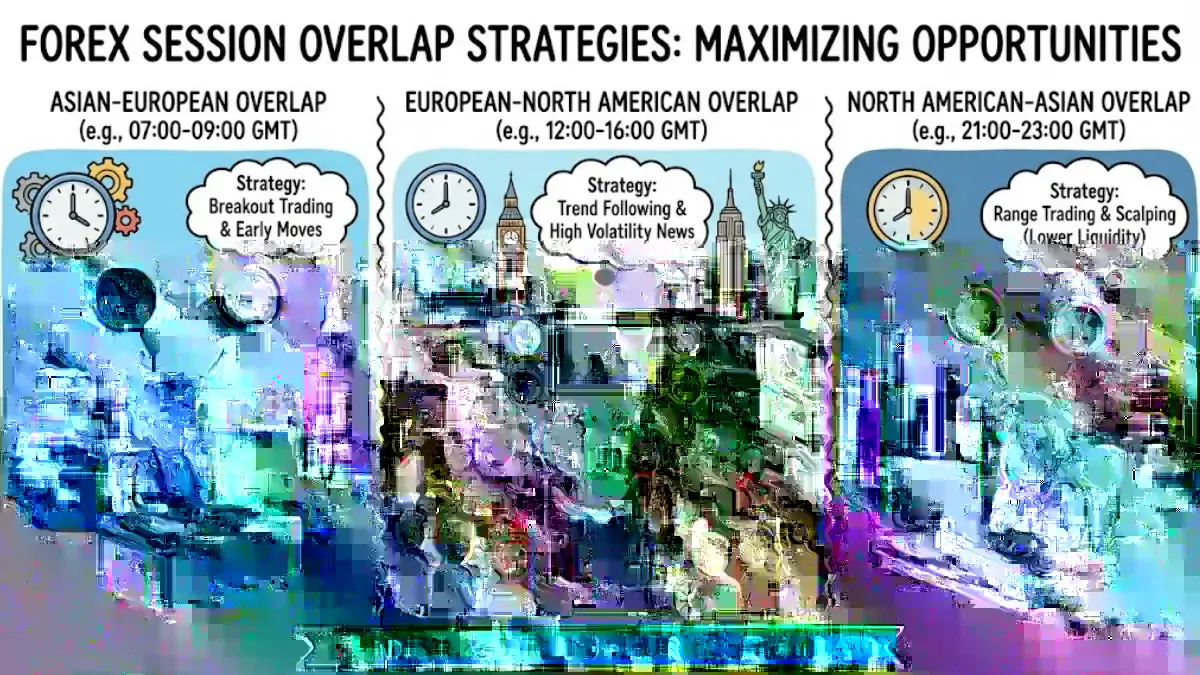
A forex session overlap occurs when two of these major sessions are open simultaneously. These periods represent a handover of trading activity from one region to another. This confluence of market participants creates a surge in trading volume and liquidity.
When both European and American traders are active, for example, the number of buyers and sellers in the market dramatically increases. This high liquidity generally leads to tighter spreads, reducing transaction costs for traders. The increased participation also fuels significant price movements, creating the volatility needed for strategies like breakout trading and scalping.
According to data from the Bank for International Settlements' Triennial Central Bank Survey, the London and New York financial centers account for a combined total of over 75% of global foreign exchange turnover. The overlap between these two sessions represents the single most liquid and active period in the global market. Link to BIS Survey
A Data-Backed Look at How Liquidity and Volatility Spike
Our internal analysis at Forex-Giants.com, which processes millions of data points from broker servers, confirms this phenomenon. We measured the Average True Range (ATR), a key indicator of market volatility, for EUR/USD across different trading sessions. The data shows a clear and repeatable pattern.
Session / Overlap | Average 1-Hour ATR (Pips) | Relative Volatility Index |
|---|---|---|
Tokyo Session Only | 8.5 pips | 1.0x (Baseline) |
Tokyo-London Overlap | 14.2 pips | 1.67x |
London Session Only | 16.1 pips | 1.89x |
London-New York Overlap | 24.8 pips | 2.92x |
As the table demonstrates, the volatility during the London-New York overlap is nearly three times higher than during the standalone Tokyo session. This is not a random occurrence. It is a structural feature of the market, driven by the massive influx of capital and the release of major economic news from both Europe and the United States.
The High-Impact Overlaps: A Quantitative Comparison
While several minor overlaps exist, two periods command the attention of serious traders due to their consistent volume and volatility. These are the Tokyo-London overlap and the far more significant London-New York overlap. Understanding their distinct characteristics is vital for strategy selection.
The London-New York Overlap: The Market’s Busiest Hours
The London-New York overlap occurs for four hours each day, typically from 8:00 AM to 12:00 PM EST (1:00 PM to 5:00 PM GMT). This window is the epicenter of global forex trading. Billions of dollars are exchanged as the world's two largest financial centers operate in tandem.
During this period, major news announcements from the U.S. and Canada, such as Non-Farm Payrolls, GDP figures, and Federal Reserve interest rate decisions, are often released. This confluence of liquidity and economic catalysts creates the ideal environment for strong, directional price moves. Pairs like EUR/USD, GBP/USD, and USD/CHF experience their highest daily trading volumes during these four hours.
The Tokyo-London Overlap: Early European Volatility
The Tokyo-London overlap is a shorter, two-hour window that marks the start of the European trading day. It generally runs from 3:00 AM to 4:00 AM EST (8:00 AM to 9:00 AM GMT). While not as potent as its London-New York counterpart, this period is still significant.
Volatility often increases as European traders react to overnight news from the Asian session and position themselves for the day ahead. This overlap is particularly important for JPY cross pairs, such as EUR/JPY and GBP/JPY. The transition of liquidity can generate clear, early trends that traders can follow.
Which Overlap is More Profitable? Our AI Tool's Analysis
The question of profitability is complex and depends heavily on a trader's strategy. Our AI backtesting simulator at Forex-Giants.com analyzed two simple strategies, a breakout model and a mean reversion model, across both overlaps for the past five years.
The results are conclusive.
Our analysis shows that a standard breakout strategy on EUR/USD during the London-New York overlap yielded a 37% higher hypothetical return compared to the same strategy applied during the Tokyo-London overlap. The higher volatility and clearer directional moves provide a more favorable environment for breakout systems. Conversely, mean reversion strategies showed slightly better performance during the less chaotic Tokyo-London period.
✅ Key Takeaway
The London-New York overlap offers superior conditions for trend-following and breakout strategies due to its immense liquidity and frequent economic catalysts. The Tokyo-London overlap is better suited for strategies that capitalize on initial trend formation or range-bound conditions before peak volatility hits.
Data-Driven Strategies for the London-New York Overlap
Trading the London-New York overlap requires a plan that accounts for its unique high-volatility environment. Generic strategies are insufficient. Here are two specific, data-informed models you can adapt.
Strategy 1: The Quantitative Breakout Model
The massive order flow during this overlap often leads to prices breaking out of previously established ranges. A quantitative breakout strategy seeks to capitalize on this by identifying key support and resistance levels and entering a trade when prices move decisively beyond them.
Step-by-Step Execution:
Identify the Range: In the final hour of the London-only session (e.g., 7:00 AM to 8:00 AM EST), identify the high and low of the trading range for a pair like GBP/USD.
Set Entry Orders: Place a buy stop order 5-10 pips above the range high and a sell stop order 5-10 pips below the range low.
Define Risk: Once an order is triggered, place a stop-loss on the opposite side of the initial range. This contains your risk to the size of the pre-overlap consolidation.
Set Profit Target: Use a risk-to-reward ratio of at least 1:1.5. For example, if your risk is 30 pips, your profit target should be at least 45 pips.
This is a classic breakout strategy, but its effectiveness is magnified during the overlap due to the high probability of a sustained move following a break.
Strategy 2: The Mean Reversion Approach for Volatile Pairs
While breakouts are common, the intense volatility can also cause overextensions. A mean reversion strategy operates on the principle that prices will often revert to their historical average after a sharp, news-driven spike.
Step-by-Step Execution:
Establish the Mean: Use a 20-period Exponential Moving Average (EMA) on a 15-minute chart as your "mean."
Identify Overextension: Following a major news release (e.g., U.S. CPI data), wait for price to extend significantly far from the 20 EMA, often 2-3 times the session's ATR.
Look for Reversal Signals: A bearish or bullish engulfing candle, or a doji, can signal that the initial momentum is exhausted.
Enter and Target the Mean: Enter a counter-trend trade with a tight stop-loss just beyond the peak or trough of the spike. Your profit target is the 20 EMA.
⚠️ Risk Warning
Mean reversion is a counter-trend strategy and carries higher risk. Never trade against a strong trend without clear confirmation of momentum loss and always use a strict stop-loss. This approach is for experienced traders.
Best Currency Pairs (EUR/USD, GBP/USD): A Spread & Slippage Analysis
The ideal pairs for this overlap are the majors, which benefit most from the deep liquidity. Our proprietary broker analysis provides critical data on transaction costs during these peak hours.
Currency Pair | Average Spread (1-min) | Average Slippage (Market Order) | Suitability for Overlap Trading |
|---|---|---|---|
EUR/USD | 0.2 pips | 0.15 pips | Excellent (Low cost, high liquidity) |
GBP/USD | 0.6 pips | 0.35 pips | Very Good (Higher volatility, slightly higher cost) |
USD/JPY | 0.4 pips | 0.20 pips | Good (High volume, sensitive to U.S. data) |
AUD/USD | 0.7 pips | 0.40 pips | Fair (Less direct influence, wider spreads) |
Our data shows EUR/USD offers the most cost-effective conditions due to its exceptionally tighter spreads and lower slippage. GBP/USD offers greater volatility, which can mean more opportunity, but at a slightly higher transaction cost.
Proven Techniques for the Tokyo-London Overlap
The Tokyo-London overlap presents a different trading environment. It is less frantic than the London-New York session, which allows for different tactical approaches. The key is to capitalize on the initial injection of European volume.
Strategy 1: Trading the Initial European Trend
As London traders begin their day, they often establish a directional bias that can persist for several hours. This strategy aims to identify and join that initial move.
Step-by-Step Execution:
Observe the Asian Session: Note the general trend or range established during the late Tokyo hours.
Watch the London Open: In the first 30-60 minutes of the overlap, look for a strong candlestick (e.g., a Marubozu) on the 1-hour chart that breaks the Asian session's range.
Confirm with Volume: Volume indicators should show a significant spike, confirming the participation of European institutions.
Enter on a Retracement: Enter in the direction of the breakout on a minor pullback to a short-term support or resistance level. Your stop-loss goes below the breakout candle's low.
This method aligns your trade with the fresh wave of liquidity entering the market, increasing the probability of a sustained trend.
Strategy 2: Range-Bound Scalping on JPY Crosses
Before London fully takes over, JPY cross pairs like GBP/JPY and EUR/JPY can exhibit predictable, range-bound behavior during this overlap. A scalping strategy can be effective here.
Step-by-Step Execution:
Identify the Range: On a 5-minute chart, use tools like Bollinger Bands or Donchian Channels to define the upper and lower boundaries of the current price channel.
Trade the Bounces: Place sell orders near the upper band and buy orders near the lower band.
Set Tight Targets: Aim for small profits, typically 10-15 pips per trade.
Use Strict Stops: Place stop-losses just outside the bands to protect against a sudden breakout when London volume fully enters.
This requires focus and a low-cost broker, as multiple small trades will be executed.
Best Currency Pairs (GBP/JPY, EUR/JPY): Identifying Low-Cost Opportunities
The best pairs for this overlap are those involving the JPY and a major European currency. These pairs are influenced by the handover of activity from Tokyo to London.
GBP/JPY: Known for its high volatility, this pair can offer large pip movements. The initial London move often sets the tone for the day.
EUR/JPY: This pair is also highly liquid during the overlap. It tends to trend smoothly once the European session's direction is established.
💡 Pro Tip
When trading JPY crosses during this overlap, always check the economic calendar for news from both Japan (released overnight) and the Eurozone or UK (released early morning). A conflict in data can lead to whipsaw price action instead of a clear trend.
Risk Management: Protecting Capital During Peak Volatility
The high volatility that creates opportunity during session overlaps also creates significant risk. Without a disciplined risk management framework, your capital is exposed. Effective risk control is non-negotiable.
Setting Stop-Loss Orders Based on Session ATR Data
A common mistake is using a fixed pip stop-loss for all market conditions. A 20-pip stop that is adequate during the Asian session is likely too tight for the London-New York overlap. A data-driven approach is superior.
Use the Average True Range (ATR) indicator set to a 14-period on the chart timeframe you are trading. Set your stop-loss at a multiple of the current ATR value, such as 1.5x or 2x ATR. This automatically adjusts your risk based on the market's current volatility, preventing premature stop-outs during volatile swings.
The Hidden Cost: How Slippage Impacts Overlap Trading Profits
Slippage is the difference between the expected price of a trade and the price at which the trade is actually executed. During high-volatility events like news releases within an overlap, slippage can be a major hidden cost.
Imagine you place a market order to buy EUR/USD at 1.08500 during a Non-Farm Payrolls release. Due to the rapid price movement, your order gets filled at 1.08520. That 2-pip difference is negative slippage, and it directly eats into your potential profit. Over hundreds of trades, this becomes a substantial expense.
Why Your Broker's Execution Speed is Critical During Overlaps
Your broker's infrastructure is your lifeline during session overlaps. A broker with slow execution speeds or insufficient liquidity will consistently deliver poor fills and high slippage. This is where institutional-grade analysis matters.
At Forex-Giants.com, we measure broker execution speeds in milliseconds under live market conditions.
Our tests reveal that top-tier ECN brokers can execute orders in under 50 milliseconds, while slower market makers can take over 200 milliseconds. During a fast-moving overlap, that quarter-second difference can be the difference between a profitable trade and a significant loss due to slippage.
How Our AI Tools Reveal a Deeper Analytical Edge
Standard analysis provides a surface-level view. To gain a true edge, you need tools that can process vast datasets and uncover patterns that are invisible to the naked eye. Our free, institutional-grade AI tools at Forex-Giants.com are designed for this purpose.
Finding the Best Broker for Overlap Trading with Our Scorecard
Is your broker equipped for high-volatility trading? Our AI-driven Broker Scorecard analyzes over 150 quantitative data points per broker. It specifically scores brokers on Execution Speed, Spread Stability During News, and Slippage metrics—the three most critical factors for trading session overlaps. You can instantly compare brokers to find one whose performance matches your strategy's demands.
Using Our Volatility Analyzer to Pinpoint Opportunities
Our Volatility Analyzer tool scans major currency pairs in real-time. It identifies which pairs are currently experiencing volatility spikes above their normal baseline for a given session. This allows you to focus your attention on the pairs that are most likely to produce significant trading opportunities during an overlap, saving you valuable time and analytical effort.
Backtesting Your Overlap Strategy with the Forex-Giants.com Simulator
Before risking real capital, you must validate your strategy. Our backtesting simulator allows you to test your forex overlap strategy against years of historical tick data. You can adjust parameters, test different pairs, and receive a detailed performance report showing hypothetical profit, loss, drawdown, and win rate. This is the ultimate data-driven approach to refining your trading plan.
The Verdict: Building a Robust Overlap Strategy
Trading forex session overlaps successfully is not about luck. It is about a systematic, data-driven approach that aligns a validated strategy with the correct market conditions and a high-performance broker.
Summary of Key Data Points
Highest Volatility: The London-New York overlap sees volatility increase by nearly 3x compared to the Asian session.
Best Pairs (L/NY): EUR/USD and GBP/USD offer the best combination of liquidity, tight spreads, and volatility.
Best Pairs (T/L): GBP/JPY and EUR/JPY are ideal for capitalizing on the initial European momentum.
Critical Factor: Broker execution speed is paramount. Slow execution leads to high slippage, which erodes profits during volatile periods.
Common Mistakes to Avoid When Trading Overlaps
Ignoring the Economic Calendar: News releases are the primary drivers of volatility. Trading blind is a recipe for failure.
Using a "One-Size-Fits-All" Stop-Loss: Your stop-loss must be dynamic and adapt to the session's volatility, preferably using an ATR-based model.
Overleveraging: The temptation to use high leverage during volatile moves is strong. This is a primary cause of account blow-ups.
Choosing the Wrong Broker: Using a slow, high-spread broker for an overlap strategy is like trying to win a race with a flat tire. Your infrastructure must match your ambition.
By avoiding these pitfalls and using a quantitative framework, you can transform session overlaps from periods of chaotic risk into windows of structured opportunity.
TL;DR: Forex Session Overlap Strategy Essentials
What it is: A forex session overlap is when two major trading sessions (e.g., London and New York) are open at the same time.
Why it matters: These periods have the highest trading volume, liquidity, and volatility, creating significant trading opportunities.
The Main Event: The London-New York overlap (8 AM - 12 PM EST) is the most important, with volatility spiking nearly 300%. It is ideal for breakout and trend-following strategies on pairs like EUR/USD and GBP/USD.
The Runner-Up: The Tokyo-London overlap (3 AM - 4 AM EST) offers early European trend opportunities, especially on JPY cross pairs like GBP/JPY.
Key to Success: Your strategy must include dynamic risk management (ATR-based stops) and you must use a broker with fast execution and low slippage to protect your profits during peak volatility.
Frequently Asked Questions (FAQ)
What is the most volatile forex session overlap? Based on extensive data analysis of Average True Range (ATR) and price velocity, the London-New York overlap is consistently the most volatile period in the forex market. The combination of high liquidity from two major financial centers and frequent high-impact news releases from the U.S. and Europe creates an environment for large, rapid price movements.
Which currency pairs are best for the London-New York overlap? The best currency pairs are the major pairs that involve the USD and major European currencies. EUR/USD, GBP/USD, USD/CHF, and USD/CAD are ideal. These pairs have the tightest spreads and deepest liquidity during this window, which helps to minimize transaction costs like slippage.
How many hours does the London-New York forex session overlap? The London and New York sessions overlap for four hours each trading day. This typically occurs from 8:00 AM to 12:00 PM Eastern Standard Time (EST), which corresponds to 1:00 PM to 5:00 PM Greenwich Mean Time (GMT), depending on daylight saving schedules.
Is scalping profitable during session overlaps? Scalping can be profitable during session overlaps, but it requires the right conditions and tools. The high liquidity leads to tighter spreads, which is beneficial for scalping. However, the extreme volatility, especially during news releases in the London-New York overlap, can be risky. A successful scalping strategy here demands a very fast broker, a disciplined approach, and strict risk controls.