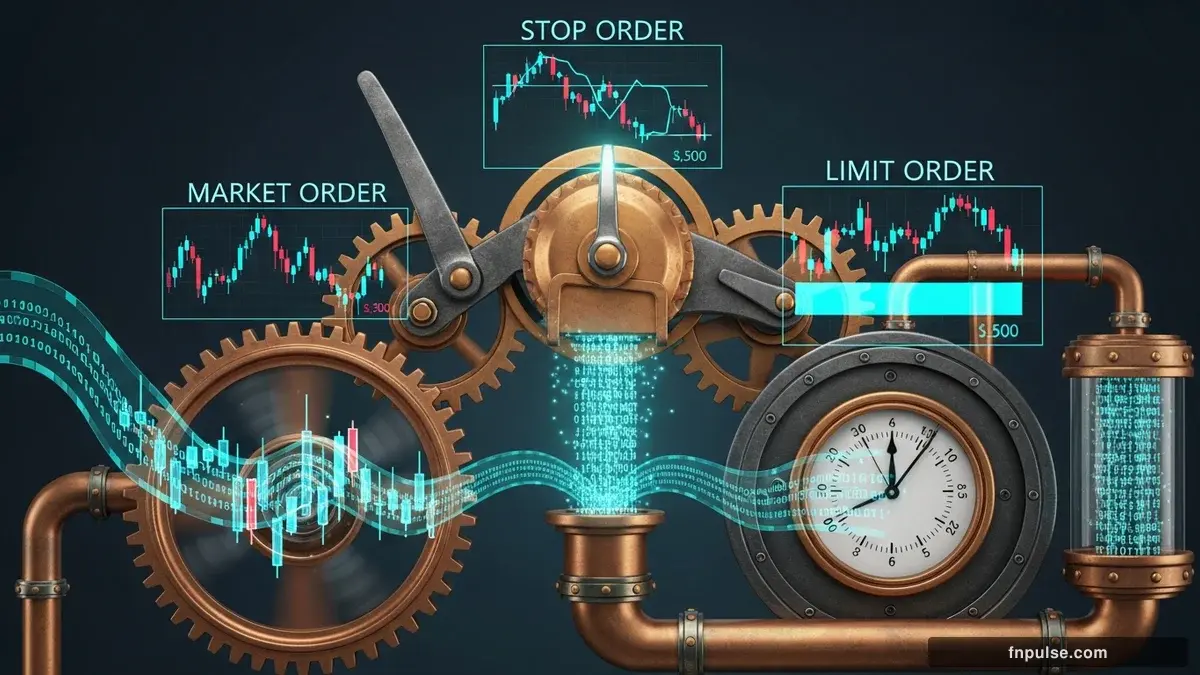
Understanding Order Types: Market, Limit, Stop
The Bank for International Settlements reports daily forex trading volume exceeding $7.5 trillion. Traders manage this massive liquidity using specific instructions sent to their brokers. Mastering order types: market, limit, stop gives you precise control over your trade execution and risk management.
Brokers execute your trades based on exact parameters. These parameters dictate price thresholds and timing rules. You must learn the mechanics of each instruction to protect your capital.
- Market order: Executes immediately at the current available price. You prioritize speed over price precision. The broker fills your request at the best available bid or ask price on the order book.
- Limit order: Executes only at a specified price or better. You prioritize price certainty over execution speed. A buy limit order sits below the current market price. A sell limit order sits above the current market price.
- Stop order: Becomes a market order once the price reaches a specific level. Traders use this instruction to enter breakouts or cap existing losses. A buy stop sits above the current price. A sell stop sits below the current price.
Learning these fundamental rules forms the core of forex trading basics. A market order guarantees execution but leaves you vulnerable to rapid price fluctuations. A limit order guarantees your price but risks zero execution if the market reverses early. A stop order protects your downside but exposes you to slippage during volatile events.
Time-in-Force Parameters
Order types require duration rules. Time-in-Force instructions tell the broker how long to keep your pending orders active.
- Good-Till-Cancelled (GTC): The order remains active indefinitely. The broker keeps the instruction on the order book until the market hits your price or you manually cancel the request.
- Day Order: The instruction expires at the end of the current trading day. Most brokers define the end of the day as 5:00 PM Eastern Time.
- Fill-or-Kill (FOK): The broker must execute the entire order immediately at your specified price. If the market lacks sufficient liquidity to fill the entire volume, the broker cancels the order completely.
- Immediate-or-Cancel (IOC): The broker fills as much of the order as possible at your specified price immediately. The system then cancels any remaining unfilled volume.
You must combine your primary order types with the correct Time-in-Force settings. This combination dictates exact execution terms.
How Order Types Affect the Forex Market
Every trade interacts directly with the broker's order book. Market participants fall into two distinct categories. They act as liquidity providers or liquidity takers. The interaction between these groups creates the bid-ask spread.
A market order takes liquidity from the market. It consumes available volume at the current bid or ask price. When large institutions place massive market orders, they consume all available liquidity at the nearest price level. The execution engine then moves to the next available price. This mechanism drives market trends.
A limit order provides liquidity to the market. It adds resting volume to the order book at specific price levels. Institutional traders place large limit orders to build positions without moving the market against themselves.
A stop order sits hidden off the public order book until triggered. Once the market hits the trigger price, the system converts the instruction into a market order. It then consumes liquidity instantly.
| Order Type | Execution Speed | Price Certainty | Market Impact |
|---|---|---|---|
| Market | Immediate | Low (Slippage risk) | Takes Liquidity |
| Limit | Delayed | High | Adds Liquidity |
| Stop | Immediate upon trigger | Low | Takes Liquidity |
Key Data Points to Watch
Execution quality dictates your long-term trading costs. Slippage occurs when your final execution price differs from your expected price. The Commodity Futures Trading Commission (CFTC) tracks execution quality and enforces market transparency rules.
During high-impact news events, liquidity providers pull their limit orders. Spreads widen instantly. A market order placed during a major economic release often results in severe negative slippage.
Watch these specific metrics on your trading platform:
- Average execution speed: Top-tier brokers execute trades in under 30 milliseconds. Faster execution reduces slippage on market orders.
- Slippage rates: Track the percentage of your trades executing at inferior prices. High slippage indicates poor broker liquidity.
- Fill rates: Monitor how often the market hits your limit order price without executing the trade. Partial fills occur when the order book lacks sufficient volume at your specified price.
Managing Slippage with Order Types
Slippage costs traders thousands of dollars annually. You must actively manage this hidden expense. Slippage happens during the microscopic delay between your order submission and the broker's execution.
News traders face the highest slippage risks. When a central bank announces interest rate decisions, prices gap. A price gap occurs when the quote jumps from one level to another without trading at the prices in between. If your stop-loss sits inside a gap, the broker executes your trade at the next available price. This creates severe losses.
To combat slippage, professional platforms offer maximum deviation settings. This feature allows you to define an acceptable slippage range for your market orders. If the market moves beyond your maximum deviation limit before execution, the broker rejects the order. This protects you from entering trades at terrible prices during sudden volatility spikes.
Limit orders provide another defense against slippage. Because a limit order demands a specific price or better, you eliminate negative slippage entirely. You trade execution certainty for price certainty.
Trading Strategies Using Stop and Limit Orders
Risk Disclaimer: Trading foreign exchange carries a high level of risk. You stand to lose your invested capital. Past performance does not guarantee future results. Never risk money you cannot afford to lose.
Professional traders deploy specific order types to match their defined market approach. You need a structured plan for every entry and exit.
Range traders buy at support levels and sell at resistance levels. They place a limit order exactly at these boundaries. This secures optimal entry prices while the market moves sideways. If the price never reaches the boundary, the trader misses the opportunity but protects their capital.
Breakout traders wait for the price to breach a key technical level. They place a stop order above resistance or below support. When momentum pushes the price through the level, the stop order triggers automatically. The trader catches the new directional trend without staring at the charts all day.
To protect capital, every single setup requires a stop-loss order. This specific instruction closes your position automatically at a predetermined loss level. You must structure your risk management rules before entering the live market. Read our comprehensive forex trading guides to build your strategy framework.
Advanced traders also deploy trailing stops. A trailing stop automatically adjusts your exit price as the market moves in your favor. It locks in profits while giving the trade room to breathe. You set the trailing distance in pips. If the market reverses by the specified pip amount, the trailing stop triggers and closes the position.
Historical Examples of Order Execution
Extreme market events expose the raw mechanics behind order execution. Analyzing these events shows why proper order selection matters.
On January 15, 2015, the Swiss National Bank abruptly removed the EUR/CHF exchange rate peg. The Bank for International Settlements (BIS) reported unprecedented volatility immediately following the announcement. The EUR/CHF price collapsed by 30% in mere minutes.
Traders holding long positions had standard stop-loss orders in place. The extreme price drop triggered thousands of these orders simultaneously. Because stop orders become market orders upon execution, they flooded the interbank network with sell instructions. The complete lack of buyers meant brokers executed these market orders at prices far below the intended stop levels. Traders suffered massive negative account balances.
This event highlights the severe risks of relying solely on standard stop orders during black swan events. Some traders now pay a premium for guaranteed stop-loss orders. These specialized instructions transfer the slippage risk entirely to the broker.
The May 2010 Flash Crash provides another clear example. Automated trading algorithms triggered a massive sell-off in US equities and related currency pairs. Algorithmic systems pulled their limit orders from the order books. Liquidity vanished in seconds. Market orders executed at absurd prices until circuit breakers paused trading. You must understand forex market mechanics to survive these rapid liquidity vacuums.
Next Steps for Your Trading Plan
You need a systematic approach to order execution. Open your trading platform and locate the order entry window right now. Practice placing each order type in a simulated demo environment.
Record your execution prices meticulously. Compare your actual fill prices to your requested prices. Calculate your average slippage on market orders during the London and New York trading sessions.
Adjust your daily strategy based on this data. Use limit orders for precise entries during quiet markets. Use stop orders to catch momentum during active sessions. Build a strict risk management protocol using stop-loss orders on every single trade.