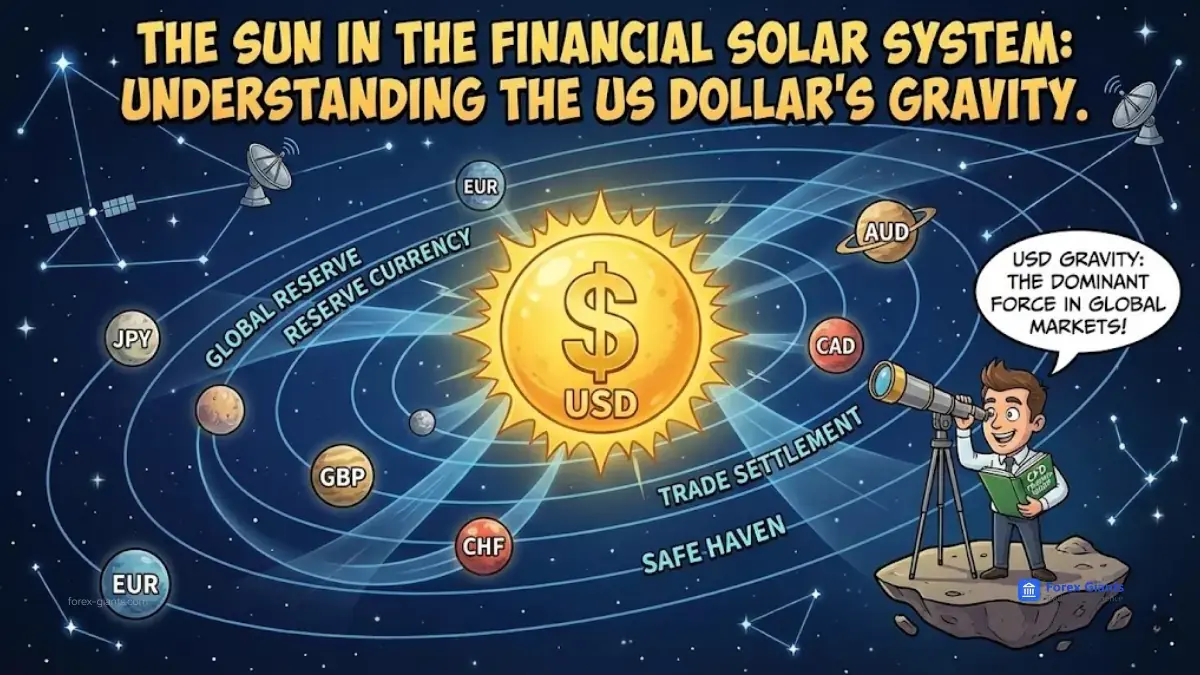
The Sun in the Financial Solar System: Understanding the US Dollar's Gravity
In the vast universe of the forex market, all currencies are not created equal. The US Dollar (USD) is not just another planet; it is the sun around which the entire financial solar system revolves. It is the world's primary reserve currency, the medium for global trade, and the ultimate safe-haven asset. As we discussed in our Master Guide to Currency Correlation, understanding the intricate relationships between currencies is paramount. At the heart of this web lies the USD. To trade any major currency pair, stock index, or commodity effectively, you must first learn to "speak Dollar."
This comprehensive guide is dedicated entirely to decoding the US Dollar. We will explore the fundamental economic forces that drive its value, from the interest rate decisions of the Federal Reserve to the vital signs of the US labor market. We will dissect its complex relationship with risk sentiment, explaining the famous "Dollar Smile" theory. Finally, we will provide a detailed map of its most important positive and negative correlations, giving you a practical framework for using the Dollar's movements to inform your trading across the entire market spectrum.
The Engine Room: What Truly Drives the US Dollar?
The value of the USD is not random; it's a reflection of the health and attractiveness of the US economy relative to the rest of the world. Four key factors are paramount.
1. The Federal Reserve's Monetary Policy (The #1 Driver)
The Federal Open Market Committee (FOMC) of the US Federal Reserve (the Fed) is the most powerful financial institution on the planet. Their decisions on interest rates dictate the flow of trillions of dollars around the globe.
Higher Interest Rates (Hawkish): When the Fed raises the Federal Funds Rate to combat inflation, it increases the "yield" on holding US Dollars. Global investors, seeking the highest return on their capital, sell other currencies to buy USD-denominated assets (like US Treasury bonds). This massive inflow of capital creates huge demand for the Dollar, causing its value to rise.
Lower Interest Rates (Dovish): When the Fed cuts rates to stimulate the economy, the yield on USD assets falls. Capital flows out of the US towards countries with higher interest rates, causing the Dollar to weaken.
Key takeaway: A hawkish Fed is a bullish USD. A dovish Fed is a bearish USD. The market hangs on every word of the Fed Chair's press conferences.
2. U.S. Economic Data (The Vital Signs)
Strong economic data reinforces the case for a strong Dollar and a hawkish Fed. The market watches these releases like a hawk:
Inflation (CPI & PPI): The Consumer Price Index is the Fed's primary inflation gauge. A higher-than-expected CPI reading suggests the Fed may need to keep rates higher for longer, which is bullish for the USD.
Employment (Non-Farm Payrolls - NFP): Released on the first Friday of each month, this is the most-watched economic report. A strong NFP number (lots of jobs created) signals a robust economy, which is USD-positive.
Retail Sales & GDP: These are direct measures of economic growth. Stronger-than-expected figures are bullish for the USD.
3. Global Risk Sentiment (The "Safe-Haven" Status)
This is what makes the USD unique. During times of global financial crisis, panic, or geopolitical uncertainty, investors don't just seek a high yield; they seek safety. They sell out of risky assets (like emerging market stocks) and pile into the safest, most liquid assets in the world: US Treasury bonds. To buy these bonds, they must first buy US Dollars.
- Risk-Off: Fear in the market = a flight to safety = a stronger USD. This is why the Dollar can sometimes rally even when US economic data is weak, if the situation in the rest of the world is perceived as being even worse.
4. The "Dollar Smile" Theory
This theory neatly combines the concepts of risk sentiment and economic outperformance. It suggests the USD strengthens at the two extremes and weakens in the middle.
Part 1: The Left Side of the Smile (Risk Aversion): A major global crisis or recession hits. Investors panic and dump risky assets, fleeing to the safety of the USD. The Dollar strengthens.
Part 2: The Bottom of the Smile (The Doldrums): The crisis subsides, and the global economy enters a period of slow, sluggish recovery. The Fed may cut rates to support the US economy. In this environment, investors seek higher yields elsewhere, and the Dollar weakens.
Part 3: The Right Side of the Smile (U.S. Outperformance): The US economy begins to recover more strongly than the rest of the world. The Fed starts to talk about raising interest rates. Capital flows back into the US to take advantage of the strong growth, and the Dollar strengthens once again.
Mapping the Connections: The Dollar's Key Correlations
Understanding what drives the USD allows us to understand its relationship with other assets. The US Dollar Index (DXY) is a useful tool that measures the value of the USD against a basket of six foreign currencies (EUR, JPY, GBP, CAD, SEK, CHF). Watching the DXY chart is a great way to gauge overall Dollar strength or weakness.
Strong Negative Correlations (Assets that tend to move opposite to the USD)
EUR/USD: This is the most traded currency pair in the world and the purest inverse play on the Dollar. When the USD strengthens, EUR/USD falls. When the USD weakens, EUR/USD rises. Its correlation is often around -0.90 or lower.
GBP/USD: Very similar to EUR/USD due to the UK's close economic ties with Europe and the USD's role as the quote currency. A strong positive correlation with EUR/USD means a strong negative correlation with the DXY.
Gold (XAU/USD): This is a classic relationship. Gold is priced in US Dollars, so as the Dollar strengthens, it takes fewer dollars to buy an ounce of gold, causing the price of XAU/USD to fall. Furthermore, during times of economic strength (when the USD is strong), the appeal of gold as a non-yielding safe-haven asset diminishes.
AUD/USD & NZD/USD: These commodity currencies are considered "risk-on." They thrive when the global economy is doing well (which is often when the USD is in the "doldrums" part of the smile). A flight to safety that strengthens the USD will almost always weaken the AUD and NZD.
Practical Application: If you are fundamentally bullish on Gold, you are implicitly bearish on the US Dollar. A good trading plan might wait for a technical breakdown on the DXY chart to confirm an entry for a long trade on XAU/USD.
Strong Positive Correlations (Assets that tend to move in the same direction as the USD)
USD/JPY: When the USD strengthens, this pair rises. This relationship is amplified by the Japanese Yen's own status as a safe-haven currency. During a "risk-off" event, both the USD and JPY can strengthen, but often the flight to the world's most liquid currency (USD) is stronger, causing USD/JPY to rise even in a risk-off mood. For more detail, check out our deep dive into the Yen.
USD/CHF: The Swiss Franc (CHF) is another major safe-haven currency. The correlation story is almost identical to that of USD/JPY. A strengthening USD generally pushes USD/CHF higher.
USD/CAD: While the CAD is a commodity currency, this pair is still driven primarily by the relative strength of the US and Canadian economies. A strong USD will generally lead to a higher USD/CAD. However, this correlation can weaken significantly if the price of oil (a key Canadian export) is moving dramatically.
Practical Application: If you see a major bullish breakout on the DXY, but USD/JPY is lagging behind, it might represent a potential "catch-up" trade. The lagging pair may offer a better entry point to ride the wave of broad Dollar strength.
How to Use This Knowledge: A Trader's Checklist
Before placing any trade on a major pair, run through this mental checklist:
What is the DXY doing? Is the US Dollar broadly strong or weak today? Is it trending or consolidating?
What is the fundamental narrative? What did the Fed say this week? What was the latest CPI/NFP print? Is the market in a "risk-on" or "risk-off" mood?
Am I aligning with or fighting the Dollar? If you are about to sell USD/JPY, you are fighting a strong Dollar. Do you have a very good reason to do so? Is there a specific, powerful driver for JPY strength that is overriding the general market theme?
Where is the confirmation? If I'm buying EUR/USD because I expect Dollar weakness, is Gold confirming this by rallying? Is USD/CHF confirming this by falling?
Pro Tip: Many professional traders dedicate one chart screen exclusively to the DXY. They use it as their primary "market compass" before ever looking at an individual currency pair.
Conclusion: The Dollar is Your Compass
You cannot navigate the forex market without first understanding its most dominant force. The US Dollar provides the context for almost every major price move. By mastering its fundamental drivers, understanding the "Dollar Smile" theory, and keeping its key correlations at the front of your mind, you equip yourself with a powerful analytical compass. This compass will not only help you find high-probability trades that are aligned with the market's primary flow but, more importantly, it will warn you when you are about to sail against a powerful and unforgiving tide.