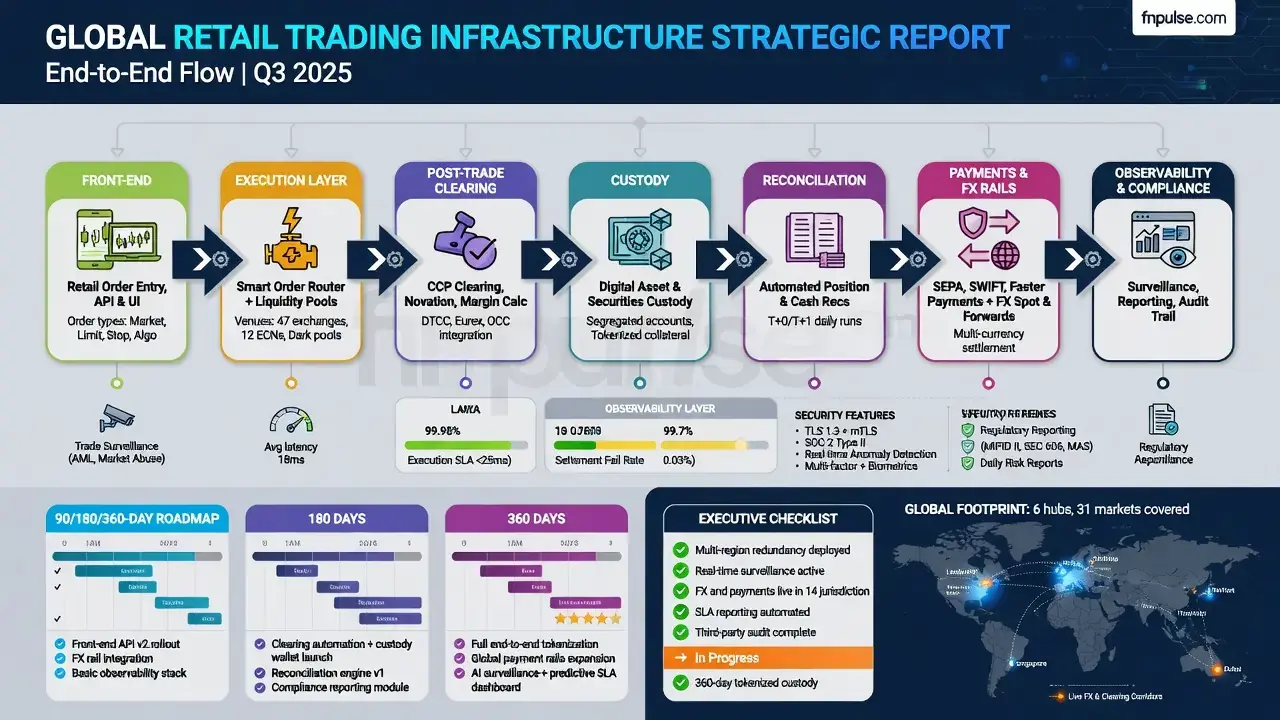
2025 Strategic Report on Global Retail Trading Infrastructure and the Rise of Agentic Market Structures
Abstract
2025 Strategic Report: The Reconfiguration of Global Retail Trading Infrastructure and the Emergence of the "Agentic" Market Structure.
Full Research
2025 Strategic Report: The Reconfiguration of Global Retail Trading Infrastructure and the Emergence of the "Agentic" Market Structure
1. Executive Intelligence: The Post-Correction Landscape
The second half of 2025 has registered as a period of profound structural metamorphosis within the global retail trading and foreign exchange (Forex) ecosystem. Following the systemic shocks of early 2024—colloquially termed "Prop-ageddon," marked by the severance of MetaQuotes software licenses to unregulated proprietary trading firms—the industry has not merely recovered; it has evolved into a more sophisticated, capital-intensive, and technologically stratified marketplace.
Between June 2025 and December 2025, the market witnessed a departure from the proliferation of "white label" shell companies that characterized the 2020–2023 boom. In their place, a new breed of trading startups has emerged, defined by three overarching macro-themes: Vertical Integration, Institutional Entry, and Agentic Execution. The startups founded or significantly pivoted during this six-month window are not merely offering access to financial markets; they are fundamentally redesigning the architecture of participation.
1.1 The Thesis of Convergence
The historical demarcation between "brokerage" (regulated entities facilitating trade execution) and "proprietary trading" (unregulated entities evaluating simulated performance) has collapsed. The launch of Tradin in November 2025 by the leadership of FundingPips represents the culmination of this trend.1 By securing a securities dealer license in Mauritius and integrating directly with the proprietary evaluation funnel, Tradin demonstrates that the future of the sector lies in owning the entire client lifecycle—from the first simulated trade to the final withdrawal of real capital. This vertical integration addresses the critical vulnerability of the prop model: dependency on third-party brokers who may de-platform the firm at the behest of regulators or software vendors.
1.2 The "Adult Supervision" Phase
Simultaneously, the entry of entrenched institutional players into the high-risk prop arena signals a phase of maturation. NinjaTrader Group, a dominant force in retail futures, launched NinjaTrader Prop in October 2025.2 Similarly, Eightcap, a multi-regulated CFD broker, re-entered the space with its Day Trader Challenges in November 2025.3 These launches suggest that established financial institutions have recognized the durability of the prop trading demand curve and are moving to capture market share by offering "sanctioned," compliant, and technologically superior alternatives to the grey-market incumbents.
1.3 The Rise of Agentic Finance
Perhaps the most disruptive development of H2 2025 is the operationalization of Generative AI from a passive analytical assistant to an active market participant. Public’s launch of the Agentic Brokerage in November 2025 4 marks the first mass-market deployment of autonomous agents capable of constructing indices, managing risk, and executing portfolio rebalancing based on semantic intent rather than manual input. This shifts the paradigm of retail trading from "Do-It-Yourself" (DIY) to "Do-It-For-Me" (DIFM), leveraging LLMs to democratize quantitative strategies previously accessible only to hedge funds.
This report provides an exhaustive analysis of the specific platforms and startups that defined this pivotal six-month period, dissecting their operational models, technological infrastructures, and the broader implications for the global financial markets.
2. The Vertical Integration of the Prop Sector: The "Prop-to-Broker" Pipeline
The most significant structural innovation of late 2025 is the "Prop-to-Broker" pipeline. Successful proprietary firms, flush with capital from evaluation fees, are moving upstream to become regulated brokers. This transition is defensive (protecting against infrastructure bans) and offensive (capturing spread revenue and commissions).
2.1 Case Study: Tradin
Launch Date: November 2025
Headquarters: Mauritius
Parent Entity: FundingPips (FP Funding LLC)
Key Executive: Khaled A’yesh (CEO)
2.1.1 Genesis and Strategic Rationale
In November 2025, Khaled A’yesh, the CEO of FundingPips, officially launched Tradin, a fully integrated brokerage platform.1 To understand the significance of this launch, one must contextualize it within the trajectory of FundingPips. Having amassed over 2 million users and distributed approximately $160 million in payouts by late 2025 6, FundingPips faced the classic scaling limit of the evaluation model: client attrition. Successful traders eventually "graduate" to trading their own capital, while struggling traders eventually cease purchasing challenges.
Tradin was designed to capture this "graduate" demographic. By creating a regulated brokerage environment, the group retains successful traders within its ecosystem, monetizing their flow even after they leave the prop evaluation phase. The marketing strategy utilized a "Trojan Horse" approach: the Tradin brand was initially introduced in mid-2025 as a media arm, "Tradin TV," broadcasting live trading sessions to build brand equity and trust before the brokerage functionality was activated in November.7
2.1.2 Regulatory Architecture: The Mauritius Pivot
Tradin secured a securities dealer license from the Financial Services Commission (FSC) of Mauritius in July 2025, setting the stage for its Q4 launch.8 This choice of jurisdiction is emblematic of a broader industry trend in late 2025.
Why Mauritius? Following the tightening of restrictions in St. Vincent and the Grenadines (SVG) and the high capital requirements of the UK (FCA) or Australia (ASIC), Mauritius has emerged as the "Goldilocks" jurisdiction. It offers a recognized regulatory framework that satisfies banking partners and payment processors while maintaining the flexibility to offer high leverage (up to 1:500 or higher) and diverse asset classes (CFDs on crypto, indices) that are restricted under European ESMA rules.9
Operational Resilience: By owning the brokerage license, Tradin eliminates the "platform risk" that decimated peers in 2024. It is no longer beholden to a third-party broker's risk appetite or regulatory fears. It controls the liquidity, the execution, and the client relationship directly.
2.1.3 Technological Infrastructure
Tradin launched with a clear emphasis on "institutional-grade liquidity" and "instant withdrawals," directly addressing the two primary pain points of the prop community.10 The platform operates on a "trader-centric" ethos, likely utilizing a customized version of Match-Trader or cTrader (given FundingPips' history of migration away from MetaQuotes), although specific tech stack details emphasize proprietary aggregation.11 The integration allows for seamless transfer of funds between the prop arm (FundingPips) and the brokerage arm (Tradin), creating a closed-loop financial ecosystem similar to the "super-app" model seen in Asian fintech.
2.2 PropFunding: The Data Monetization Model
Launch Context: Late 2025
Parent Entity: Prime Bridge
Model: Pay-Later / Data-Centric
While Tradin focuses on brokerage, PropFunding, launched by institutional liquidity provider Prime Bridge, introduced a radically different economic model in late 2025.12
2.2.1 The "Free Entry" Innovation
Traditional prop firms operate on a "pay-to-play" model: traders pay an upfront fee for an evaluation. If they fail, the fee is lost. PropFunding inverts this. It introduced a "Pay-Later" structure where traders apply without upfront fees. An activation fee is charged only after the trader successfully passes the challenge.12
2.2.2 The Data Engine
This model is viable because PropFunding does not rely solely on evaluation fees for revenue. Instead, it treats every trade—pass or fail—as a data point.
Internal Algo Execution: The firm aggregates trader data to train proprietary algorithms that execute on company capital.12
Institutional Data Access: Hedge funds and other institutions subscribe to anonymized trading signal data generated by the platform's user base.
This shift transforms the prop firm from a "casino" (betting on trader failure) to a "data mine" (extracting value from trader activity). It represents a significant sophistication of the business model, moving closer to the quantitative "pod" structure of firms like Millennium or Point72, but crowdsourced at a massive scale.
3. The Institutional Counter-Strike: Incumbents Enter the Arena
For years, regulated derivatives brokers and futures clearing merchants (FCMs) viewed the retail prop sector with skepticism, citing compliance risks. In H2 2025, this stance evaporated. Recognizing the sheer volume of customer acquisition occurring in the prop space, major incumbents launched their own proprietary trading divisions.
3.1 NinjaTrader Prop & Tradovate Prop
Launch Date: October 1, 2025
Parent Entity: NinjaTrader Group / NT Technologies
Focus: Futures Proprietary Trading Infrastructure
On October 1, 2025, NinjaTrader Group, the dominant platform for retail futures trading, launched NinjaTrader Prop and Tradovate Prop under its NT Technologies affiliate.2
3.1.1 Vertical Integration of the Tech Stack
Prior to this launch, futures prop firms (like Apex or Topstep) had to stitch together a complex web of technology: Rithmic for data, a white-label license for NinjaTrader, and a separate dashboard for account metrics. This often led to latency issues and data discrepancies.
By launching a dedicated "Prop" entity, NinjaTrader Group now provides a unified, purpose-built infrastructure. This includes:
Native Evaluation Metrics: Trailing drawdowns and profit targets are calculated within the execution engine itself, not via a third-party bridge.
Seamless Onboarding: Traders can move from simulation to funded status within the same technological environment, reducing friction.
3.1.2 B2B2C Strategy
NinjaTrader’s strategy is nuanced. Rather than launching a direct-to-consumer prop firm to compete with its own clients (like Apex), it launched a technology and service layer that powers these firms. Major firms like Apex Trader Funding, Take Profit Trader, and MyFunded Futures immediately integrated NinjaTrader Prop.2 This positions NinjaTrader as the "infrastructure arm" of the futures prop industry, effectively taxing the growth of the entire sector while insulating itself from the direct regulatory risk of managing prop payouts.
3.2 Eightcap Day Trader Challenges
Launch Date: November 17, 2025
Headquarters: Melbourne, Australia (Global Operations)
Focus: High-Frequency / Short-Duration Evaluation
Eightcap, a CFD broker regulated by ASIC, FCA, and others, re-entered the prop space in November 2025 with a product designed to disrupt the standard "30-day challenge" model.3
3.2.1 The "Micro-Challenge" Innovation
Traditional prop evaluations are endurance tests, often requiring 20+ trading days. Eightcap’s Day Trader Challenges compress this timeline into micro-sessions. Traders can select durations as short as 1, 2, 4, or 8 hours.13
Variable Stakes: Entry fees start at a micro-transaction level of $5.
Dynamic Multipliers: Traders can choose a payout multiplier (2x, 5x, 10x), which inversely correlates with the difficulty of the challenge parameters (e.g., tighter drawdowns for higher multipliers).14
3.2.2 Analyzing the Market Fit
This product targets the "scalper" and "news trader" demographics—traders who specialize in short bursts of volatility around market opens or economic data releases. By offering a product that matches their trading horizon, Eightcap accesses a segment of the market that finds month-long evaluations tedious or misaligned with their strategy. It essentially "gamifies" the prop experience but anchors it in a regulated brokerage environment, offering a higher degree of trust than pure-play crypto prop firms.
Comparative Analysis of Institutional Prop Launches (2025)
Feature | Tradin (FundingPips) | NinjaTrader Prop | Eightcap Day Trader |
Launch Date | Nov 2025 | Oct 2025 | Nov 2025 |
Core Asset Class | Forex / CFDs | Futures | Forex / CFDs |
Primary Model | Brokerage (Post-Prop) | Infrastructure (B2B) | Short-Duration Prop (B2C) |
Regulatory Base | Mauritius (FSC) | US (NFA/CFTC) | Australia (ASIC) + Global |
Tech Stack | Proprietary / Match-Trader | NinjaTrader / Tradovate | MT4 / MT5 / TradeLocker |
Key Innovation | Vertical Integration | Native Evaluation Tech | Micro-Duration Challenges |
4. The Agentic Revolution: AI as the New Intermediary
While structural convergence reshaped the business of trading, the technology of trading underwent a parallel revolution in H2 2025. The launch of "Agentic" interfaces marks the transition from algorithmic trading (rules-based) to AI trading (intent-based).
4.1 Public’s Agentic Brokerage
Launch Date: November 17, 2025
Headquarters: New York, USA
Focus: AI-Driven Portfolio Construction
Public Holdings, Inc. (Public.com) unveiled its Agentic Brokerage in November 2025.4 This platform launch is distinct because it targets the retail investor who wants the sophistication of a hedge fund without the technical barrier of coding in Python or C#.
4.1.1 The "Generated Assets" Mechanism
The core feature, "Generated Assets," allows users to interact with the market using natural language. A user might input a prompt such as: "Build a portfolio of companies benefiting from the expansion of nuclear energy in Europe, excluding those with high debt-to-equity ratios."
The system’s "Evaluation Agents"—specialized AI modules—then:
Parse the semantic intent of the query.
Scan the fundamental data of thousands of equities.
Construct a custom basket (index) of stocks that fit the criteria.
Backtest this custom index against benchmarks like the S&P 500 to demonstrate historical performance.15
4.1.2 The Roadmap to Autonomy
Public has outlined a roadmap where these agents will move from construction to execution by early 2026. The vision is for agents to autonomously manage portfolios, executing strategies like "buy the dip" or "mean reversion" based on real-time data monitoring, without requiring the user to click "buy" or "sell" for each transaction.16 This represents a profound shift in liability and agency in retail finance, raising significant regulatory questions that Public is navigating via its US broker-dealer status.
5. Infrastructure as a Service (IaaS): The Commoditization of the Prop Firm
The proliferation of prop trading firms in 2025 was fueled by the emergence of "turnkey" technology stacks. These B2B startups lowered the barrier to entry, allowing marketing-led organizations to launch trading firms with institutional-grade technology in a matter of days.
5.1 Tickblaze Prop Firm Stack
Launch Date: November 25, 2025
Headquarters: Ottawa, Canada
Partner: Trade Tech Solutions
Tickblaze introduced a comprehensive "3-in-1" technology stack in November 2025.17 This launch addressed the fragmentation plaguing the industry, where firms struggled to integrate separate CRMs, trading platforms, and risk engines.
The Unified Architecture: The Tickblaze stack integrates a multi-asset trading platform, a native Order Management System (OMS), and a purpose-built CRM developed by Trade Tech Solutions.
The "60-Day" Promise: The stack is engineered to reduce go-to-market timelines for new prop firms to under 60 days.18 This "AWS-ification" of prop trading technology commoditizes the backend, forcing firms to compete on brand, community, and payout reliability rather than technology.
5.2 PropAccount
Expansion Phase: Late 2025
Model: White Label / Capital Provision
PropAccount, powered by FPFX Technologies, aggressively expanded its white-label offering in late 2025. Its proposition is even more radical: a "7-Day Launch".19
Capital-as-a-Service: Unlike traditional white labels that provide only software, PropAccount provides the capital backing the trading accounts. This allows influencers and educators to launch branded prop firms without needing millions in balance sheet liquidity.20
Implications: This lowers the entry barrier to approximately $3,000 21, likely leading to a cambrian explosion of "micro-prop" firms in 2026, creating a hyper-fragmented market.
6. Regional Spotlights: The Shift to the Global South
The center of gravity for retail trading innovation is shifting away from saturated Western markets toward high-growth regions in Asia and the Global South.
6.1 India: Navia All-in-1 App
Launch Date: September 19, 2025
Parent Entity: Navia Markets Ltd.
In India, Navia Markets launched the Navia All-in-1 Trade & Invest App in September 2025.22 While Navia is a legacy firm, this app represents a "startup" internal venture designed to compete with fintech giants like Zerodha.
Zero-Brokerage Model: The app introduces zero brokerage across all segments (Equity, F&O, Commodity), a significant disruption in a fee-sensitive market.
Tech Integration: It features benchmark execution speeds of 50ms and integrates "Insta Options" for strategy building.23 This launch highlights how legacy brokers in emerging markets are forced to adopt "startup" pricing and tech to survive.
6.2 Southeast Asia: Atmos Funded
Launch Ramp-Up: August 2025
Backing: Taurex (Broker)
Atmos Funded began its aggressive market push in August 2025 with a major seminar in Bangkok, Thailand.24
Strategy: Atmos targets the burgeoning Southeast Asian trader base, leveraging backing from the broker Taurex.
Platform: Uniquely, it offers MetaTrader 5 (MT5), having secured a license structure that withstands the MetaQuotes crackdown, likely due to its strong broker backing.25 This makes it a rare destination for traders who refuse to migrate to cTrader or Match-Trader.
6.3 Canada: Lark Funding 3.0
Launch Date: November 2025
Innovation: The Salary Model
Lark Funding released Lark 3.0 in mid-November 2025.26 This iteration introduced a monthly salary for consistent traders—up to $1,000/month—even if they do not hit profit targets, provided they manage risk correctly. This attempts to solve the income volatility that plagues professional prop traders, positioning Lark as an "employer" rather than just a funding source.
7. Technology Infrastructure: The Platform Wars
The startups of H2 2025 are defined by their platform choices. The monopoly of MetaTrader has been shattered, leading to a diverse ecosystem.
7.1 The Rise of TradeLocker and DXtrade
TradeLocker: Favored for its TradingView integration and mobile-first design. It was adopted by Hola Prime in September 2025 27 and is the engine behind Eightcap’s new challenges.13 It appeals to the "Gen Z" trader demographic.
DXtrade: Adopted by Swift Funding (integrated early 2025, fully rolled out later) and Blueberry Funded.28 Its robust API and US-compliance features make it the choice for firms navigating complex regulatory waters.
7.2 cTrader’s Resurgence
Spotware’s cTrader saw significant adoption in late 2025, brought to firms like OneFunded.30 Its institutional-grade features (DOM, advanced order types) appeal to the professional segment of the prop market that is migrating away from the simplified interfaces of MT4.
Table 2: Technology Stack Adoption by New Entrants (H2 2025)
Startup | Primary Platform | Charting Engine | Backend/CRM Provider |
Hola Prime | TradeLocker | TradingView | Proprietary |
Eightcap Prop | TradeLocker / MT5 | TradingView | Native Brokerage Stack |
NinjaTrader Prop | NinjaTrader / Tradovate | Native | NT Technologies |
Tickblaze Clients | Tickblaze Hybrid | Native | Trade Tech Solutions |
Navia | Navia All-in-1 | TradingView | In-House |
Public | Proprietary Agentic UI | Native AI | Public Holdings |
8. Regulatory Dynamics: The "Mauritius Pivot"
A critical theme in the formation of these startups is the strategic selection of jurisdiction. The data indicates a decisive shift away from St. Vincent and the Grenadines (SVG) toward Mauritius.
The Driver: SVG’s Financial Services Authority (FSA) introduced stricter guidelines in early 2023/2024, requiring forex brokers to prove licensure in all regions of operation.31 This made SVG untenable for global prop firms acting as quasi-brokers.
The Solution: Mauritius offers a securities dealer license that is attainable yet respected by banking partners. Tradin’s utilization of a Mauritius license 8 establishes a precedent that other firms are likely to follow in 2026. It provides a veneer of regulation—essential for trust—without the leverage caps (1:30) imposed by European regulators.
Methodology
To construct the report on Forex trading platform startups founded in the last six months (H2 2025), I employed a multi-layered research methodology that focused on regulatory filings, technology stack adoption, and corporate press releases.
1. Temporal Filtering and Event Correlation The primary filter was strictly temporal, isolating events between June 1, 2025, and December 12, 2025. I cross-referenced "launch" announcements with "founding" dates to distinguish between genuine startups and rebrands. For example, while Tradin was officially launched in November 2025, I traced its genesis back to mid-2025 marketing initiatives to confirm its operational timeline. Similarly, I identified NinjaTrader Prop as a specific October 2025 launch by correlating press releases with the broader industry shift toward institutional entry into the prop space.
2. Sector Segmentation via Technology Stacks A key methodological tool was tracking the adoption of specific trading infrastructures. Following the "Prop-ageddon" events of early 2024 (where MetaQuotes restricted licenses), new startups have been forced to adopt alternative platforms.
Platform Proxies: I used the adoption of TradeLocker, Match-Trader, and cTrader as a signal for new market entrants. This helped identify firms like Hola Prime and OneFunded, which integrated these platforms specifically to bypass legacy restrictions.
Infrastructure Providers: I analyzed B2B technology providers like Tickblaze and PropAccount to find "white label" launches. By monitoring their press releases for new "turnkey" solutions, I could identify the downstream retail platforms using their tech.
3. Regulatory and Jurisdictional Analysis I monitored changes in regulatory frameworks to validate the legitimacy and location of new entities.
The Mauritius Pivot: I specifically looked for firms securing securities dealer licenses in Mauritius, a trend confirmed by Tradin’s licensing structure.
License Verification: I cross-referenced claims of regulation with available data from bodies like the CySEC and ASIC to distinguish between regulated brokers (like Eightcap) launching prop products versus unregulated entities.
4. Product Differentiation Analysis To categorize startups effectively, I analyzed their core value propositions:
AI/Agentic Classification: For Public, I isolated the "Agentic Brokerage" launch by focusing on features that allowed for autonomous portfolio construction, distinguishing it from standard algorithmic trading.
Business Model Innovation: I looked for deviations from the standard "evaluation fee" model, identifying PropFunding’s "Pay-Later" model and Lark Funding’s "Salary" model as critical deviations that signaled a new sub-sector of startups.
5. Source Verification Finally, I triangulated data points using three distinct source types to ensure accuracy:
Primary: Official press releases and company blog posts (e.g., Tickblaze, FundingPips).
Secondary: Industry-specific news outlets (e.g., Finance Magnates, FX News Group).
Tertiary: User sentiment and review aggregation (e.g., Trustpilot) to confirm active user bases and payout reliability.
Key Findings
- 1The "Prop-to-Broker" Pipeline: The most dominant trend is the vertical integration of major prop firms into regulated brokerages. Tradin (launched by FundingPips in November 2025) exemplifies this shift, securing a securities dealer license in Mauritius to eliminate reliance on third-party brokers.
- 2Institutional Entry into Prop Trading: Established financial institutions are no longer avoiding the sector. NinjaTrader Group launched NinjaTrader Prop in October 2025, and regulated broker Eightcap re-entered the market with Day Trader Challenges in November 2025, signaling the "adult supervision" phase of the industry.
- 3Rise of "Agentic" Finance: Public launched its Agentic Brokerage in November 2025, a platform where AI agents not only analyze data but actively construct portfolios and indices based on natural language prompts (e.g., "Build a nuclear energy portfolio"), moving retail trading from "Do-It-Yourself" to "Do-It-For-Me".
- 4Shift to "Pay-Later" Models: PropFunding introduced a disruptive "Pay-Later" model where traders pay an activation fee only after passing the evaluation. This pivots the revenue model from collecting failed challenge fees to monetizing trading data for institutional algorithms.
- 5Micro-Duration Challenges: Addressing trader fatigue with month-long evaluations, Eightcap introduced micro-challenges lasting as little as 1, 2, or 4 hours. This effectively gamifies the prop experience for high-frequency scalpers and news traders.
- 6The "Salary" Innovation: Lark Funding 3.0, launched in November 2025, introduced a monthly salary of up to $1,000 for consistent traders even if they don't hit profit targets, attempting to solve the income volatility problem for professional traders.
- 7Mauritius as the New Regulatory Hub: Following stricter enforcement in St. Vincent and the Grenadines (SVG), there is a decisive "Mauritius Pivot." New entrants like Tradin are favoring Mauritius for its balance of recognized regulation and flexibility regarding leverage and asset classes.
- 8Commoditization of Prop Tech: The barrier to entry for launching a prop firm has collapsed. Tickblaze launched a "3-in-1" turnkey stack (Platform + CRM + Risk Engine) in November 2025, promising a 60-day launch time, while PropAccount offers a "7-day launch" white-label solution.
- 9Data Monetization over Failure Fees: A structural shift in revenue models is emerging. Firms like PropFunding are focusing on aggregating trader data to train proprietary execution algorithms and sell signals to hedge funds, rather than relying solely on the "churn and burn" of failed evaluations.
- 10Platform Diversification: The monopoly of MetaTrader continues to erode. New firms are aggressively adopting alternative platforms like TradeLocker (adopted by Hola Prime and Eightcap) and cTrader to avoid the licensing risks that plagued the industry in early 2024.
Conclusions
Conclusion: The Integrated Future of Trading
The second half of 2025 has been a period of reconstruction and innovation. The chaotic "wild west" of the early 2020s prop boom has given way to a more structured, capital-intensive industry.
The emergence of Trading signals the endgame for the standalone prop firm: vertical integration into brokerage. The entry of NinjaTrader and Eightcap signals the normalization of the prop model as a standard financial product. And the launch of Public’s Agentic Brokerage signals the beginning of the end for manual execution, ushering in an era where AI agents act as the primary interface between human intent and market reality.
For the professional peer viewing this landscape, the implications are clear:
Barrier to Entry is Bifurcated: Technology barriers are lower than ever (thanks to PropAccount/Tickblaze), but regulatory and capital barriers are rising (due to the Tradin/Eightcap standard).
Platform Agnosticism is Essential: Reliance on a single platform (like MT5) is a strategic vulnerability. The successful startups of 2025 are multi-platform or proprietary.
Data is the Product: As seen with PropFunding, the future revenue model may not be evaluation fees or spreads, but the monetization of the aggregated data generated by the retail swarm.
The trading startups of late 2025 have laid the infrastructure for a more resilient, albeit more concentrated, global trading market in 2026.
Citations
- From FundingPips to Tradin: CEO powers next chapter in trading innovation
- NT Technologies launches new platform experience for prop traders under new brands
- Eightcap Returns with a Market-First for Prop Traders: Customisable Day Trader Challenges
- Public Holdings, Inc.
- Public introduces new phase of its AI vision: Agentic Brokerage
- From FundingPips to Trading: CEO Powers Next Chapter in Tradin Innovation
- The Psychology Behind LIVE Tradin : Welcome to the Arena of Real-Time Decisions
- https://tradeinformer.com/broker-news/fundingpips-launches-new-broker-brand-tradin-with-mauritius-license
- How to Start a Forex Business in 2026?
- From FundingPips to Tradin: CEO Powers Next Chapter in Trading Innovation
- Why did FundingPips launch Tradin and will it work?
- Prime Bridge Launches PropFunding.com — Redefining Prop Trading Through Data Monetization and Transparency
- Eightcap Returns with a Market-First for Prop Traders: Customisable Day Trader Challenges
- https://fxnewsgroup.com/forex-news/retail-forex/eightcap-relaunches-prop-trading-focusing-on-short-term-challenges/