On This Page
- What Is Your First Forex Trade: Step-by-Step?
- Why Your First Forex Trade Matters for Forex Traders
- How Your First Forex Trade: Step-by-Step Works
- Key Concepts & Terminology for Your First Trade
- Practical Example: Executing a EUR/USD Trade
- Common Mistakes to Avoid on Your First Forex Trade
- Advanced Order Techniques
- Tools & Resources for New Traders
- Frequently Asked Questions
What Is Your First Forex Trade: Step-by-Step?
The global foreign exchange market facilitates over $7.5 trillion in daily trading volume, according to the Bank for International Settlements. Your first forex trade is your initial entry into this vast market. It is the practical execution of buying one currency while simultaneously selling another, based on your analysis that the currency you buy will increase in value against the one you sell.
This action is more than a simple click. It represents the culmination of your preparation: choosing a broker, learning the software, analyzing a currency pair, and defining your risk. It transforms theoretical knowledge into a tangible market position with real financial outcomes.
Executing your first trade correctly involves a structured process, not a guess. It requires understanding fundamental concepts like currency pairs, lot sizes, and risk management from the very beginning. This guide provides the exact framework for that process. For a broader overview, explore our complete collection of articles on forex trading basics.
Why Your First Forex Trade Matters for Forex Traders
Your first forex trade is a critical milestone. It serves as the bridge between academic learning and practical application. This initial experience shapes your habits, discipline, and psychological response to market movements, setting the foundation for your entire trading career.
From Theory to Practice
Reading about trading and executing a trade are two different experiences. Your first live or demo trade makes abstract concepts concrete. You will see the spread in real-time, watch your profit and loss fluctuate with each price tick, and feel the direct impact of your decisions.
The market does not reward theoretical knowledge. It rewards correct application. Your first trade is your first test of application.
Building Foundational Habits
The process you follow for your first trade often becomes your default process. By focusing on a meticulous, step-by-step approach from the start, you build positive habits.
- Risk Management First: Did you set a stop-loss before entering?
- Position Sizing: Did you calculate your trade size based on your risk tolerance?
- Analysis-Driven: Was your trade based on a clear reason or an impulse?
Getting these steps right from the beginning makes them second nature. It helps you avoid the common pitfalls that cause many new traders to fail.
How Your First Forex Trade: Step-by-Step Works
Placing your first forex trade follows a logical sequence. Each step builds upon the last, ensuring you enter the market with a clear plan and defined risk. We recommend executing these steps in a demo account first to build confidence without risking capital.
- Select a Regulated Broker: Your broker provides access to the forex market. Prioritize brokers regulated by top-tier authorities like the FCA (UK) or CySEC (EU). Your choice impacts fees, platform stability, and security. For German-speaking users, we offer a comprehensive guide to selecting a forex broker.
- Open and Fund Your Account: Start with a demo account to practice risk-free. When you are ready for a live account, begin with an amount of capital you are prepared to lose.
- Choose a Currency Pair: Beginners should start with major pairs like EUR/USD, GBP/USD, or USD/JPY. These pairs have high liquidity and lower spreads, making them more predictable and less expensive to trade.
- Analyze the Market: Decide why you are entering the trade. Your analysis can be technical (studying price charts and patterns) or fundamental (analyzing economic data). A solid plan prevents emotional decisions. Learn more about technical analysis for forex traders to build this skill.
- Decide to Buy or Sell: Based on your analysis, determine your direction. If you believe the base currency (the first one in the pair) will rise against the quote currency (the second one), you buy. If you believe it will fall, you sell.
- Set Your Order Size (Position Sizing): This is a crucial risk management step. Your order size, measured in lots, determines how much money you risk per pip movement. A standard lot is 100,000 units, a mini lot is 10,000, and a micro lot is 1,000.
- Place a Stop-Loss and Take-Profit Order: A stop-loss (SL) is an order that automatically closes your trade at a predetermined price to limit your loss. A take-profit (TP) order closes your trade at a specific profit target. Always set a stop-loss.
- Execute the Trade: Once all parameters are set, you execute the trade. Your broker will fill the order at the best available market price.
- Monitor and Close: Keep an eye on your open position. Your trade will close automatically if it hits your SL or TP. You can also close it manually at any time based on market conditions.
Key Concepts & Terminology for Your First Trade
Understanding the language of forex is essential before you place your first trade. These core terms define the mechanics of every position you will take. Memorize them to ensure you understand exactly what is happening with your capital.
Core Trading Terms Explained
Each of these concepts directly impacts the profit or loss of your trade. They are the building blocks of market interaction.
- Currency Pair: The two currencies being traded, for example, EUR/USD. The first currency is the base currency, and the second is the quote currency. When you buy EUR/USD, you are buying euros and selling U.S. dollars.
- Bid/Ask Spread: The difference between the buy (ask) price and the sell (bid) price. This is the broker's fee for facilitating the trade. The price must cross the spread before your trade becomes profitable.
- Pip (Percentage in Point): The smallest unit of price movement in a currency pair. For most pairs, it is the fourth decimal place (0.0001). For JPY pairs, it is the second decimal place (0.01).
- Lot Size: The standardized quantity of currency you are trading. This determines your risk and reward per pip.
- Standard Lot: 100,000 units of the base currency.
- Mini Lot: 10,000 units.
- Micro Lot: 1,000 units.
- Leverage: Borrowed capital from your broker to control a larger position than your own funds would allow. A 100:1 leverage means you can control a $100,000 position with $1,000 of your own money. While it can amplify profits, it also amplifies losses. Our guide on leverage and margin explains this in detail.
- Margin: The amount of your own capital required to open and maintain a leveraged position. It is not a fee, but a good-faith deposit held by the broker.
Reference Table: Lot Size and Pip Value
This table illustrates how lot size affects the value of a single pip movement in a USD-quoted pair (like EUR/USD or GBP/USD).
| Lot Type | Units | Pip Value (in USD) |
|---|---|---|
| Standard Lot | 100,000 | $10.00 |
| Mini Lot | 10,000 | $1.00 |
| Micro Lot | 1,000 | $0.10 |
Practical Example: Executing a EUR/USD Trade
Let's walk through a complete example of a first forex trade. This scenario uses realistic figures to show you how the concepts of position sizing, stop-loss, and pip value work together.
Scenario Setup
- Account Balance: $1,000
- Currency Pair: EUR/USD
- Current Ask Price: 1.0850
- Current Bid Price: 1.0849
- Your Analysis: You believe the EUR will strengthen against the USD based on recent economic data from the European Central Bank. You decide to buy.
- Risk Rule: You will risk no more than 2% of your account on a single trade.
Step-by-Step Trade Execution
Calculate Maximum Risk in Dollars:
Your total risk is 2% of your $1,000 account balance.
$1,000 0.02 = $20
Your maximum acceptable loss on this trade is $20.Determine Your Stop-Loss Level:
You place your stop-loss 25 pips below your entry price. This is a technical decision based on your chart analysis, placing it below a recent support level.
Entry Price: 1.0850
Stop-Loss Price: 1.0850 - 0.0025 = 1.0825Calculate Your Position Size:
Now you determine the appropriate lot size so that a 25-pip loss equals your maximum risk of $20.
Risk per Pip = Total Risk / Stop-Loss in Pips
Risk per Pip = $20 / 25 pips = $0.80 per pip
Since a mini lot ($1 per pip) is too large and a micro lot ($0.10 per pip) is too small, you will trade 8 micro lots.
Position Size = 8 micro lots (0.08)
This gives you a risk of $0.80 per pip, matching your calculation.Set Your Take-Profit Level:
You aim for a risk-to-reward ratio of 1:2. Your risk is 25 pips, so your profit target is 50 pips.
Take-Profit Price = 1.0850 + 0.0050 = 1.0900Place the Order:
You enter the following into your trading platform:
Action: Buy
Pair: EUR/USD
Volume: 0.08
Stop-Loss: 1.0825
Take-Profit: 1.0900
By following these steps, you have entered a trade where the risk is pre-defined and controlled. Your potential loss is capped at $20, while your potential profit is $40.
Common Mistakes to Avoid on Your First Forex Trade
Your first forex trade is a learning experience, but avoiding common errors can protect your capital and build good habits. Many beginners make the same preventable mistakes. Awareness is the first step to avoiding them.
- Using Too Much Leverage: Leverage is a powerful tool, but it is also the primary reason new traders lose money quickly. Using high leverage on your first trade means a small price movement against you can wipe out a significant portion of your account. Start with low or no leverage.
- Forgetting the Stop-Loss: Trading without a stop-loss is like driving without brakes. It exposes you to unlimited risk. Always define your maximum acceptable loss with a stop-loss order before you enter any trade. This is the core principle of successful risk management.
- Trading on Emotion: Fear and greed are your worst enemies. Your decisions should be based on your trading plan and analysis, not on a gut feeling or the fear of missing out. Stick to your pre-defined entry, exit, and risk parameters.
- Risking Too Much Capital: A common rule is to risk no more than 1-2% of your trading capital on a single trade. If your account is $1,000, your maximum risk per trade should be $10-$20. This allows you to survive a string of losses without destroying your account.
- Not Using a Demo Account: Jumping into a live account without practicing on a demo is a costly error. Use a demo account to test your strategy, learn the platform's functions, and experience market movements without financial risk.
Advanced Order Techniques
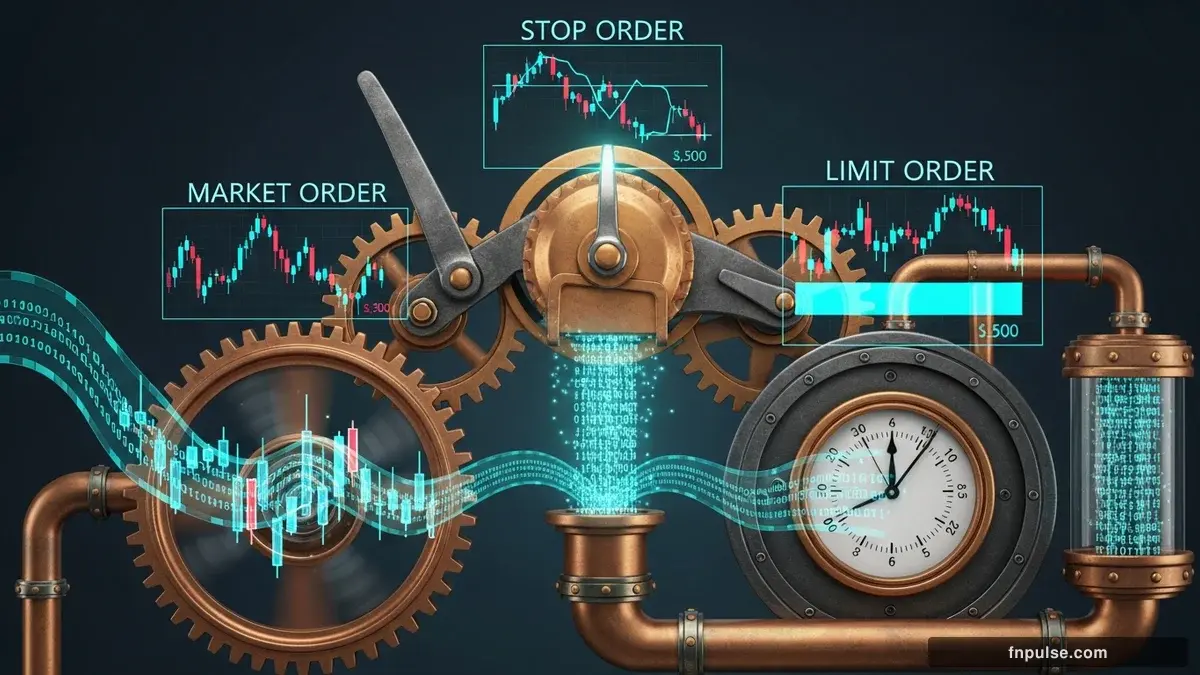
Once you are comfortable with placing a basic market order (buying or selling at the current price), you can explore more advanced order types. These allow you to plan trades in advance and enter the market at specific price levels, even when you are not actively watching the charts.
Pending Orders: Entering the Market Automatically
Pending orders instruct your broker to open a position for you once the price reaches a certain level. This is essential for traders who cannot monitor the market 24/5.
| Order Type | Description | When to Use It |
|---|---|---|
| Buy Limit | An order to buy below the current market price. | You expect the price to fall to a support level and then reverse upwards. |
| Sell Limit | An order to sell above the current market price. | You expect the price to rise to a resistance level and then reverse downwards. |
| Buy Stop | An order to buy above the current market price. | You expect the price to break through a resistance level and continue rising. |
| Sell Stop | An order to sell below the current market price. | You expect the price to break through a support level and continue falling. |
Using these orders helps you execute a trading plan with discipline, removing the temptation to enter a trade impulsively. They are a cornerstone of systematic, strategy-based trading.
Risk Disclaimer: All trading involves substantial risk of loss and is not suitable for every investor. The use of leverage can lead to losses greater than your initial deposit. The content provided by FNPulse is for educational purposes only and should not be considered financial advice.
Tools & Resources for New Traders
Successful trading requires the right tools. Your first forex trade will be smoother and more informed if you equip yourself with professional-grade resources. Most of these are available for free from your broker or reputable financial websites.
Essential Toolkit for Your First Forex Trade
- Trading Platform: This is your software for analyzing charts and placing trades. MetaTrader 4 (MT4) and MetaTrader 5 (MT5) are the industry standards, known for their powerful charting capabilities and support for automated trading.
- Charting Software: While platforms include charts, dedicated tools like TradingView offer more advanced drawing tools, indicators, and a social community where you can share ideas.
- Economic Calendar: This is your schedule for major economic news releases, such as interest rate decisions, inflation reports (CPI), and employment data. These events cause significant market volatility. Reputable calendars are available from major financial news providers.
- Central Bank Websites: For fundamental analysis, go directly to the source. Official statements and meeting minutes from central banks like the U.S. Federal Reserve provide direct insight into future monetary policy, which is a primary driver of currency values.
- A Trading Journal: Document every trade you make. Record your entry and exit points, the reason for the trade, the outcome, and what you learned. This journal is your personal feedback loop for continuous improvement.
Your next step is to open a demo account and familiarize yourself with these tools. Practice identifying currency pairs, using charting tools, and placing mock trades based on an economic calendar event. For our German audience, a detailed introduction to forex trading is available in our guide, Forex Handel für Anfänger.
Frequently Asked Questions
How much money do I need for my first forex trade?
You can start with as little as $100 with many brokers, thanks to micro lots. However, a starting balance of $500 to $1,000 allows for more flexible position sizing and better risk management. Always start with capital you can afford to lose.
What is the best currency pair for a first trade?
Major currency pairs like the EUR/USD, GBP/USD, and USD/JPY are best for beginners. They offer high liquidity, which means tighter spreads and smoother price action. They are also widely covered by financial news, making analysis more accessible.
Can I lose more money than I deposit?
This depends on your broker's policies. Brokers in many regulated jurisdictions, such as the EU and UK, are required to provide negative balance protection. This ensures you cannot lose more than your account balance. Always confirm this feature with your broker before trading.
How long should I practice with a demo account?
Practice on a demo account until you are consistently profitable for at least one to three months. You should be able to follow your trading plan without emotional errors and be completely comfortable with your trading platform's functions before moving to a live account.