Forex Leverage Explained
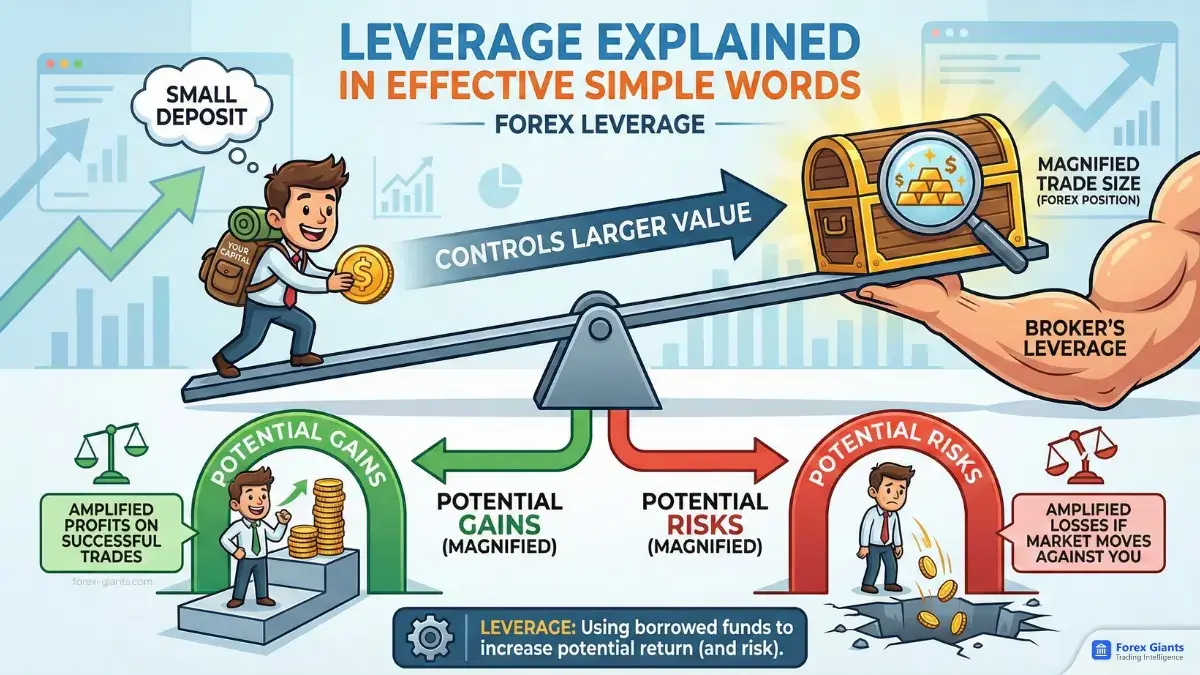
Leverage is the double-edged sword of forex trading. It can amplify your profits dramatically—or wipe out your account in minutes. Understanding leverage is critical to long-term survival in forex.
What is Leverage?
Leverage allows you to control a large position with a small amount of capital. It's essentially borrowing money from your broker to increase your market exposure.
The Formula
Leverage Ratio = Total Position Size ÷ Required Margin
Example:
You have $1,000 in your account
You use 50:1 leverage
You can control: $1,000 × 50 = $50,000 position
In Practice
Without Leverage:
Account: $1,000
Position: $1,000 (1 micro lot EUR/USD)
10-pip move = $1 profit/loss
With 50:1 Leverage:
Account: $1,000
Position: $50,000 (0.5 standard lots EUR/USD)
10-pip move = $50 profit/loss
Result: Leverage magnifies gains and losses by 50x
Common Leverage Ratios
Retail Forex Leverage by Region
Region | Max Leverage | Regulation |
|---|---|---|
United States | 50:1 (majors), 20:1 (minors) | NFA/CFTC |
Europe (EU) | 30:1 (majors), 20:1 (minors) | ESMA |
United Kingdom | 30:1 (majors), 20:1 (minors) | FCA |
Australia | 30:1 (retail), 500:1 (pro) | ASIC |
Rest of World | 500:1 - 3000:1 | Varies |
Why the difference? Regulators in US/EU/UK limit leverage to protect retail traders from catastrophic losses.
Leverage by Trader Experience
Beginners: 5:1 to 10:1
Intermediate: 10:1 to 20:1
Advanced: 20:1 to 50:1
Professionals: 50:1+ (with strict risk management)
How Leverage Works: Real Example
Scenario: You want to trade 1 standard lot of EUR/USD (100,000 units)
Without Leverage (1:1)
Required capital: $100,000
Most retail traders can't afford this
With 100:1 Leverage
Required capital: $100,000 ÷ 100 = $1,000 (margin)
You only need $1,000 to control $100,000
The Trade:
EUR/USD at 1.1000
You buy 1 lot (100,000 EUR)
Price moves to 1.1010 (+10 pips)
Profit: 100,000 × 0.0010 = $100
Return on margin:
- $100 profit ÷ $1,000 margin = 10% gain on a 10-pip move!
But if price fell 10 pips:
Loss: $100
Return: -10% on $1,000 margin
The Dark Side of Leverage
Leverage Can Wipe You Out Fast
Example: Over-Leveraging
Account: $1,000
Leverage: 100:1
Position: 10 standard lots EUR/USD ($1,000,000)
Margin used: $1,000,000 ÷ 100 = $10,000
Problem: You only have $1,000!
What happens:
Price moves 10 pips against you
Loss: 10 standard lots × 10 pips × $10 = $1,000
Account balance: $0 (margin call, position closed)
Result: 10 pips wiped out your entire account.
Margin Call Explained
A margin call occurs when your account equity falls below the required margin to keep positions open.
Example:
Account: $1,000
Position: 1 standard lot EUR/USD (requires $1,000 margin at 100:1)
Usable margin: $0 (you're fully leveraged)
Price drops 10 pips = -$100 loss
Equity: $900
Margin call triggered - Broker closes your position
To avoid margin calls: Never use more than 10-20% of available margin.
Safe Leverage Usage
The 1-2% Risk Rule
Never risk more than 1-2% of your account per trade, regardless of leverage available.
Example:
Account: $10,000
Risk per trade: 1% = $100
Stop loss: 20 pips
Position size: $100 ÷ 20 pips = $5 per pip (0.5 standard lots)
Margin required (at 50:1):
0.5 lots = $50,000
Margin: $50,000 ÷ 50 = $1,000
Used margin: $1,000 ÷ $10,000 = 10% (safe!)
Leverage vs Position Size
Key Insight: Leverage determines margin required, but position size determines risk.
Example 1: High Leverage, Small Position
Account: $10,000
Leverage: 500:1
Position: 0.1 lot ($10,000)
Margin used: $10,000 ÷ 500 = $20
Risk: Low (only 0.1 lot)
Example 2: Low Leverage, Large Position
Account: $10,000
Leverage: 10:1
Position: 1 lot ($100,000)
Margin used: $100,000 ÷ 10 = $10,000
Risk: Extreme (entire account as margin!)
Lesson: High leverage isn't dangerous if you trade small positions. Over-leveraging (using too much margin) is the real killer.
Calculating Effective Leverage
Effective Leverage = Total Position Value ÷ Account Equity
Example:
Account: $5,000
Position: 0.5 lot EUR/USD = $50,000
Effective leverage: $50,000 ÷ $5,000 = 10:1
Interpretation:
Even if your broker offers 500:1 leverage, you're only using 10:1 effectively
This is good risk management
Target effective leverage: <10:1 for most traders
Leverage by Trading Style
Scalping (High Frequency)
Recommended leverage: 20:1 to 50:1
Why: Quick in/out, tight stops, need margin efficiency
Risk management: Strict stop losses, no more than 5-10 pips risk
Day Trading
Recommended leverage: 10:1 to 30:1
Why: Moderate position sizes, holding a few hours
Risk management: 10-30 pip stops, 1-2% risk per trade
Swing Trading
Recommended leverage: 5:1 to 10:1
Why: Holding days/weeks, larger stops needed
Risk management: 50-100 pip stops, 1% risk per trade
Position Trading
Recommended leverage: 2:1 to 5:1
Why: Long-term holds, need margin buffer
Risk management: 100-200 pip stops, <1% risk per trade
Leverage Regulation by Broker Type
Retail Brokers (ESMA/FCA Regulated)
Max leverage:
Majors: 30:1
Minors: 20:1
Exotics: 10:1
Benefits:
Regulatory protection
Negative balance protection (can't lose more than deposit)
Compensation schemes
Offshore Brokers (Less Regulated)
Max leverage:
Often 500:1 to 3000:1
Some offer "unlimited leverage"
Risks:
⚠️ No negative balance protection
⚠️ Weaker regulation
⚠️ Potential for scams
⚠️ You can lose MORE than your deposit
Warning: High leverage offshore brokers are often used by beginners who blow up accounts quickly.
Professional Trader Leverage
How Pros Use Leverage
Myth: Pro traders use 100:1+ leverage
Reality: Most pros use 5:1 to 20:1 effective leverage
Why?
Risk management - Pros protect capital first
Drawdown control - High leverage = large drawdowns
Margin safety - Need buffer for volatility
Compounding - Steady gains beat gambling
George Soros' famous GBP trade (1992):
Used 10:1 leverage (not 100:1)
Tight risk management
Made $1 billion
Leverage Mistakes to Avoid
❌ Using maximum leverage - Just because you can doesn't mean you should
❌ Forgetting margin requirements - Check margin before trading
❌ Trading multiple pairs with high leverage - Diversification doesn't reduce leverage risk
❌ Adding to losing positions with high leverage - Recipe for disaster
❌ Ignoring swap costs - High leverage means high swap payments on overnight positions
How to Choose the Right Leverage
Step 1: Assess Your Experience
Beginner: 10:1 max
1+ year experience: 20:1
3+ years experience: 30:1
Professional: 50:1+
Step 2: Calculate Position Size First
Always calculate position size based on risk, not leverage.
Formula:
Position Size = (Account Balance × Risk %) ÷ Stop Loss Pips
Then check required margin: Will your leverage accommodate this?
Step 3: Maintain Margin Buffer
Target: Use <20% of available margin
Maximum: Never exceed 50% margin usage
Example:
Account: $10,000
Available margin (at 30:1): $300,000
Safe position size: $60,000 (20% of margin)
Leverage Calculator
Quick Formula:
Max Position Size = Account Balance × Leverage Ratio
Example:
Account: $5,000
Leverage: 20:1
Max position: $5,000 × 20 = $100,000 (1 standard lot)
But don't trade max! Aim for 10-20% of max.
Summary: Leverage Quick Guide
Acceptable Leverage:
Beginners: 5:1 to 10:1
Intermediate: 10:1 to 20:1
Advanced: 20:1 to 50:1
Red Flags:
Broker pushing 500:1+ leverage = Wants you to blow up
No negative balance protection = Avoid
Margin call on 10-pip move = Over-leveraged
Golden Rule:
Leverage is a tool, not a strategy. Use it to enable risk management, not to gamble.
Next Steps:
Remember: The goal is to stay in the game long enough to become profitable. High leverage is the #1 reason traders fail. Trade small, trade smart, and survive.