Surviving the Dip: A Strategic Framework for Managing and Recovering from Forex Drawdowns
Trading involves loss. No trader escapes this reality. The difference between a professional and an amateur lies in how they handle the periods when equity curves slope downward. Drawdowns represent the cost of doing business in the financial markets. Managing these dips determines long-term survival. Ignoring them guarantees failure.
Markets in December 2025 move with high velocity. Algorithmic execution and global macroeconomic shifts create rapid price adjustments. Traders without a plan for these inevitable declines lose their capital. You must possess a framework to stabilize your account, preserve your mental capital, and climb back to profitability.
Understanding the Mechanics of Drawdown
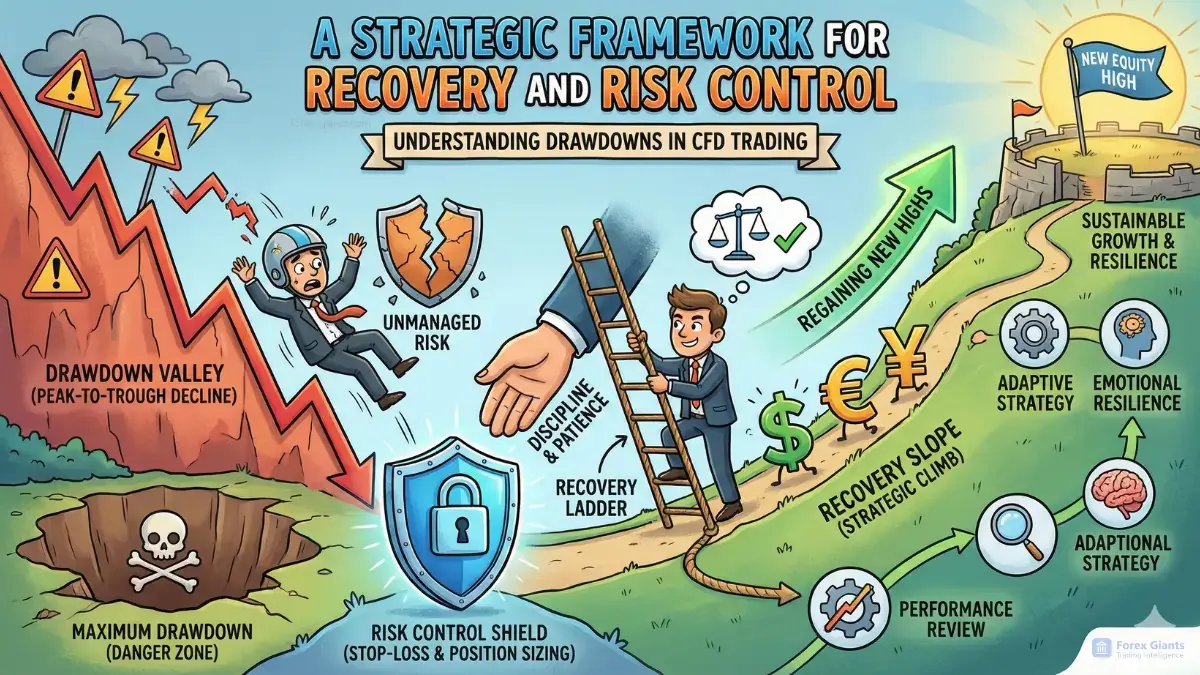
A drawdown measures the decline from a historical peak in total equity to a subsequent trough. Traders express this as a percentage. If an account starts at $10,000, rises to $15,000, and drops to $12,000, the drawdown calculates from the $15,000 peak. The loss is $3,000. The drawdown percentage is 20%.
Two types of drawdown exist in Forex trading:
Absolute Drawdown: The difference between the initial deposit and the lowest point the account reaches. This metric shows how much of the original capital is at risk.
Maximum Drawdown (MDD): The largest percentage drop from a peak to a trough before a new peak forms. This metric indicates the volatility and risk profile of a strategy.
Understanding these metrics prevents panic. A 10% drawdown in a high-volatility strategy differs from a 10% drawdown in a conservative carry trade. Context matters.
The Asymmetric Mathematics of Recovery
Losses work against you mathematically. A specific percentage loss requires a larger percentage gain to break even. This asymmetry catches many traders off guard. They believe a 50% loss requires a 50% gain to recover. This belief is false.
Review the recovery requirements:
5% Loss: Requires 5.3% gain to break even.
10% Loss: Requires 11.1% gain to break even.
20% Loss: Requires 25% gain to break even.
30% Loss: Requires 42.9% gain to break even.
40% Loss: Requires 66.7% gain to break even.
50% Loss: Requires 100% gain to break even.
90% Loss: Requires 900% gain to break even.
The difficulty of recovery increases exponentially as losses deepen. A 20% drawdown is manageable. A 50% drawdown requires doubling the remaining capital just to return to the starting point. Protecting the downside preserves the ability to compound future gains. You must cap losses early.
The Psychology of the Dip
Drawdowns destroy mental capital faster than financial capital. Emotional reactions often cause more damage than the market itself. Traders experiencing a losing streak face specific psychological traps.
Revenge Trading The desire to win back losses immediately leads to forced trades. Traders abandon their system. They increase position sizes to recover quickly. This behavior usually deepens the hole.
The Gambler's Fallacy Traders often believe a win is "due" after a series of losses. The market does not care about past results. Each trade is an independent event. Probability does not guarantee a win because the last five trades were losses. Betting on a reversal without confirmation leads to ruin.
Paralysis by Analysis Fear of further loss stops traders from executing valid setups. They hesitate. They miss the recovery phase because confidence is gone. You must maintain execution discipline even during a drawdown.
Immediate Action Protocol
When a drawdown exceeds your predefined tolerance threshold (e.g., 10%), you must act. Do not hope for a reversal. Hope is not a strategy. Implement this protocol immediately.
1. Stop Trading
Cease all new entries. Close open positions if they violate risk parameters. Stepping away breaks the emotional cycle of losing. It prevents revenge trading. You need a clear mind to analyze the situation.
2. Isolate the Cause
Determine why the drawdown occurred. Three primary causes exist:
Execution Error: You deviated from the plan. You moved stop losses. You took impulsive entries. This is a discipline problem.
Strategy Failure: The market conditions changed. A trend-following system fails in a ranging market. A mean-reversion system fails during a breakout. The system is out of sync.
Normal Variance: The strategy is valid, but the probabilities are playing out negatively. Losing streaks happen even in profitable systems. This is a statistical reality.
Honest diagnosis is mandatory. Fixing an execution error requires discipline. Fixing a strategy failure requires recalibration.
Strategic Audit and Diagnostics
Open your trading journal. Review the last 20 trades. Analyze the data objectively.
Check Your Risk Per Trade Did you risk more than 1% or 2% on single trades? Inconsistent sizing skews results. If one loss wiped out five wins, your sizing is the problem.
Analyze Market Correlation Did you lose on EUR/USD, GBP/USD, and AUD/USD simultaneously? These pairs often move together against the USD. You likely took the same trade three times. This triples the risk. You must treat correlated pairs as a single exposure unit.
Review Trade Duration Are you holding losers too long? Are you cutting winners too short? The risk-reward ratio often degrades during a slump. Ensure your winners still pay for your losers.
Recalibrating Position Sizing
Recovery requires defense. You must earn the right to trade big again. Reduce your position size immediately. If you normally risk 1% per trade, cut this to 0.5% or 0.25%.
Benefits of Reduced Sizing:
Lowers Emotional Stress: Smaller losses hurt less. You execute better when fear is absent.
Extends Runway: You have more bullets. A 0.5% risk allows 200 consecutive losses before ruin. This buys time for the strategy to align with the market.
Prevents Catastrophe: A string of further losses will not destroy the remaining equity.
Increase size only when profitability returns. Add size incrementally. Move from 0.25% to 0.5% after a set number of winning trades. Move back to 1% only when the account stabilizes and the equity curve flattens or rises.
Managing Drawdowns in 2025 Markets
The Forex market in late 2025 presents specific challenges. High-frequency trading algorithms and AI-driven liquidity pools dominate price action. Volatility spikes occur without news catalysts. Traditional support and resistance levels often experience "stop hunts" before reversing.
Adapting to Algorithmic Noise Tight stops are dangerous in 2025. Algorithms hunt liquidity clusters. If your stop is at an obvious technical level, you will get stopped out before the move happens. Widen stops and reduce position size to maintain the same risk amount. Give the trade room to breathe.
News Event Risks Global economic divergence drives current trends. Central bank policies differ significantly across major economies. Volatility during rate announcements is extreme. Avoid holding positions through Tier-1 data releases unless the position is small and hedged. The slippage during these events invalidates stop-loss protection.
The Framework for Resilient Portfolio Construction
Preventing deep drawdowns is superior to recovering from them. Portfolio construction determines the depth of the dip.
Diversify Across Strategies Do not rely on one setup. Combine non-correlated strategies.
Trend Following: Makes money when markets move. Loses in chop.
Mean Reversion: Makes money in ranges. Loses in strong trends.
Breakout: Captures volatility expansion.
Running these simultaneously smooths the equity curve. When one strategy enters a drawdown, the others often perform well.
Diversify Across Timeframes Trade daily charts for macro trends. Trade 15-minute charts for intraday volatility. Different timeframes have different cycles. Mixing them reduces the impact of a specific market condition on the total account.
Monitor Correlation Constantly Currency correlations shift. USD and JPY might correlate positively in risk-off environments and negatively in risk-on environments. Check correlation tables weekly. Ensure you do not expose the account to single-currency risk across multiple pairs.
Risk of Ruin Calculations
Professional traders calculate their Risk of Ruin (ROR). This probability statistic estimates the chance of losing a specific portion of the account based on win rate and reward-to-risk ratio.
Formula Components:
Win Rate: Percentage of winning trades.
Payoff Ratio: Average win size divided by average loss size.
Risk Per Trade: Percentage of capital risked.
If your win rate is 40% and your payoff ratio is 1:1, your ROR is 100%. You will eventually lose everything. If you raise the payoff ratio to 2:1, the ROR drops significantly. If you lower the risk per trade, the ROR drops near zero.
Keep the ROR at 0%. Adjust parameters until the math guarantees survival over an infinite sample size.
Step-by-Step Recovery Plan
Follow this linear path to exit the drawdown.
Phase 1: Stabilization Your goal is to stop the bleeding. Do not aim for profit. Aim for zero loss. Tighten selection criteria. Take only A+ setups. Reject anything marginal. Success in this phase looks like a flat equity curve.
Phase 2: Confidence Building Execute trades with minimal risk (0.25%). Focus on the process. Follow the checklist perfectly. Seeing green trades, even small ones, restores mental balance. You prove to yourself that you possess the skill to extract money from the market.
Phase 3: Momentum As the win rate normalizes, increase risk to 0.5%. Let profits run. Trail stops to lock in gains. The equity curve begins to curl upward. Do not rush. Compounding works best with consistency, not speed.
Phase 4: Normalization Return to standard risk sizing (1% or 2%) only after recovering 50% of the drawdown or achieving a new high-water mark in emotional discipline. The account is now back in normal operation.
Discipline and Routine
Routine anchors a trader during chaos. Establish strict daily habits.
Pre-Market Routine Analyze the calendar. Mark key levels. Review open positions. Visualize the plan for the day.
In-Trade Management Do not watch every tick. Set alerts. Walk away. Micro-managing trades during a drawdown leads to premature exits.
Post-Market Review Log every trade. Note the emotion felt during entry and exit. Review compliance with rules. Grading yourself on execution matters more than the P&L.
The Role of Leverage
Leverage is the primary cause of blown accounts. It magnifies drawdowns. In a drawdown, you must de-lever. If you normally trade at 1:10 effective leverage, drop to 1:2 or 1:1. Cash is a position. Holding cash reduces portfolio volatility. It gives you the option to buy when clarity returns.
Conclusion
Drawdowns provide feedback. They tell you something is wrong with your execution, your system, or your alignment with the market. Listening to this feedback saves your career. Ignoring it ends your career.
Survival requires humility. You must accept the loss. You must detach your ego from the money. The market owes you nothing. You extract profit by managing risk, not by predicting the future.
Follow the framework. Cut size. Audit the process. Rebuild confidence. The math of recovery works if you give it time. Stay in the game. Protect your capital. The recovery begins with the next disciplined trade.