The Institutional Edge in Forex Markets
Retail traders often struggle against an invisible force. Markets move in ways defying standard logic. Support levels break only to see price reverse immediately. Trends reverse without warning. This chaos is not random. Algorithms and institutional capital drive these movements. Central banks, hedge funds, and large financial institutions dictate price action. These entities operate with volumes requiring specific mechanics to enter and exit positions. Smart Money Concepts (SMC) provides the framework to understand these mechanics.
SMC is not a magic system. The methodology translates raw price action into a narrative of institutional intent. You stop guessing. You start tracking the footprint of big money. Success relies on identifying where these large players accumulate positions and where they manipulate price to generate liquidity. This guide breaks down the core components of SMC: Market Structure, Order Blocks, Liquidity, and Imbalance. Mastering these elements allows alignment with the dominant market force.
Market Structure: The Foundation
Price never moves in a straight line. The market oscillates. Understanding the structure of these oscillations determines your bias. Trading against the structure guarantees failure. You must identify the current trend direction before looking for entries.
Swing Points and Trend Definition
Market structure consists of swing highs and swing lows. A bullish trend creates higher highs and higher lows. A bearish trend creates lower lows and lower highs. Identifying these points requires precision.
Strong Highs: A high leading to a break of a swing low. Price should not breach this high in a bearish trend. Banks defend these levels.
Weak Highs: A high failing to break a swing low. Price likely targets these highs for liquidity. Anticipate a breakout above them.
Strong Lows: A low leading to a break of a swing high. These levels hold support in a bullish trend.
Weak Lows: A low failing to create a new high. Price gravitates toward these lows to clear stop losses.
Break of Structure (BOS)
A Break of Structure confirms trend continuation. Price closes beyond a previous swing point. The close is vital. Wicks do not confirm a break. A wick beyond a high implies a liquidity grab, not a continuation. You must wait for a candle body close. This confirms the institutional intent to push price further in the trend direction.
Change of Character (CHoCH)
Trends eventually end. A Change of Character signals the first potential reversal. In a bullish trend, price makes higher highs. A sudden break below the most recent higher low creates a CHoCH. This shift suggests bears took control. Do not confuse CHoCH with a trend change. This signal merely indicates a shift in short-term momentum. A valid BOS following a CHoCH confirms the new trend.
Order Blocks: The Institutional Footprint
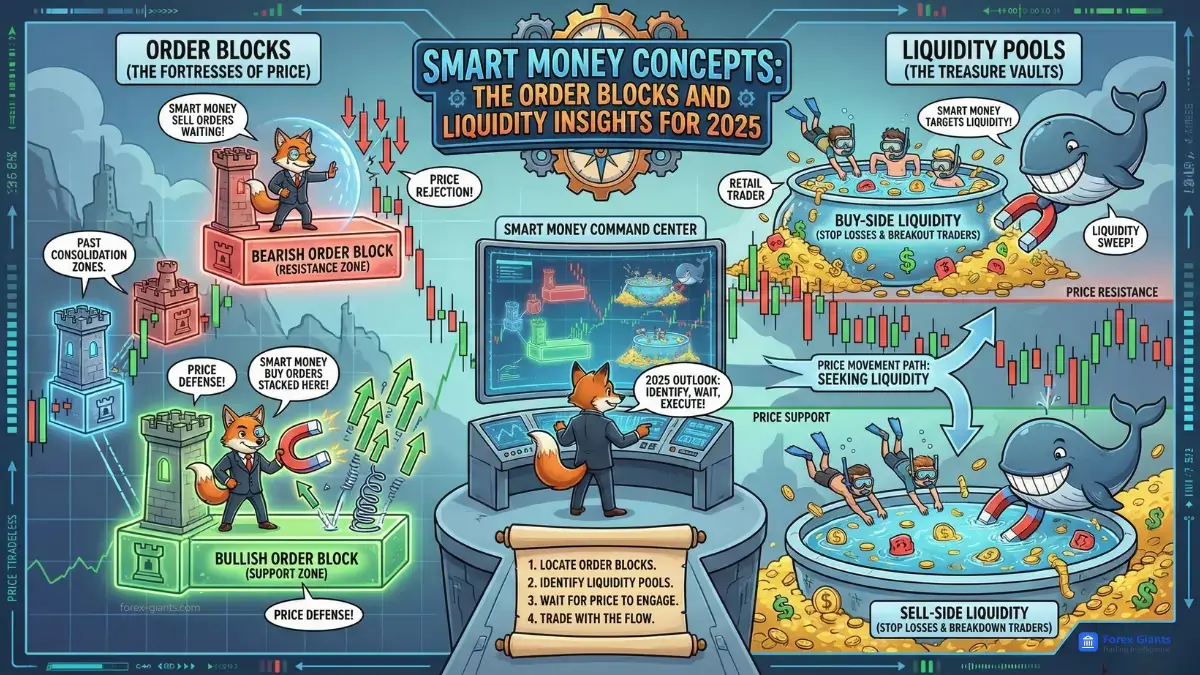
Order Blocks (OB) represent specific areas where institutions initiated large moves. Banks cannot enter full positions at once. Doing so would slip the price and ruin their entry average. They split orders. An Order Block marks the consolidation or the last opposing candle before an impulsive move breaks structure.
Identifying Valid Order Blocks
Not every candle is an Order Block. High-probability blocks possess specific characteristics. You must filter out noise.
Structure Break: The move initiating from the block must break market structure (BOS). This proves the move had sufficient volume.
Imbalance Creation: The move must leave a Fair Value Gap (FVG). This indicates urgency and a lack of liquidity on the opposing side.
Unmitigated Status: Price has not returned to this level yet. Once price touches the block, the block becomes mitigated. Do not use mitigated blocks.
Bullish Order Block
Identify the last bearish candle before a strong bullish move breaking structure. Institutions sold to buy. They manipulated price down to accumulate orders before driving price up. They hold drawdown positions in this bearish candle. Price must return to this level to mitigate those losses. Institutions close their sell orders at breakeven upon the return. This action adds buying pressure. You enter here.
Bearish Order Block
Identify the last bullish candle before a strong bearish move breaking structure. Institutions bought to sell. They drove price up to induce buyers before dumping the market. They hold drawdown buy positions. Price returns to this candle. Institutions exit buy orders. This fuels the sell-off. You enter short here.
Refinement
A daily Order Block covers a large price range. Risking the entire range requires a wide stop loss. Refine the zone. Go to lower timeframes. A 4-hour Order Block sits inside the daily block. A 15-minute block sits inside the 4-hour block. Refining reduces the risk area and increases the risk-to-reward ratio. Precision matters.
Liquidity: The Fuel of the Market
Liquidity refers to available orders. Buyers need sellers. Sellers need buyers. Institutions trade massive sizes. They need a pool of opposing orders to fill their positions. Without liquidity, they cannot move price. They manipulate the market to create these pools.
Retail traders place stop losses at obvious levels. Above double tops. Below double bottoms. Under trendlines. These clusters of stop losses represent liquidity. Institutions target these areas. SMC traders call this "sweeping liquidity."
Types of Liquidity
Recognizing where liquidity rests prevents you from becoming the liquidity.
Equal Highs (EQH): Two or more highs at the same level. Retail books teach this as resistance. Traders sell and place stops above. Price will spike through to trigger stops before reversing.
Equal Lows (EQL): Two or more lows at the same level. Retail sees support. Traders buy and place stops below. Price drops to clear these stops.
Trendline Liquidity: A perfect diagonal trendline induces traders to touch-trade. Stops accumulate below the line in an uptrend. Price eventually smashes through the line to collect all stops.
Inducement
Inducement is a trap. Price creates a minor pullback before a valid Order Block. This pullback looks like a reversal or a support level. Early buyers enter. They place stops below this minor low. The true Order Block sits lower. Price drops, takes the stops (inducement), taps the Order Block, and then rallies. Always identify the inducement before the zone. If no inducement exists before your zone, your zone likely becomes the inducement.
Fair Value Gaps (FVG) and Imbalance
Markets seek equilibrium. An impulsive move creates an inefficiency. Price moves too fast in one direction. Orders on the opposing side do not get filled. This leaves a gap on the chart. We call this a Fair Value Gap (FVG) or Imbalance.
Identifying an FVG
Look at a three-candle sequence.
Candle 1: The wick forms the lower bound (in a bearish trend).
Candle 2: A large impulsive candle.
Candle 3: The wick forms the upper bound.
A gap exists between the low of Candle 1 and the high of Candle 3. No trading occurred in this price range. This void acts as a magnet. Price draws back to this area to offer fair value to both buyers and sellers. We use FVGs as entry zones or targets. An Order Block aligning with an FVG offers higher probability.
Premium and Discount Zones
Institutions buy low and sell high. You must quantify "low" and "high." The Premium and Discount array helps.
Use a Fibonacci tool. Measure the range from the current swing low to the swing high.
Equilibrium: The 50% level.
Discount Zone: The area below 50%. You only look for buys here. Buying above 50% implies paying a premium. Banks avoid this.
Premium Zone: The area above 50%. You only look for sells here. Selling below 50% implies selling cheap.
Wait for price to retrace into the Discount zone before buying a bullish Order Block. Wait for price to rally into the Premium zone before selling a bearish Order Block. This filter increases the strike rate significantly.
The Smart Money Entry Model
Combining these concepts creates a repeatable process. You do not chase price. You wait for the setup to come to you. Following a checklist ensures consistency.
The Setup Checklist
Identify the Higher Timeframe Trend: Check the Daily or 4-Hour chart. Determine the direction. Is price making higher highs or lower lows?
Locate the Trading Range: Mark the recent swing high and swing low.
Find the Point of Interest (POI): Identify an unmitigated Order Block within the Premium (for sells) or Discount (for buys) zone. Ensure an FVG accompanies the block.
Wait for Liquidity Sweep: Watch for price to take out internal liquidity or inducement before reaching the POI.
Wait for Mitigation: Price enters the POI.
Lower Timeframe Confirmation (Optional but Recommended): Drop to the 15-minute or 1-minute chart. Wait for a CHoCH inside the POI. This confirms the reversal.
Entry: Place a limit order at the start of the lower timeframe Order Block or the FVG.
Stop Loss: Place the stop loss above the high (for sells) or below the low (for buys) of the Order Block. Add a few pips for spread.
Take Profit: Target the next opposing liquidity pool. Look for weak highs/lows or an opposing unmitigated Order Block.
Risk Management in SMC
High risk-to-reward ratios define SMC trading. Tight stops associated with refined Order Blocks allow for high R-multiples. A 1:5 or 1:10 risk-to-reward ratio occurs frequently. However, win rates may be lower than retail support/resistance strategies. You might lose three trades in a row. Each loss costs 1%. The fourth trade wins 10%. You end up up 7%. This math dictates profitability.
Position Sizing
Never risk more than 1-2% of your account on a single trade. Determine the stop loss distance in pips. Calculate the lot size based on that distance and your risk percentage. Consistency in risk prevents an account blow-up during a losing streak. Losing streaks happen. They test your psychology. Trust the probabilities.
Psychological Discipline
SMC requires patience. You wait for price to hit a specific zone. Price often misses the zone by a pip and moves in your direction. This triggers FOMO (Fear Of Missing Out). Do not chase. Chasing ruins the risk-to-reward ratio. It exposes you to liquidity sweeps. If price misses your zone, let the trade go. The market provides endless opportunities.
Trust the analysis. Once you execute the trade, remove emotions. Set the stop loss. Set the take profit. Walk away. Watching every tick creates anxiety. Anxiety leads to premature exits. Let the probabilities play out.
Analyzing 2025 Market Conditions
Volatility characterizes the current 2025 financial landscape. Central bank policies diverge globally. This divergence creates strong trends in pairs like USD/JPY and EUR/USD. SMC thrives in volatility. Impulsive moves create large Fair Value Gaps. Liquidity sweeps become more aggressive.
Algorithmic efficiency increases annually. The machines seeking liquidity operate faster. Precision becomes non-negotiable. Old retail patterns fail at higher rates. Double tops act as bait more often than reversal signals. Adapting to the institutional mindset separates profitable traders from liquidity providers.
Common Pitfalls to Avoid
Novice SMC traders make specific errors. Awareness of these errors accelerates the learning curve.
Over-refining: Zooming into the 1-second chart introduces too much noise. You get stopped out by spread. Stick to 1-minute or 5-minute charts for entries.
Ignoring Liquidity: Marking an OB without checking for liquidity usually fails. If the setup lacks inducement, the OB becomes the liquidity. Price will smash through the OB.
Counter-Trend Trading: Trying to catch every reversal yields losses. Trade with the higher timeframe trend. Catching the "big move" is easier when flowing with the river.
Forcing Trades: Not every day offers a setup. Some days range. Price stays in equilibrium. Stay flat. Protecting capital holds equal importance to growing capital.
Application: A Practical Exercise
Open a chart. Choose a major pair like GBP/USD. Go to the daily timeframe.
Mark the most recent swing high and low.
Identify the break of structure.
Highlight the candle responsible for the break.
Check for an FVG.
Look for liquidity near the zone.
Observe how price reacted when it returned to this zone. Backtesting builds confidence. Do not trade live funds until you verify the concepts on historical data. Verify 100 setups. Note the win rate. Note the average risk-to-reward. Only then should you fund an account.
The Path Forward
Smart Money Concepts offer a lens to view the market clearly. You stop seeing random candles. You see orders. You see traps. You see intent. This knowledge transforms trading from gambling into a strategic business. The banks show their hand every day. The charts reveal their positions. You simply need to read the signs.
Discipline bridges the gap between knowledge and profit. Execution requires controlling the self. The strategy works. The variable remains the trader. Commit to the process. Master the setup. Manage the risk. The results will follow.