Beyond the Hype of Commission-Free Trading
The last few years have seen an explosion in retail investing, fueled by a new generation of slick, user-friendly trading apps. Their headline promise, commission-free trading, has democratized access to the markets, allowing millions to build portfolios with just a few taps.
But beneath the simple interface of buying and selling lies a complex ecosystem of technology, international regulation, and clever business models that most users never see. The platform on your phone is the tip of a very large iceberg.
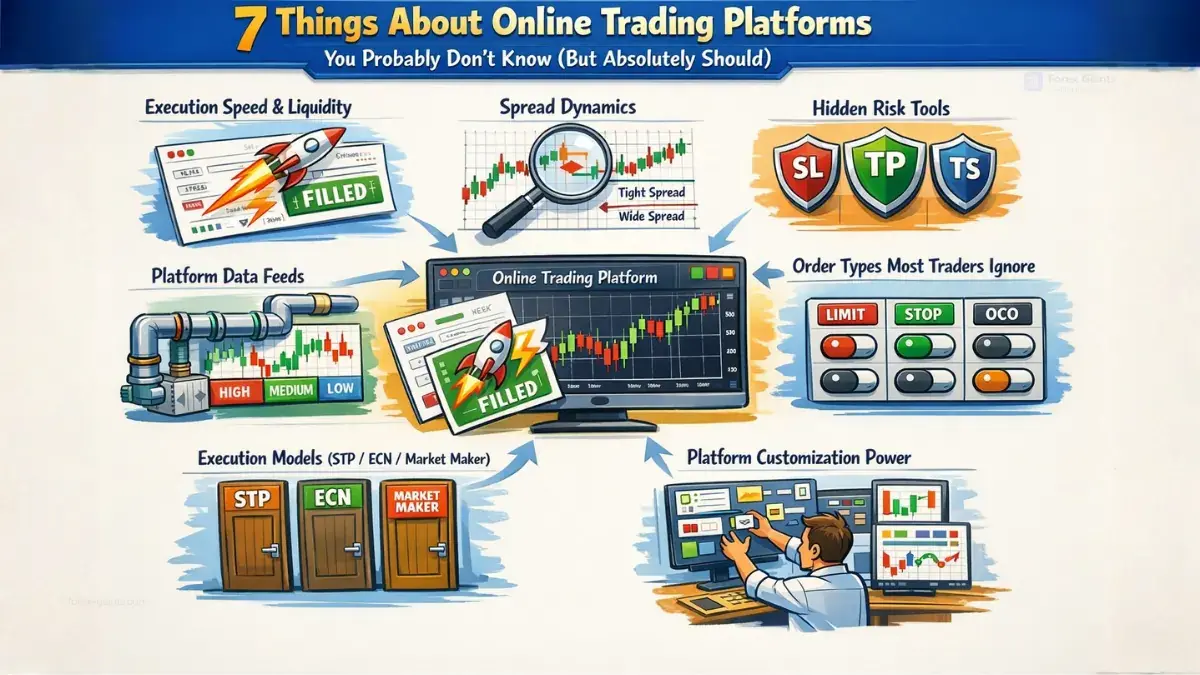
This article pulls back the curtain to reveal seven of the most surprising and impactful realities of modern online trading you should understand before placing your next trade.
1. The "Free" Trading Mirage: How Your Broker Really Makes Money
That "commission-free" label on your Invest or ISA account isn't a lie, but it’s not the whole story. These accounts are effectively loss leaders, products sold at a loss to attract customers for more profitable services, subsidized by other, more lucrative parts of the business.
So, how does a zero-commission broker stay profitable? The revenue comes from several key areas:
The CFD Division: The primary revenue engine for many platforms is their Contract for Difference (CFD) division. CFDs are high-risk derivatives involving leverage. Unlike commission-free stock investing, CFD trading involves dynamic spreads (the difference between the buy and sell price) and overnight financing fees, which generate consistent income for the broker.
Currency Conversion Fees: When you buy a US stock from a GBP or EUR account, the platform performs a currency conversion.
For Invest/ISA accounts, this typically involves a small fee, such as 0.15% on the converted amount.
For CFD accounts, this fee increases to 0.5%, but it is applied only to the resulting profit or loss of a trade, not the total transaction value.
Interest on Uninvested Cash: Your broker earns interest on the cash sitting idle in your account. While they may pay you a competitive rate, they earn a slightly higher rate from the banks or money market funds where they hold pooled client money. This difference, known as the "spread," becomes a substantial, low-risk revenue stream when applied across millions of users.
"Free" doesn't mean no one pays; it means the costs are structured to align with the broker's broader business strategy.
2. The Geographic Lottery: Why Your Account Protection Could Be £85,000 or €1,000,000
When you open an account with a global broker like Trading 212, you are not just dealing with a single company. You are onboarded by a specific legal entity regulated in a particular country, and this detail has massive implications for the safety of your money.
A broker is often a collection of distinct companies (e.g., Trading 212 UK Ltd in the UK, Trading 212 Markets Ltd in Cyprus, Trading 212 FXFlat in Germany). The compensation scheme that protects you depends entirely on which entity holds your account:
FCA (UK): Clients are protected by the Financial Services Compensation Scheme (FSCS) for up to £85,000.
CySEC (EU): Clients are protected by the Investor Compensation Fund (ICF) for up to €20,000.
The Surprising Twist:
Clients under the Trading 212 Markets Ltd (CySEC) entity also benefit from additional private insurance, underwritten by Lloyds of London, which covers assets up to 1 million EUR per client. Your ultimate financial safety net isn't determined by the brand name, but by the corporate structure operating behind the scenes.
3. The Double-Edged Sword of Fractional Shares
Fractional shares have been a game-changer, allowing investors to buy a slice of high-priced stocks like Google or Amazon with as little as €1. While this accessibility is a strength, it comes with a significant drawback: the "lock-in" effect.
While you can typically transfer full shares between brokers via an "in-specie" (asset-to-asset) transfer, fractional shares are often ineligible for such transfers.
Why? Fractional shares are not direct holdings but contractual rights recorded on the broker's books and held collectively in a single omnibus account.
The Consequence: If you switch platforms, you are forced to liquidate (sell) all fractional holdings. This can trigger a capital gains tax event on your profits. You then have to withdraw the cash and re-buy assets at the new broker, potentially at a different price.
4. The Hidden Partnership: Your Broker Might Be Using Its Biggest Competitor
The competitive landscape is not clear-cut. It surprises most investors to learn that Trading 212 uses its competitor, Interactive Brokers (IBKR), for back-end order execution.
This is common: "neo-brokers" often partner with established institutional firms to handle the complex plumbing of global trade execution. While this gives the neo-broker access to deep liquidity, it creates a dependency.
The Risk: During the 2021 "meme stock" volatility, restrictions imposed by Interactive Brokers directly impacted Trading 212 users, demonstrating that this relationship can be a single point of failure.
5. The Invisible Hand of Regulation: Leverage Caps and Safety Nets
Retail traders, especially in Europe under ESMA (European Securities and Markets Authority), are protected by strict product intervention measures. These are hard rules, not suggestions:
Strict Leverage Limits:
To prevent catastrophic losses, leverage is capped based on asset volatility:
30:1 for major currency pairs.
20:1 for non-major currency pairs, gold, and major equity indices.
10:1 for commodities (non-gold) and non-major indices.
5:1 for individual equities.
2:1 for cryptocurrencies.
Negative Balance Protection:
This guarantees a retail investor can never lose more money than the total amount deposited. This rule was a direct response to events like the 2015 Swiss Franc crash, where traders ended up owing brokers huge sums of money.
6. Drawings vs. Indicators: It's Your Analysis vs. The Computer's
On charting platforms like TradingView, users often confuse two fundamental tools. Understanding the difference is crucial for technical analysis:
Drawing Tools: These are manual graphical elements (trend lines, channels, text) used to visualize your own analysis. They are flexible and allow you to express your unique ideas about market structure.
Indicators: These are automated calculations (like RSI or Moving Averages) based on price and volume. They "stick" to the price data and provide automated readings based on predefined mathematical formulas.
The difference? Drawing tools personalize the chart to express your view; indicators apply standardized models to the market data.
7. The Ultimate Reality Check: Your Tools are a Compass, Not a Crystal Ball
After exploring the technology and regulations, the truth lies in how these tools are used. A sophisticated platform offers no guarantees of success.
As one indicator developer on TradingView states:
"Auxiliary indicators are a 'Compass,' not a 'Book of Prophecy.' This indicator is merely a tool that mathematically calculates and visualizes past price data. A 'magic indicator' that predicts future price fluctuations 100% accurately or guarantees profit does not exist."
Trading platforms can systematize analysis, but they cannot eliminate risk. The final responsibility for all investments lies with "Yourself".
Conclusion: The Informed Investor
Modern trading platforms are marvels of financial technology, but their simplicity is deceptive. By understanding what happens behind the screen, from business models to regulatory webs, you move from being a mere user to an informed investor.
What is the one thing you'll look at differently the next time you open your trading app?