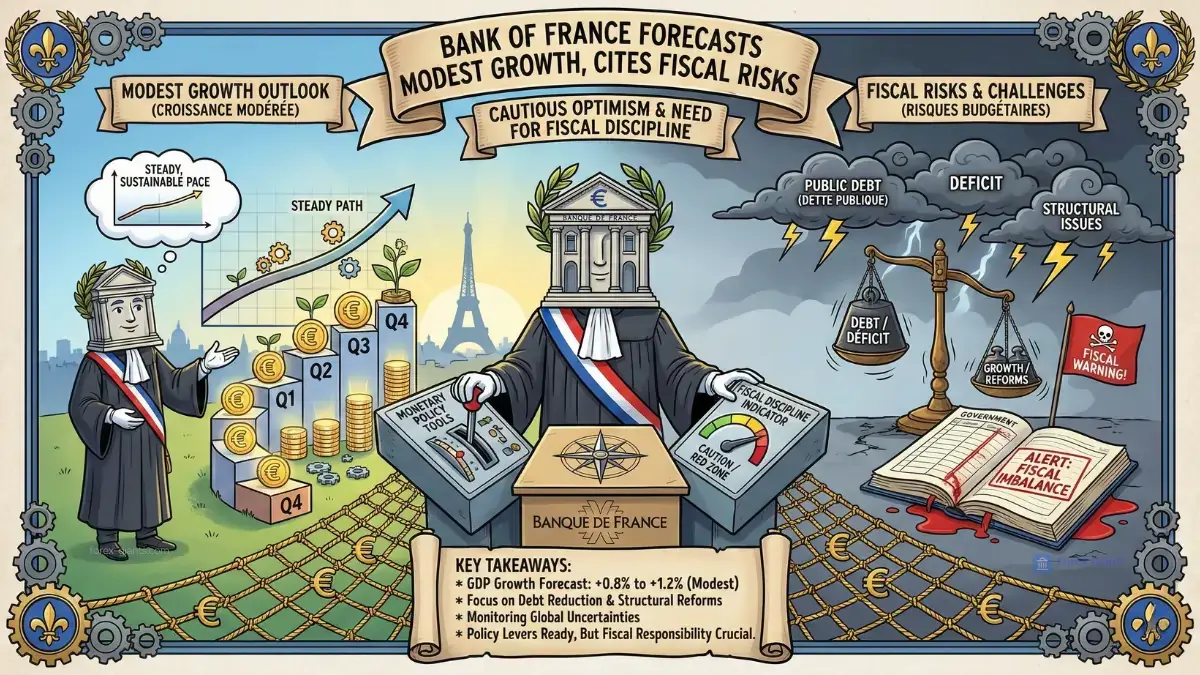
Bank of France Forecasts Modest Growth, Cites Fiscal Risks
France's economy shows resilience, but budget uncertainty and political instability weigh on investor confidence.
France expects to avoid recession in 2025, projecting 0.6% GDP growth. The Bank of France notes this modest recovery hinges on consumer demand. However, mounting fiscal pressures and political shifts present significant challenges.
France's economy anticipates modest expansion through 2025. The Bank of France projects a 0.6% GDP growth rate. This forecast suggests France will bypass a recession. You observe this growth after a slow first quarter, which saw a mere 0.1% increase.
Economic activity should accelerate in the second half of the year. Domestic demand fuels this expected pickup. Foreign trade, by contrast, continues to act as a drag on overall performance. This structure matters for your market analysis.
Despite the growth projection, serious concerns persist over France’s financial health. Prime Minister Bayrou’s minority government recently passed the 2025 budget. They did so following a no-confidence vote. This highlights underlying political fragility.
The new budget relies heavily on increased business taxes. Critically, it does little to reduce the national deficit. Business leaders express apprehension. Organizations like the Medef federation warn against these policies. They fear France will fall behind international rivals. This impacts your outlook on corporate earnings and investment climate.
You must consider the direct impact on businesses.
Higher taxation affects profit margins. This influences hiring decisions and investment plans. Companies facing increased costs may hesitate to expand. This translates into slower economic momentum.
cpi" title="Understanding inflation and CPI in forex">Inflation offers a brighter spot. Prices expect to drop sharply to 1.0% in 2025. Falling energy prices drive this decline. This eases pressure on household budgets. Lower inflation supports consumer spending. This aligns with the forecast for stronger domestic demand.
However, France's public finances remain delicate. National debt levels rise. Fiscal consolidation, the process of reducing deficits and debt, faces delays. This ongoing fiscal strain adds a layer of risk to the economic outlook. Traders monitor government bond yields for signs of distress.
Political instability casts a long shadow. France has seen four prime ministers within a year. Such frequent government changes erode confidence among investors. Stability is crucial for long-term economic planning. Your investment decisions should account for this volatility.
Global economic uncertainty also poses a threat. Trade tensions, particularly new U.S. tariffs, threaten French export prospects. A slowdown in international trade directly impacts export-oriented sectors. You need to assess these external pressures.
Specific sectors show vulnerability.
Construction experiences the greatest strain from budget doubts. Services, a key part of the French economy, also exhibit signs of slowing. These sectoral weaknesses underscore the fragility of the overall recovery. You track these segments for early warning signals.
France shows growth, but this growth appears precarious. The central bank emphasizes avoiding recession. This growth depends on consumer resilience and a stable fiscal environment. The uncertainty surrounding taxation and government consistency worries businesses. This concern is as important as the raw economic figures.
Monitor these developments closely. The interplay between modest growth, fiscal challenges, and political shifts defines France's current economic narrative. Your understanding of these factors will inform your trading strategies in the European market.

FN Pulse Editorial Team
Expert Trading Analysts
Our editorial team consists of experienced forex traders, financial analysts, and market researchers dedicated to providing accurate and actionable trading education.