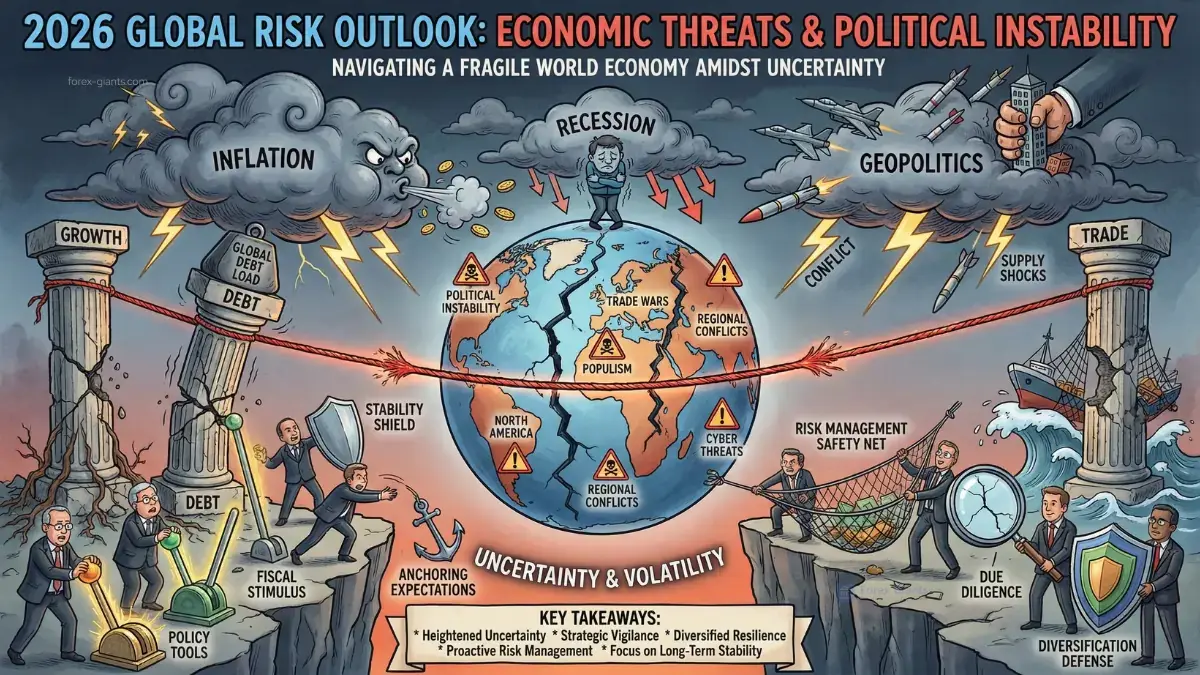
As 2025 concludes, the financial world confronts a convergence of structural economic fractures and escalating geopolitical friction. Volatility will not just be a feature of 2026; it will be the defining asset class.
The era of easy money and geopolitical stability is definitively over. A new cycle—defined by scarcity, conflict, and the violent return of the bond vigilante—begins now. Below is an analysis of the primary threbats to global stability and the actionable strategies required to navigate them.
I. Major Political & Security Risks
The transition into 2026 is dominated by the erosion of the post-WWII security architecture.
Global Security: The Third Nuclear Age
We are entering a "Third Nuclear Age," characterized by multipolar rivalries and the disintegration of containment frameworks.
The February 2026 Flashpoint: The New START arms-control treaty is set to expire on February 5, 2026. Without renewal, US and Russian nuclear stockpiles will be unbound by formal limits for the first time in decades.
Proliferation Risks: This lack of restraint accelerates a complex rivalry involving established powers and the "quartet of chaos" (China, Russia, Iran, North Korea), increasing the statistical probability of a kinetic event.
The Geopolitical Void
The gap between global threats and the United States' political will to police them is widening. A shift toward transactional foreign policy encourages regional aggressors to test red lines.
Middle East Entrenchment: Conflict in Gaza and Lebanon has metastasized into a generational struggle, threatening the stability of Jordan and Egypt.
The Eurasian Axis: Coordination between Russia and China regarding defense industrial bases creates a formidable challenge to NATO logistics.
Environmental Tail Risks: The AMOC Anomaly
While climate policy focuses on gradual warming, markets are ignoring abrupt non-linear risks.
Critical Note: Recent high-impact modeling suggests a significant probability of the Atlantic Meridional Overturning Circulation (AMOC) collapsing within this century. A collapse in the 2025-2030 window would trigger severe cooling in Northern Europe and catastrophic drought in the Global South, forcing a repricing of global agricultural futures.
II. Macro-Economic Threats
The global economy is squeezed between the rock of protectionism and the hard place of debt.
The Return of Protectionism
If the US administration executes its proposed trade framework—specifically a universal baseline tariff and targeted 60% levies on China—the fallout will peak in 2026.
Stagflationary Shock: Scenario modeling suggests this combination could push cumulative inflation higher by 13–23% while shrinking US GDP by 3–10% by 2028 compared to the baseline.
Labor Supply Shocks: Proposed mass deportations would remove millions from the labor force, creating an immediate supply-side shock to the service and construction sectors, further embedding inflation.
The Sovereign Debt Wall
Governments worldwide accumulated excessive debt during the "free money" era. 2026 is the year the bill comes due.
Fiscal Dominance: The US enters 2026 with debt-to-GDP ratios exceeding historical norms. Treasury issuance is flooding the market, forcing the "term premium" (the extra yield investors demand to hold long-term debt) significantly higher.
The Indian Bright Spot? In contrast to Western profligacy, India aims to trim its budget deficit to 4.5% of GDP in the 2025-26 fiscal year. However, coalition politics and populist demands threaten this fiscal discipline.
III. Financial Market Dynamics
The Federal Reserve's Trap
The Federal Reserve faces a mathematical impossibility in 2026. They must manage Real Yields (r) where:
r = i - π
Where $i$ is the nominal interest rate and $\pi$ is inflation.
To curb the returning inflation ($\pi$), they must raise rates ($i$). However, raising rates increases the interest expense on the national debt to unsustainable levels, risking a fiscal spiral. They are cornered.
Eurozone Fragmentation
Europe faces a "divergence crisis."
Spread Widening: Watch the spread between German Bunds (safe assets) and Italian BTPs (risk assets). Widening spreads indicate stress.
Political Paralysis: With political gridlock in France and Germany, the ECB lacks the political cover to utilize anti-fragmentation tools (like TPI) without being accused of monetary financing.
The Commodity Supercycle
The "Greenflation" thesis remains intact. Underinvestment in traditional extraction infrastructure (CAPEX) during the ESG boom has created a structural supply deficit.
Energy: Oil remains the backbone of the economy. Developing nations prioritize growth over decarbonization.
Metals: Copper and aluminum are in critical shortage due to the triple demand of AI data centers, EV grids, and defense manufacturing.
IV. Investment Strategy & Actionable Themes
In 2026, passive indexing (60/40 portfolios) is a strategy for capital destruction. Active management and "Anti-Fragile" positioning are required.
1. Currency & Forex
Short EUR/USD: The Euro suffers from energy dependency and weak demographics. Parity ($1.00) is a magnetic target.
USD/JPY Caution: While the interest rate differential favors the USD, the Bank of Japan will defend the Yen aggressively. Expect volatility that destroys tight stop-losses.
Emerging Markets: Avoid currencies in nations with high dollar-denominated debt. Defaults are likely in sub-Saharan Africa.
2. Strategic Longs
Defense & Aerospace: Geopolitical friction is secular, not cyclical. Order books for major defense contractors are full for the rest of the decade.
Energy Midstream: Pipelines and storage offer inflation-linked cash flows and dividends, acting as a bond proxy with upside.
Gold (XAU/USD): Gold is not just a trade; it is insurance against sovereign error. Central banks in the East are accumulating gold to diversify away from US Treasuries. Buy dips aggressively.
3. Sectors to Avoid
Unprofitable Tech: High interest rates increase the "discount rate" applied to future cash flows. Companies promising profits in 2030 will see their stock prices crushed in 2026.
Consumer Discretionary: The "strong consumer" narrative is fading. Credit card delinquencies are rising. Avoid retailers exposed to middle-income spending.
4. The "Black Swan" Watchlist
Traders must hedge against low-probability, high-impact events:
Nuclear/Kinetic Event: A tactical detonation or direct NATO-Russia engagement.
Cyber-Systemic Failure: A state-sponsored attack on clearinghouses (DTCC/Euroclear) halting global liquidity.
US Constitutional Crisis: Post-election disputes paralyzing the Executive branch.
Verdict for the Trader
Survival precedes profit.
In 2026, leverage is the enemy. The markets will punish complacency with extreme volatility. Reduce position sizing, widen stops, and hold higher cash balances to deploy when panic strikes. The global economy is transforming; ensure your portfolio transforms with it.