Currency connects the global economy. Every international transaction depends on the value of one money against another. You buy a product from overseas. You travel to a foreign country. You invest in global stocks. An exchange rate dictates the cost in every instance. Traders profit by predicting these fluctuations. Understanding the mechanics behind these rates separates successful market participants from gamblers.
This guide explains the fundamental components of exchange rates. You will learn how to read quotes. You will understand the economic forces moving prices. You will gain the knowledge necessary to interpret market movements as of late 2025.
The Anatomy of a Currency Quote
Forex trading involves buying one currency while selling another. Prices appear in pairs. The first currency listed serves as the base currency. The second currency functions as the quote currency (or counter currency).
Consider the EUR/USD pair. If the rate displays 1.1200, one Euro costs 1.1200 US Dollars. The base currency always equals one unit. The quote currency shows how much of the second currency acts as the equivalent value.
Buying and Selling
Every pair has two prices: the Bid and the Ask.
Bid: The price at which the market buys the base currency from you. You sell at the bid.
Ask: The price at which the market sells the base currency to you. You buy at the ask.
The Ask price always exceeds the Bid price. This difference represents the spread. Brokers and liquidity providers earn revenue through this gap. High liquidity pairs like EUR/USD or USD/JPY typically offer tighter spreads. Exotic pairs involving emerging market currencies often present wider spreads due to lower trading volumes.
Pips and Lots: Measuring Movement
Traders measure price changes in pips. A pip stands for "percentage in point." For most currency pairs, a pip corresponds to the fourth decimal place. A move from 1.1200 to 1.1201 equals one pip.
Yen pairs act as the exception. In USD/JPY, the second decimal place represents the pip. A move from 145.50 to 145.51 equals one pip.
Determining Value
Position size determines the monetary value of a pip. Forex trading uses "lots" to standardize trade sizes.
Standard Lot: 100,000 units of the base currency. On EUR/USD, one pip usually equals $10.
Mini Lot: 10,000 units. One pip equals $1.
Micro Lot: 1,000 units. One pip equals $0.10.
Leverage allows traders to control large positions with smaller capital. A 100:1 leverage ratio means you control $100,000 with a $1,000 deposit. High leverage increases potential gains. High leverage also amplifies risk. A small price move against your position wipes out the account balance if risk management fails.
The Role of Central Banks
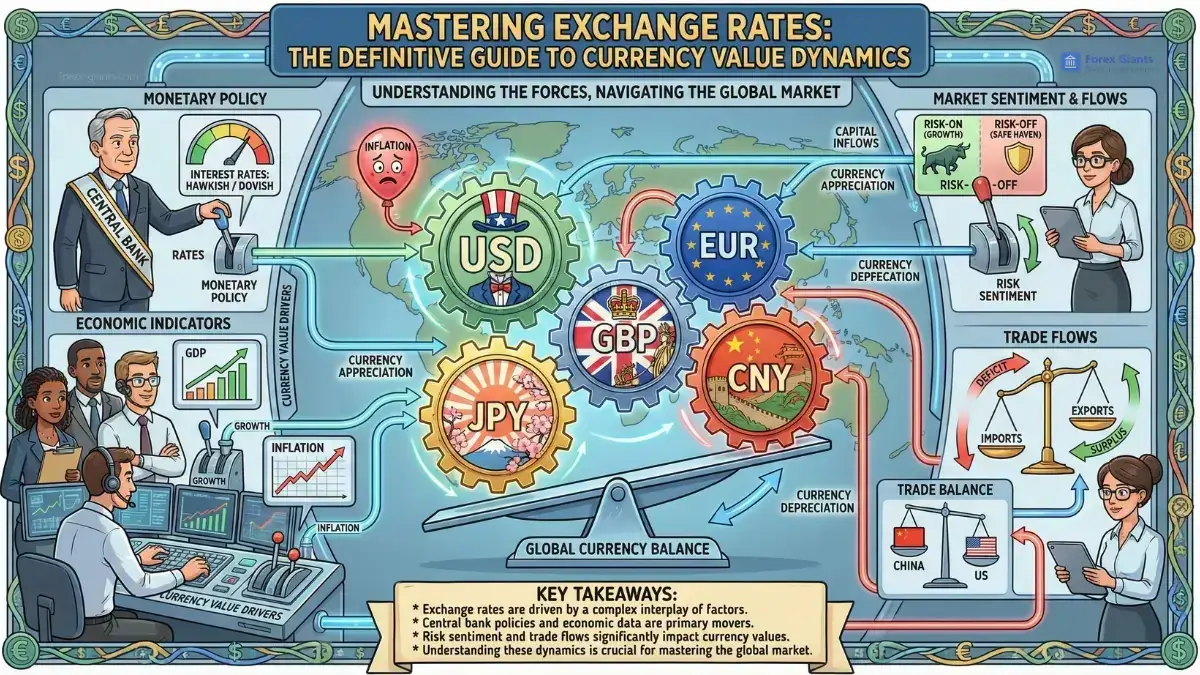
Central banks influence exchange rates more than any other entity. These institutions control the money supply and set interest rates. Their decisions ripple through the global market instantly.
Interest Rates
Capital seeks yield. Investors move money to countries with higher interest rates to earn a better return on safe assets like government bonds. This flow of funds creates demand for the currency. The value rises.
Consider the Federal Reserve in the United States. When the Fed raises rates, the US Dollar often strengthens. Global investors sell other currencies to buy Dollars. They invest in US assets. When the Fed cuts rates, the Dollar often weakens as capital seeks higher yields elsewhere.
Key central banks to monitor include:
Federal Reserve (Fed): United States
European Central Bank (ECB): Eurozone
Bank of Japan (BoJ): Japan
Bank of England (BoE): United Kingdom
Swiss National Bank (SNB): Switzerland
Bank of Canada (BoC): Canada
Reserve Bank of Australia (RBA): Australia
Reserve Bank of New Zealand (RBNZ): New Zealand
Quantitative Easing and Tightening
Central banks sometimes buy financial assets to inject money into the economy. Economists call this Quantitative Easing (QE). QE increases the money supply. A higher supply typically lowers the currency's value.
Quantitative Tightening (QT) reverses this process. The central bank sells assets or lets bonds mature without reinvesting. This reduces the money supply. Scarcity drives the currency value up.
Economic Indicators Driving Volatility
Exchange rates react to economic health. Data releases provide a scorecard for a nation's economy. Strong data attracts investment. Weak data repels capital.
Inflation (CPI and PPI)
Inflation erodes purchasing power. A currency buys less goods than before. High inflation hurts an economy. Yet the market reaction often depends on central bank expectations.
If inflation rises, traders anticipate the central bank will raise interest rates to cool the economy. This expectation causes the currency to spike upwards immediately after the data release. The Consumer Price Index (CPI) measures inflation at the consumer level. The Producer Price Index (PPI) measures inflation at the wholesale level.
Gross Domestic Product (GDP)
GDP measures the total value of goods and services produced. It serves as the primary indicator of economic health. Rising GDP signals a robust economy. Companies generate profits. Wages rise. Consumer spending increases. This environment attracts foreign investors. Demand for the local currency grows.
Employment Data
Jobs drive consumption. High employment leads to high spending. The US Non-Farm Payrolls (NFP) report commands immense attention. Released on the first Friday of every month, this report shows the number of jobs added in the US (excluding farm workers).
A strong NFP number often rallies the US Dollar. A weak number causes a sell-off. Traders brace for volatility during this release. Spreads widen. Price action becomes erratic.
Geopolitics and Market Sentiment
Money hates uncertainty. Political instability frightens investors. Wars, elections, and trade disputes alter exchange rates drastically.
Safe Haven Currencies
During times of crisis, capital flees risky assets. Investors park money in "safe haven" currencies. These currencies tend to retain value or appreciate during turmoil.
US Dollar (USD): The world's reserve currency. In extreme panic, everyone wants cash. The deepest liquidity lies in the Dollar.
Swiss Franc (CHF): Switzerland maintains neutrality and a stable banking system. The Franc appreciates when Europe faces instability.
Japanese Yen (JPY): Japan holds massive foreign assets. During crises, Japanese investors repatriate funds, strengthening the Yen.
Riskier currencies, such as the Australian Dollar or Emerging Market currencies, tend to fall during geopolitical tension. Traders call this "Risk-Off" sentiment.
Exchange Rate Regimes
Not all currencies trade freely. Governments choose how their currency interacts with the rest of the world.
Floating Exchange Rates
Market forces dictate the value. Supply and demand set the price. The US Dollar, Euro, and Yen float. Volatility occurs naturally based on economic data and sentiment. Most major pairs operate under this regime.
Fixed (Pegged) Exchange Rates
A government sets a specific value against another currency. The central bank must hold large reserves to maintain this peg. They buy or sell their own currency to keep the rate stable.
Gulf nations often peg their currencies to the US Dollar. This provides stability for oil exports. Hong Kong also maintains a peg to the USD. Pegs eliminate volatility but require massive financial resources to defend. If the market overwhelms the central bank, the peg breaks. This event causes massive, chaotic price swings.
Understanding Cross Rates
Most currency transactions involve the US Dollar. A cross rate involves two currencies neither of which is the US Dollar. Examples include EUR/GBP, EUR/JPY, and GBP/JPY.
Calculation of cross rates happens via the Dollar. To get the EUR/GBP rate, the market divides EUR/USD by GBP/USD. You do not need to perform this math manually. The platform handles the calculation.
Cross pairs offer unique opportunities. They allow traders to target specific regional economics. If the Eurozone economy outperforms the UK, a trader buys EUR/GBP. The US Dollar's strength or weakness becomes irrelevant to the specific trade thesis.
Carry Trade Mechanics
The carry trade involves borrowing a low-interest-rate currency to buy a high-interest-rate currency. The trader profits from the interest rate differential.
Example: Japan has a 0.5% interest rate. The US has a 5.0% interest rate. A trader sells JPY and buys USD. The trader earns the difference (roughly 4.5% annualized) daily.
This strategy works best in stable markets. If the funding currency (JPY) appreciates significantly, the capital loss on the exchange rate wipes out the interest gains. Risk management remains vital here.
The Impact of Global Trade
Importers and exporters constantly exchange currency. These real-world flows create underlying demand.
A Japanese car manufacturer sells vehicles in America. They receive US Dollars. They need Japanese Yen to pay workers and suppliers in Tokyo. They sell Dollars and buy Yen. This transaction puts downward pressure on USD/JPY.
Large mergers and acquisitions also move markets. If a US company buys a British firm for 10 billion Pounds, they must convert Dollars to Pounds. A massive order hits the market. The Pound spikes.
Analyzing the Market: 2025 Perspective
As we navigate late 2025, specific trends dominate the exchange rate environment. The synchronization of global monetary policies has fractured. Some nations battle lingering inflation. Others fight deflationary pressures.
The Digital Influence
Central Bank Digital Currencies (CBDCs) now operate alongside traditional fiat. While not replacing standard pairs, the efficiency of cross-border settlements has improved. Settlement times have decreased. Intraday volatility has changed pattern due to faster liquidity flows.
Algorithmic Dominance
High-frequency trading algorithms execute the majority of volume. These programs react to news headlines in milliseconds. Human traders must adapt. Do not chase price spikes immediately after news. Algorithms trigger stop-losses. Wait for the initial dust to settle. Identify the true trend after the knee-jerk reaction.
Practical Steps for Analysis
To predict exchange rates, use a structured approach.
1. Identify the Long-Term Trend: Check the weekly and daily charts. Is the pair making higher highs or lower lows? Do not fight the macro trend.
2. Review the Economic Calendar: Know what data releases come out today. Avoid opening new positions minutes before a major announcement like the NFP or a Rate Decision.
3. Monitor Bond Yields: Watch the 10-year government bond yields. If US yields rise faster than German yields, EUR/USD typically falls. Bond markets signal smart money flow.
4. Check Commodity Prices: Commodity currencies correlate with raw materials.
AUD and NZD: Correlate with Gold and Copper.
CAD: Correlates with Oil prices.
USD: Often moves inversely to Gold.
Risk Management Principles
Understanding rates provides no benefit without survival skills. The market moves randomly in the short term.
Stop Loss Orders
Always use a stop loss. This order closes your trade automatically if the price moves against you by a set amount. Determine your exit point before you enter the trade. Accept the loss as a business expense. Never move a stop loss further away to avoid taking a loss.
Position Sizing
Risk only a small percentage of your capital on a single trade. A common rule suggests risking no more than 1% to 2% of the account balance. If you have $10,000, risk $100 to $200. This discipline ensures you survive a losing streak.
Risk-to-Reward Ratio
Target trades where the potential profit exceeds the risk. A 1:2 ratio means you risk $100 to make $200. With this ratio, you stay profitable even if you lose 50% of your trades.
Common Misconceptions
Novice traders often fall for myths regarding exchange rates.
Myth: A cheap currency is good to buy. Low exchange rates do not equal value. A currency trading at historical lows often has fundamental reasons for being there. Catching a falling knife results in losses. Trend following usually outperforms contrarian betting.
Myth: News always moves the market logically. Sometimes positive data leads to a sell-off. Traders say, "Buy the rumor, sell the fact." The market prices in the good news before the release. When the news hits, traders take profit. The price drops despite the positive data.
Myth: You need complex indicators. Price action reigns supreme. Support and resistance levels, trendlines, and candlestick patterns tell the story. Complex indicators often lag behind price. Keep charts clean.
The 24-Hour Cycle
The forex market operates 24 hours a day, 5 days a week. Liquidity shifts as the sun moves across the globe.
Asian Session (Tokyo/Sydney): Often quieter. JPY and AUD pairs see action. Range trading strategies work well here.
London Session: The most liquid session. London serves as the financial hub. Massive volume enters the market. Trends often start here. Volatility peaks.
New York Session: High volume, especially in the morning when it overlaps with London. USD pairs dominate. Economic data from the US shakes the market.
Understanding which session matches your trading style improves results. Scalpers prefer the London/New York overlap. Swing traders analyze the daily close.
Final Strategic Considerations
Exchange rates represent the collective psychology of the world. They reflect fear, greed, stability, and growth. No single formula predicts every move. Success comes from probability management.
Focus on the relationship between interest rates and growth. Watch the central banks closely. Respect the technical trends on the charts. Use strict money management.
The market rewards discipline. It punishes impulsiveness. Study the rates. Plan the trade. Execute with precision. The flow of global currency offers endless opportunity for the prepared mind.