Yes Bank Share Price 2026: Financial Forecasts and Strategic Analysis
Date: December 24, 2025
Yes Bank stands at a critical juncture as 2025 ends. The banking sector in India demonstrated resilience throughout the year. Investors now look toward 2026 with specific questions regarding growth, asset quality, and stock valuation. This analysis provides a detailed breakdown of the Yes Bank share price potential for the coming year. We examine technical charts, fundamental ratios, and macroeconomic indicators influencing the stock.
2025 Performance Review
The year 2025 proved stabilizing for Yes Bank (Organization). Management focused on deposit granularity and loan book diversification. The bank successfully exited the reconstruction phase mentally and operationally. Volatility remained high during Q1 2025 but settled by Q3. The stock price consolidated within a specific range, frustrating short-term traders but encouraging long-term accumulators.
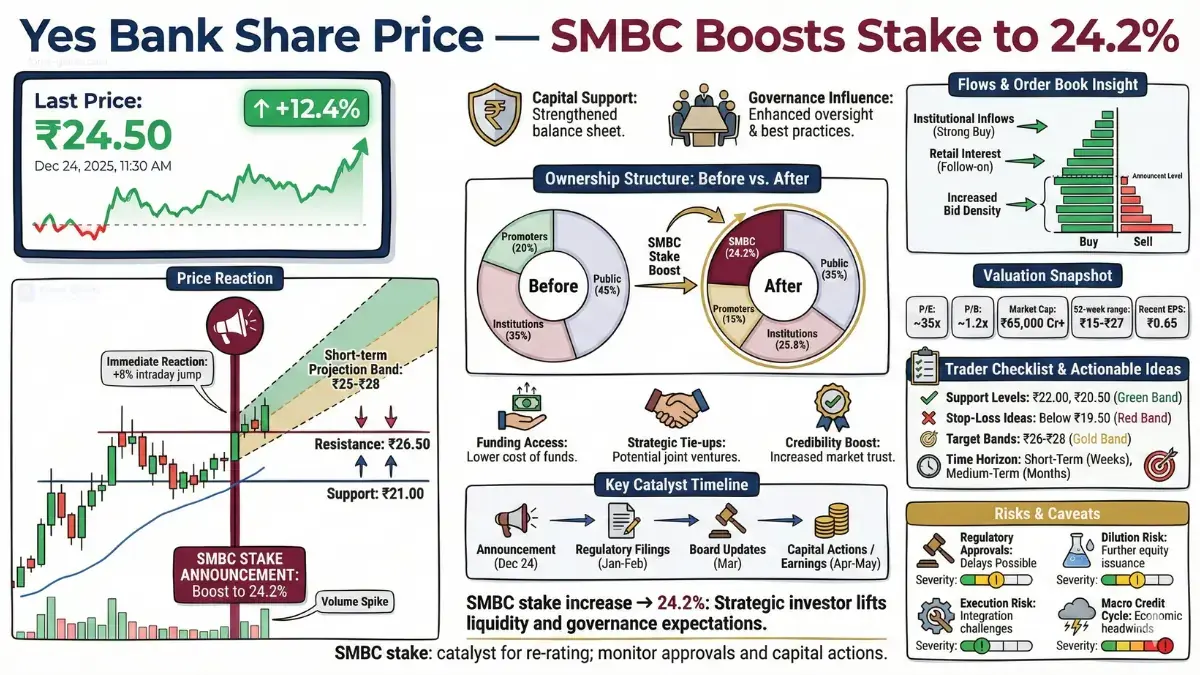
Scenario table — 2025 forecast bands (decision‑ready)
Scenario | Target band (late‑2025) | Primary driver |
|---|---|---|
Conservative | ₹15–₹20 | Continued margin pressure, slower credit recovery; valuation re‑rating risk. |
Base case | ₹21–₹28 | SMBC stake credibility, steady credit growth, improved NIMs and institutional flows. |
Optimistic | ₹28–₹35+ | Strong earnings surprise, successful capital actions, strategic tie‑ups or M&A tailwinds. |
Sources: MoneyMintIdea
Key Milestones Achieved in 2025
NPA Reduction: Gross Non-Performing Assets dropped below significant thresholds. Asset Reconstruction Company (ARC) deals finalized in previous years yielded recoveries.
Deposit Growth: CASA (Current Account Savings Account) ratios improved. Retail deposits surged, reducing reliance on bulk corporate deposits.
Digital Adoption: The bank expanded the UPI market share. Digital transactions accounted for a majority of retail volume.
Profitability: Quarterly results showed consistent net profit generation. Operating margins expanded slightly despite inflationary pressures.
Investors witnessed the stock reacting to these improvements. The price did not explode upwards. The market demanded consistent proof of stability. Yes Bank provided this proof over four consecutive quarters.
Fundamental Analysis for 2026
Valuation models for 2026 require scrutiny of core banking metrics. Price moves depend on earnings growth and book value expansion. We analyze the balance sheet strength expected for the fiscal year 2026.
Net Interest Margin (NIM) Trajectory
NIM remains the primary profitability gauge. Yes Bank struggled with low NIMs immediately post-crisis. The trend reversed in 2025. Projections for 2026 suggest NIM expansion to industry standards. Lower cost of funds drives this change. As the bank replaces high-interest legacy borrowings with low-cost retail deposits, margins widen. This expansion directly impacts Earnings Per Share (EPS).
Asset Quality and Provisioning
Slippages determine banking success. Fresh slippages in 2025 remained within guidance. The provision coverage ratio (PCR) stands healthy. For 2026, analysts expect credit costs to normalize. Lower credit costs mean higher bottom-line profits. The legacy bad loan portfolio no longer dictates the narrative. The focus shifts to the quality of the new loan book. This book consists largely of granular retail and MSME loans, historically safer than large corporate exposures.
Capital Adequacy Ratio (CAR)
Basel III norms demand strict capital buffers. Yes Bank maintains a CAR well above regulatory requirements. This capital cushion allows for aggressive lending in 2026. The bank does not need immediate dilution of equity to fund growth. Shareholder value remains protected from near-term equity raising risks.
Technical Analysis: Chart Patterns and Levels
Technical indicators on the weekly and monthly charts offer insights for entry and exit points in 2026. The long-term trend shows a rounding bottom formation.
Support and Resistance Levels
Primary Support: The 200-day Moving Average (DMA) acts as the floor. Historically, price bounces occurred here throughout late 2025.
Major Resistance: The multi-year overhead supply zone remains the key hurdle. Breaking this level requires high volume participation.
Fibonacci Retracement: The stock respects the 38.2% and 50% retracement levels from the previous major swing high. Traders use these levels to define risk.
Momentum Indicators
RSI (Relative Strength Index): The monthly RSI exhibits a positive divergence. Price made lower lows while RSI made higher lows in early 2025. This signal often precedes a bullish reversal.
MACD (Moving Average Convergence Divergence): The MACD line crossed above the signal line on the weekly timeframe. Positive histograms suggest building momentum entering 2026.
Volume Analysis: Accumulation volume spikes appeared in Q4 2025. Institutional investors likely bought dips. Low volume on pullbacks indicates weak selling pressure.
2026 Price Targets and Scenarios
forecasting specific price points involves analyzing three distinct scenarios. Markets remain unpredictable. These scenarios help in risk management.
The Bull Case Scenario
Under this scenario, the Indian economy grows above 7%. The RBI cuts repo rates, boosting credit uptake. Yes Bank captures market share from competitors. The stock breaks key resistance levels with high volume.
Catalysts: Consecutive quarters of 20% profit growth. Successful monetization of subsidiaries. Upgrade in credit ratings by global agencies.
Target Range: Significant upside potential exists. The stock attempts to reclaim pre-2020 resistance zones.
The Base Case Scenario
This scenario assumes steady GDP growth of 6-6.5%. The bank performs in line with sector averages. Deposit growth matches credit growth. The stock grinds higher slowly.
Catalysts: Stable NIMs. Moderate reduction in operating expenses. No negative regulatory surprises.
Target Range: Gradual appreciation. The price tracks book value growth. Investors receive returns matching the Nifty Bank index.
The Bear Case Scenario
Global recession fears materialize. Inflation spikes, forcing RBI to hike rates. Asset quality deteriorates in the MSME segment. The stock faces selling pressure.
Catalysts: Rise in fresh NPAs. Loss of market share to larger private banks. Management attrition.
Target Range: The stock tests historical lows. Support levels at the 200-week moving average face challenges. Range-bound action dominates.
Macroeconomic Influences in 2026
External factors heavily influence banking stocks. Yes Bank operates within the broader context of the Indian financial system.
Interest Rate Cycle
The RBI monetary policy committee decisions dictate liquidity. Late 2025 saw a pause in rate hikes. Expectations for 2026 lean toward rate cuts. Lower rates typically aid banks by increasing loan demand. Yes Bank benefits significantly from this cycle due to a high sensitivity to interest rate margins.
Inflation Trends
CPI inflation data impacts borrower repayment capacity. Controlled inflation ensures low delinquency rates in the retail portfolio. High inflation erodes real income and increases default risk. Current data suggests inflation remains within the RBI tolerance band.
Digital Rupee and Fintech
The adoption of the CBDC (Central Bank Digital Currency) alters the payment landscape. Yes Bank actively participated in pilot programs. Full-scale rollout in 2026 offers revenue opportunities in transaction processing. The bank's partnership with fintech firms provides a competitive edge in customer acquisition.
Institutional Activity and Sentiment
Analyzing FII (Foreign Institutional Investor) and DII (Domestic Institutional Investor) flows reveals smart money positioning.
FII Trends
Foreign investors reduced underweight positions in Indian mid-cap banks during 2025. Yes Bank saw renewed interest from emerging market funds. This inflow provides liquidity and stability to the stock price.
DII Holdings
Domestic mutual funds increased stakes in select private banks. Fund managers look for value plays. Yes Bank fits the value investing criteria due to the price-to-book valuation gap compared to top-tier peers.
Sectoral Comparison
Benchmarking Yes Bank against peers clarifies the investment thesis.
Vs. HDFC Bank/ICICI Bank: These giants command premium valuations. They offer safety but lower percentage growth potential. Yes Bank offers higher beta and higher potential percentage returns from a lower base.
Vs. IDFC First Bank/Federal Bank: These mid-cap peers serve as direct competition. Yes Bank fights for the same deposit base. Comparing CASA ratios between these three reveals the winner in the liability franchise war.
Vs. PSU Banks: Public sector banks rallied in previous years. The rotation might shift back to private lenders in 2026 as PSU valuations appear stretched.
Strategic Risks to Consider
Investors must acknowledge potential pitfalls. Risk management preserves capital.
Execution Risk: Management must deliver on guidance. Any deviation punishes the stock severely.
Regulatory Risk: RBI norms regarding unsecured lending might tighten. This would impact the high-yield segments of the loan book.
Technological Failures: Cyber security threats pose a significant danger. Any downtime affects reputation and customer trust.
Competition: Neobanks and large tech companies entering finance squeeze margins. The fee income pool shrinks.
The Role of Retail Investors
Retail ownership in Yes Bank remains high. This creates unique supply dynamics. During price rallies, trapped retail investors from previous years tend to sell. This overhead supply slows down vertical moves. The absorption of this supply by institutions marks a key signal for a sustainable bull run. You must watch the delivery percentage data daily. High delivery percentage indicates genuine buying interest rather than intraday speculation.
Digital Banking and Technology Stack
The future belongs to tech-first banks. Yes Bank invested heavily in API banking. The corporate banking interface underwent an overhaul in 2025. For 2026, the focus lies on AI-driven personalization. The bank aims to cross-sell products using data analytics. Success here increases revenue per customer without increasing physical branch costs.
UPI and Payments Dominance
Yes Bank processes a massive volume of UPI transactions. This volume generates data. The bank monetizes data by offering pre-approved loans. In 2026, this high-margin lending product line will likely contribute significantly to the net profit.
Quarterly Outlook Breakdown for 2026
Q1 2026 (January - March)
Focus on budget announcements. The Union Budget sets the tone. Infrastructure spending announcements benefit the corporate loan book. Tax changes impact disposable income. Volatility usually peaks in February.
Q2 2026 (April - June)
Earnings season dominates. Full-year results for FY25 release in April. Guidance for FY27 arrives. Market participants adjust positions based on management commentary. Pre-monsoon rural demand indicators influence sentiment.
Q3 2026 (July - September)
Monsoon progress impacts agricultural loans. Festival season preparation begins. Credit card spending ramps up. The bank typically sees higher fee income during this period.
Q4 2026 (October - December)
Global macro trends dictate flows. FIIs rebalance portfolios before year-end. The outcome of US elections (if applicable to global trade policies) or geopolitical shifts impact emerging market currencies.
Investment Strategy for 2026
Investors require a disciplined approach. Do not chase momentum blindly.
Staggered Buying: Enter positions in tranches. Buy on dips to support levels. Avoid lump-sum investment at resistance zones.
Stop Loss Discipline: Define exit points before entry. Protect capital against adverse moves.
Diversification: Do not allocate more than 5-10% of the portfolio to a single turnaround story. Balance with stable large-cap holdings.
Review Cycle: Check quarterly results religiously. Verify if the NPA numbers align with your thesis.
Comparison with Nifty Bank Index
The Nifty Bank Index serves as the benchmark. Yes Bank often exhibits a high correlation with the index but with higher beta. If Nifty Bank falls 1%, Yes Bank often falls 1.5% or more. Conversely, rallies produce outsized gains. Understanding this relationship helps in hedging strategies. Traders use Nifty Bank futures to hedge Yes Bank equity holdings.
The Logic Behind the Valuation
Analysts often use the Price to Book (P/B) ratio for banks. Yes Bank traded at a discount to the industry average P/B for years. The reconstruction necessitated this discount. As the bank normalizes, the P/B ratio should expand (re-rating). If the book value increases by 15% and the P/B multiple expands by 10%, the stock price compounding effect becomes substantial. This double engine drives multi-bagger returns in turnaround stocks.
Final Portfolio Considerations
Yes Bank in 2026 presents a classic risk-reward proposition. The existential crisis lies in the past. The future depends on execution and growth. The stock suits investors with a moderate to high risk appetite. Conservative investors might find better comfort in HDFC or Kotak Bank. Aggressive investors see the potential for alpha generation here.
Review the charts weekly. Track the RBI announcements. Monitor the deposit growth rates. These three variables will dictate the Yes Bank share price trajectory in 2026. The market rewards patience and due diligence. Ensure your investment thesis remains grounded in data, not hope. The numbers tell the story. Follow the numbers.