Mastering the Forex Carry Trade: Profit from Interest Rate Differentials
The Foundation of Yield Generation
The Forex carry trade stands as a fundamental strategy for institutional and retail traders alike. This approach differs from technical day trading. You do not scalp small movements. You do not look for immediate breakouts. Instead, you focus on the interest rate differential between two currencies. The goal involves earning interest payments while holding a position.
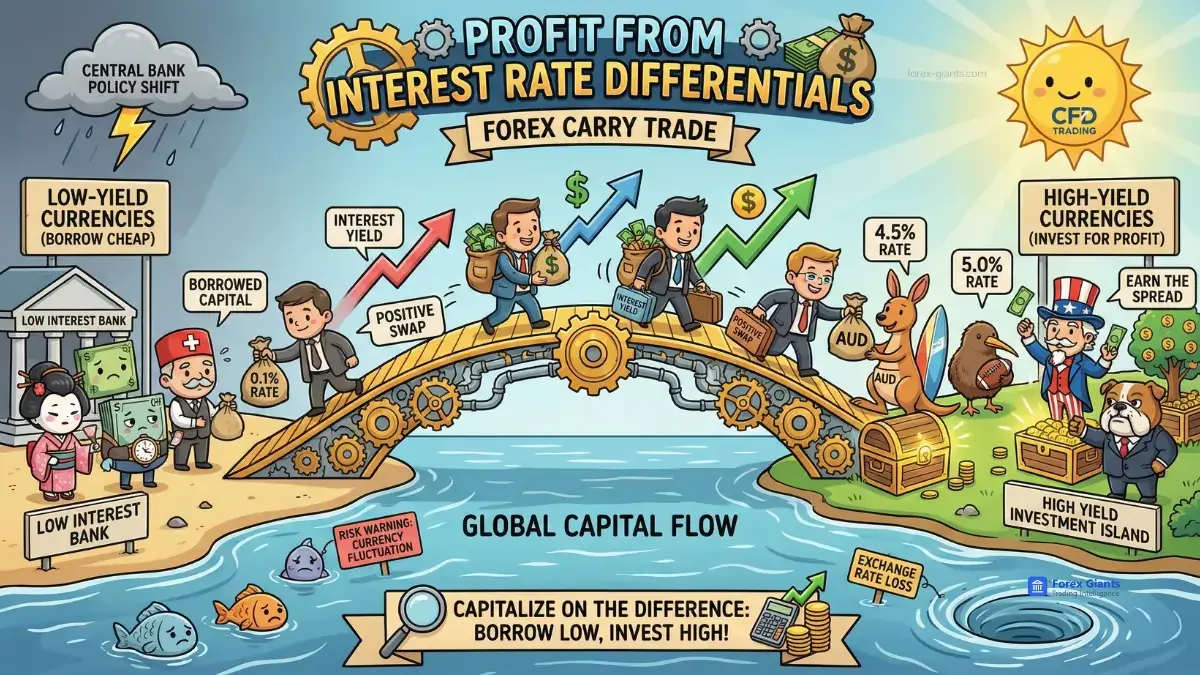
Simplicity defines the core concept. You sell a currency with a low interest rate. You buy a currency with a high interest rate. The broker pays you the difference between these two rates. This payment occurs daily. Traders call this "positive swap" or "rollover." Over time, these small payments accumulate into significant returns. The strategy works best in stable market environments where the high-yielding currency does not depreciate against the funding currency.
Success requires patience. Income generation happens overnight. This contrasts with capital gains sought by day traders. The carry trade resembles collecting rent on a property. You own the asset. The asset generates cash flow. Market appreciation serves as a secondary bonus. The primary objective remains the daily interest income.
Analyzing the Mechanics of the Swap
Understanding the mechanics ensures proper execution. Every currency pair involves two interest rates. The central bank of the respective country sets these rates. For example, consider the Australian Dollar (AUD) and the Japanese Yen (JPY). Assume the Reserve Bank of Australia sets rates at 4.50%. Assume the Bank of Japan sets rates at 0.50%. The difference equals 4.00%.
Buying AUD/JPY involves borrowing JPY to purchase AUD. You pay 0.50% interest on the borrowed JPY. You earn 4.50% interest on the held AUD. The net profit equals 4.00% annually. Brokers calculate this daily. They credit your account at the "rollover" time. This usually occurs at 5:00 PM New York time.
Not all brokers offer the exact central bank rate. They apply a spread to the swap rates. This spread covers their costs. You must check the specific swap rates provided by your broker. Some brokers offer poor rates. This reduces the profitability of the strategy. A serious carry trader compares broker swap rates before opening an account. Small differences in rates affect long-term returns significantly.
The Role of Leverage in Carry Trading
Leverage amplifies the potential return of a carry trade. This tool allows control of a large position with a small amount of capital. A 4.00% annual yield becomes much larger with leverage. Consider a 10:1 leverage ratio. A 4.00% yield transforms into a 40% return on equity. This assumes the exchange rate stays flat.
High leverage introduces danger. The market moves against you sometimes. A leveraged position amplifies losses from price movements. A 10% drop in the currency pair price wipes out the equity in a 10:1 leveraged account. Risk management dictates conservative leverage use. Experienced carry traders often stick to leverage ratios below 5:1. This buffer withstands market volatility.
Liquidation risk poses a constant threat. Brokers close positions if the margin level falls too low. A sudden "flash crash" eliminates years of accumulated interest earnings. You must maintain sufficient margin in the account. This prevents a margin call during temporary drawdowns. Survival ensures the continued collection of interest payments.
Identifying High-Probability Currency Pairs
December 2025 presents specific opportunities. Global inflation has largely stabilized. Central banks now diverge in their policies. Some economies require high rates to combat lingering price pressures. Others maintain low rates to stimulate growth. This divergence creates the spreads necessary for carry trading.
The classic "funding currencies" usually include the Japanese Yen (JPY) and the Swiss Franc (CHF). These economies historically maintain low borrowing costs. Selling these currencies provides the capital to buy higher-yielding assets.
"Target currencies" include those from economies with higher inflation or stronger growth. Look at the Australian Dollar (AUD), New Zealand Dollar (NZD), and US Dollar (USD). Emerging market currencies like the Mexican Peso (MXN), Turkish Lira (TRY), or South African Rand (ZAR) offer even higher rates. These come with higher risk. Political instability or economic weakness causes rapid devaluation in emerging markets.
Selection criteria must go beyond the interest rate. You must analyze the economic health of the target country. A strong economy supports currency value. A weak economy leads to depreciation. High interest rates often signal economic trouble. Inflation might run rampant. The central bank raises rates to stop the bleeding. Buying such a currency is dangerous. The devaluation often exceeds the interest earned. This creates a "yield trap."
Central Bank Policies in Late 2025
The Federal Reserve currently maintains a steady policy. The European Central Bank has adjusted its stance. The Bank of Japan has moved slightly away from negative rates but remains the lowest in the G7. This environment favors specific pairs.
Traders must monitor central bank statements. A hint of a rate cut destroys the appeal of a carry trade currency. The currency value drops immediately. The interest differential narrows. Traders rush to the exit. This "unwinding" causes sharp price declines. You must stay ahead of these shifts. Follow the economic calendar. Watch inflation reports (CPI). Watch GDP numbers. These indicators predict central bank actions.
Interest rate parity theory suggests high-yielding currencies should depreciate. This balances the total return. Real-world markets do not always follow theory. Capital flows chase yield. This demand drives up the value of the high-yielding currency. This creates a dual profit engine: capital appreciation and interest income. This phenomenon persists for long periods. Eventually, the cycle turns. Recognizing the turning point defines the expert trader.
Risk Management Strategies
Capital preservation takes precedence over yield generation. The primary risk involves exchange rate depreciation. You hold a long position in a high-yield currency. If the currency drops 5%, and you earned 3% in interest, you suffer a net loss. The exchange rate movement dominates the P&L.
Stop-loss orders protect against catastrophic moves. Wide stops suit this strategy better than tight stops. The pair needs room to breathe. Volatility is noise. A trend change is a signal. Place stops below major technical support levels on weekly charts.
Diversification reduces risk. Do not put all capital into one pair. Build a basket of carry trades. Buy AUD/JPY. Buy USD/CHF. Buy NZD/CAD. If one pair suffers from a localized economic shock, the others maintain the portfolio stability. Correlation analysis assists here. Avoid pairs moving in perfect lockstep. A basket approach smoothes the equity curve.
Hedging offers another layer of protection. You hold the spot position to earn interest. You buy a put option to protect against downside price risk. The cost of the option reduces the net yield. The protection warrants the cost during volatile periods. This creates a synthetic floor for the position.
The Impact of Global Economic Cycles
Carry trades thrive in "risk-on" environments. Investors feel optimistic. They seek yield. Capital flows from safe havens to high-growth economies. Stock markets rise. Commodities rise. High-yield currencies appreciate. This environment maximizes carry trade profitability.
"Risk-off" environments destroy carry trades. Fear grips the market. Investors seek safety. They sell high-risk assets. They buy back funding currencies like JPY and CHF. This causes the funding currency to surge in value. The carry trade position loses value rapidly. You must recognize the global sentiment. During a recession or geopolitical crisis, exit carry trades. Cash is a position. Waiting for stability preserves capital.
The current 2025 landscape shows mixed signals. Growth persists in North America. Asia faces headwinds. This mixed picture requires selectivity. Blindly buying the highest yield fails. Focusing on countries with trade surpluses and fiscal responsibility succeeds. Avoid countries with high debt-to-GDP ratios combined with political instability.
Evaluating Broker Swap Rates and Conditions
Broker selection influences the bottom line directly. Brokers differ in how they calculate rollover rates. Some take a larger cut. Institutional-grade brokers usually offer better swap rates than retail "market maker" brokers. Check the contract specifications. Look for "Swap Long" and "Swap Short" values.
Triple swap Wednesday matters. The Forex market settles T+2. Holding a position over Wednesday night incurs three days of interest. This covers the weekend settlement. Wednesday becomes the most important day for carry traders. Opening a position on Wednesday morning allows capturing this triple yield. Closing before Wednesday misses it.
Account currency plays a minor role. Profits accrue in the quote currency. If you trade AUD/JPY, you earn interest in JPY. The broker converts this to your account currency. Exchange rate fluctuations affect the value of the accumulated interest. This impact remains small compared to the principal position risk.
Technical Analysis for Entry Points
Fundamental analysis dictates what to trade. Technical analysis dictates when to trade. Do not enter a carry trade when the pair is overbought. Wait for a pullback. Use weekly and daily charts. Identify long-term trends.
Moving averages help identify the trend direction. The 200-day moving average serves as a key filter. Only take long carry trades when price sits above this average. This ensures trading with the long-term momentum. Buying a falling knife because of a high interest rate leads to losses. The trend is your friend. The yield acts as the bonus.
RSI and MACD indicators spot entry opportunities. An oversold condition in an uptrend offers a prime entry. You enter at a better price. You start earning interest immediately. The price appreciation adds to the profit. Patience in waiting for these setups improves the risk-reward ratio.
The Psychology of the Long-Term Holder
Carry trading requires a different mindset than day trading. Boredom becomes the enemy. The position might not move for weeks. You simply collect the daily payment. The urge to tinker with the trade arises. Resist this urge. Over-trading kills carry trade portfolios.
Drawdowns test resolve. A 2% drop in equity feels painful. You must trust the analysis. If the fundamental reasons for the trade persist, hold the position. If the central bank policy changes, exit the position. Distinguish between market noise and fundamental shifts. Discipline separates the profitable carry trader from the gambler.
Greed leads to excessive leverage. Seeing the daily payments creates a desire to increase position size. Adding to a position increases the average entry price. This raises the breakeven point. It increases vulnerability to pullbacks. Maintain strict position sizing rules. Never risk more than a set percentage of the account on a single trade.
Monitoring Economic Indicators
Stay informed. Read the central bank minutes. These documents reveal the future direction of interest rates. A hawkish tone suggests rates will rise or stay high. This supports the long position. A dovish tone suggests rates will fall. This warns of potential weakness.
Inflation data drives interest rates. Higher inflation forces central banks to raise rates. This helps the carry trade currency. Lower inflation allows rate cuts. This hurts the carry trade currency. The Consumer Price Index (CPI) serves as the most critical report. Pay attention to the core CPI. This excludes volatile food and energy prices.
Employment data reflects economic health. Strong employment supports rate hikes. Weak employment leads to rate cuts. The US Non-Farm Payrolls (NFP) report moves markets globally. Similar reports in Australia, Canada, and New Zealand impact their respective currencies.
Emerging Market Opportunities and Pitfalls
Emerging markets offer the highest yields. Countries like Turkey, Mexico, and South Africa often have rates exceeding 10%. The risk matches the reward. These currencies suffer from high volatility. Political decisions impact monetary policy. Liquidity dries up during crises.
Spread betting on emerging markets requires smaller position sizes. The wide bid-ask spreads increase transaction costs. The high swap rates compensate for this over time. Only hold these positions if the trend is clearly bullish. Do not fight a crashing emerging market currency. The interest rate cannot compensate for a 20% currency devaluation.
Check the political calendar. Elections cause volatility. Avoid holding large positions through uncertain elections in emerging markets. The outcome often leads to sudden policy shifts. Stability attracts capital. Uncertainty repels it.
Comparing Carry Trade to Fixed Income
Carry trading offers higher potential returns than government bonds. Bonds offer fixed yields. Currency carry trades offer variable yields plus capital appreciation. The risk profile differs significantly. Bonds guarantee principal repayment if held to maturity (barring default). Currencies have no such guarantee. The exchange rate fluctuates endlessly.
Carry trading suits investors with a higher risk tolerance. It fits into a diversified investment portfolio. It provides exposure to global macroeconomic trends. It acts as a hedge against domestic currency weakness. If your home currency yields nothing, diversifying into high-yield foreign currencies preserves purchasing power.
Advanced Strategy: The Basket Approach
Professional funds rarely trade a single pair. They construct a portfolio. They might long AUD, NZD, and MXN. They might short JPY, CHF, and EUR. This balances the exposure. If the AUD drops, the NZD might rise. The net yield remains positive. The volatility of the portfolio decreases.
weighting the basket depends on conviction. Assign higher weight to the strongest economies. Assign lower weight to the riskier ones. Rebalance the portfolio monthly. If a currency appreciates significantly, trim the position. Take profits. If a currency creates a valid technical setup, add to the position.
This approach requires more capital. Managing multiple positions demands attention. The stability gained justifies the effort. It transforms the strategy from a gamble on one pair into a systematic investment process.
Future Outlook for 2026
Looking ahead helps planning. Analysts predict a normalization of global rates in 2026. The extreme differentials might narrow. The carry trade will evolve. Selection becomes even more critical. Economies with structural advantages will maintain higher rates. Resource-rich nations often fall into this category.
Technological changes impact the market. Algorithmic trading dominates execution. Algorithms react instantly to interest rate news. You cannot beat the machines on speed. You beat them on patience. The carry trade exploits a long-term inefficiency. Algorithms often focus on short-term noise.
Prepare for shifts in the global reserve currency dynamic. The USD dominance faces challenges. Diversification into other high-yield currencies protects against long-term USD weakness. The carry trade remains a viable strategy as long as sovereign nations maintain independent monetary policies.
Developing a Carry Trade Plan
Create a written plan. Define the entry criteria. Define the exit criteria. Determine the maximum leverage. List the acceptable currency pairs. Set a routine for checking swap rates. Review the portfolio weekly.
Adherence to the plan prevents emotional decisions. The market offers temptation daily. The plan keeps you grounded. If the conditions do not meet the criteria, do not trade. Cash is a valid position. Waiting for the perfect alignment of technical trend and fundamental yield differential ensures the highest probability of success.
Summary of Key Execution Steps
Analyze Interest Rates: Identify the highest and lowest interest rates among major central banks.
Check the Trend: Ensure the high-yield currency is in an uptrend against the low-yield currency.
Calculate Swaps: Verify the broker pays a positive swap on the specific pair.
Determine Risk: Set a stop-loss based on technical support levels.
Size Position: Calculate lot size to keep leverage low (below 5:1).
Monitor: Check economic calendar for rate decisions and inflation data.
Hold: Allow time for interest to accumulate.
Final Thoughts on Wealth Generation
The Forex carry trade offers a path to wealth building different from high-frequency trading. It leverages the global economic structure. It rewards patience and understanding of macroeconomics. The strategy demands respect for risk. Leverage kills the careless. Discipline rewards the prudent. In the market conditions of late 2025, opportunities exist for those willing to do the work. Analyze the rates. Check the charts. Manage the risk. Let the interest compound.