The calendar reads December 2025. Our financial Industry looks very different than five years ago. High interest rates persist. Volatility defines the major pairs. Retail traders face exhaustion. They churn faster than brokers acquire them. The old strategies failed. Bonuses draw regulatory fire. Aggressive leverage marketing attracts the wrong audience. Brokerages relying on outdated acquisition models face extinction. The path forward exists. The industry calls this path Smart Gamification.
Rising acquisition costs and demanding traders force brokers to rethink engagement. Personalized in-platform experiences are now critical.
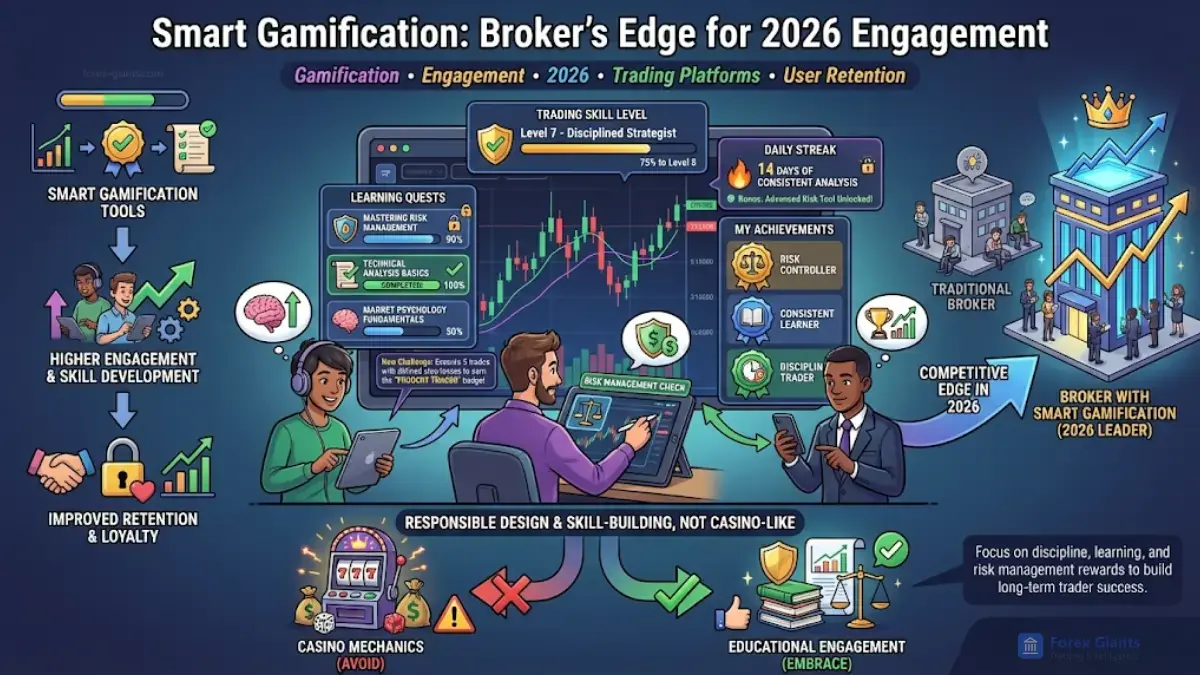
Smart gamification implies more than digital confetti. Most brokers misunderstand the term. They add badges for trade volume. They create leaderboards rewarding reckless risk. These tactics mirror gambling. Regulators despise gambling mechanics disguised as trading. Smart gamification focuses on education. The strategy rewards longevity. The system incentivizes risk management. This approach defines success for 2026.
CFD brokers face an engagement crisis. Smart gamification offers a solution, transforming trader journeys and boosting retention.
CFD brokers confront a critical challenge. Most traders register, hesitate at KYC, explore briefly, and then leave. They often move to a competitor before a follow-up email arrives. This represents an engagement problem, not just a conversion issue.
The Engagement Crisis for Brokers
Lead acquisition costs are rising for brokers. Trader switching costs are lower. Generic emails and reactive call center outreach no longer work. Traders demand platforms that understand them, guide them, and adapt to their behavior in real time. Brokers leading in 2026 will offer personal, supportive, and compelling in-platform experiences.
Beyond Traditional Gamification
Early gamification in trading involved badges, competitions, and leaderboards. These tactics had limitations. They failed to re-engage traders after friction, doubt, or loss. The solution lies in smarter gamification.
What Smart Gamification Delivers
Gamification definition:
Smart gamification applies game design elements to non-game contexts to improve user outcomes. The focus shifts from addiction to proficiency. You must understand the difference.
Dumb Gamification:
Rewards high leverage usage.
Celebrates trade frequency.
Uses flashing lights for every execution.
Hides risk warnings behind animations.
Smart Gamification:
Rewards completing educational modules.
Unlocks lower spreads for consistent risk management.
Celebrates stop-loss adherence.
Visualizes skill progression through data.
The distinction matters. One model burns clients. The other model builds traders. Building traders ensures long-term revenue. The 2026 broker needs long-term revenue to survive.
Smart gamification builds adaptive, data-driven user journeys. It responds to each trader's behavior, skill level, and risk profile in real time. It combines behavioral personalization, automation, and subtle UX design. This creates a cohesive retention strategy that operates seamlessly.
Key functionalities include:
Widgets: Interactive pop-ups like quizzes, bonuses, or trading competitions. These trigger in real time based on trader behavior.
Missions: Guides traders through milestones such as onboarding, KYC document uploads, depositing, and platform exploration. Missions progress dynamically based on trader actions.
Bonus Engine Integration: Allows missions and widgets to attribute rewards using existing bonus configurations.
Mission Boards: Provide users a direct view of active missions, progress, and rewards in one interface.
Industry-Specific Mission Boards: Offer trading-themed designs for a native mission experience.
These components create a feedback loop. Each interaction informs the next. The platform continuously adapts.
The Power of Hidden Personalization
Each trader interacts uniquely with a platform. Gamification adapts to match their interests, expectations, and behaviors.
Consider a bonus promotion. Two traders see the same design. Behind the scenes, numbers, weighting, and outcomes calibrate dynamically. This depends on each user's history, behavior, or risk level. A high-value trader receives larger rewards. A hesitant new user gets smaller, frequent wins to build confidence. A disengaged trader receives a perfectly timed reactivation offer. This is hidden personalization. Traders experience familiarity. Brokers gain precision.
Missions apply the same principle. A confident trader receives missions encouraging advanced tools or portfolio diversification. A trader stalled at KYC sees a simplified verification mission with tangible rewards. The interface remains consistent. The strategy leaves nothing to chance.
Solving Drop-Offs and Improving Retention
Smart gamification addresses critical moments. These include onboarding, KYC, first deposits, first losses, and platform exploration.
Onboarding: Transforms passive forms into interactive journeys. Missions guide traders step-by-step. Rewards reinforce progress.
KYC: Becomes palatable through mission framing. Context-aware pop-ups remind traders of verification benefits.
First Deposits: Gain clarity through missions tied to funding milestones.
First Losses: Soften when missions encourage education, demo practice, or structured trades with bonus buffers.
Platform Exploration: Deepens engagement through missions encouraging new asset classes, analytical tools, or community features.
This results in proactive engagement. Brokers guide traders before friction arises. This represents a decisive step forward. It will define customer engagement in 2026 and beyond.
The Shift Defining 2026
The brokerage industry stands at a crossroads. Acquisition costs are unsustainable. Regulatory scrutiny tightens. Traders are more demanding.
Thriving brokers in 2026 will not compete solely on spreads and asset coverage. They will compete on personal and supportive in-platform experiences. Gamification is central to this shift. It shapes into structured, behavior-driven journeys. It blends engagement, education, and incentivization. Traders will expect platforms to adapt to their goals, experience level, and risk tolerance.
Early adopters of smart gamification report higher completion rates, longer sessions, improved retention, and better lifetime value. The question is not if this works. It is whether brokers will adopt it before competitors.
The Failure of Volume-Based Incentives
Review the industry performance from 2020 to 2024. Brokers prioritized volume. They rewarded frequent trading. This model creates a conflict of interest. Clients lose money quickly. They blame the platform. They leave. The Cost per Acquisition (CPA) rises every year. The Lifetime Value (LTV) drops. This math destroys balance sheets.
Volume-based rewards also attract regulatory scrutiny. The FCA and ESMA tightened rules again in early 2025. They explicitly target mechanics encouraging excessive trading. A broker offering a "High Volume" badge invites a fine. The compliance department prohibits these outdated methods. Marketing teams must adapt or perish.
The Retention Crisis
Client retention poses the primary challenge for 2026. Traders have infinite choices. Artificial Intelligence generates signals everywhere. Fees approach zero. The platform experience remains the only differentiator. A static interface bores the user. A difficult interface frustrates the user. Smart gamification solves this engagement gap. The platform becomes a mentor. The user feels progress outside of Profit and Loss (PnL). PnL fluctuates. Progress must remain constant. Constant progress builds loyalty.
Core Mechanics for 2026
Implementation requires specific features. You need concrete tools. Abstract concepts fail. Develop these mechanics immediately.
1. The Trader Skill Tree
Video games use skill trees to show character growth. Trading platforms must adopt this visual. A new user starts at Level 1. The interface limits their tools. They see basic charts. They access major pairs only. This restriction protects the user.
Progression requires action. The user watches a video on technical analysis. They pass a quiz. They unlock a new indicator. The user places ten trades with a stop-loss. They unlock a new asset class. The interface expands as the user learns. This provides a sense of achievement. The user feels the platform investing in their success. They stay to unlock the next level.
2. Risk Management Streaks
Apps like Duolingo use streaks to build habits. Apply this to risk control. Do not track login streaks. Track discipline streaks. Create a "Guardian" badge. Award this badge to users who set a stop-loss on every trade for thirty days. Offer a tangible reward. Reduce their swap fees for the next month. This aligns the broker's interest with the client's survival. The client stays alive longer. The broker earns more spread revenue over time.
3. Collaborative Challenges
Trading feels lonely. Isolation leads to emotional decision-making. Social trading often means blind copying. Smart gamification encourages collaboration. Create teams based on trading styles. A "Scalper Team" competes against a "Swing Trader Team". The metric for victory is not profit percentage. The metric is Sharpe Ratio. The metric is consistency. The team with the lowest drawdown wins. This fosters a community of prudent trading. Users police each other. They share strategies to reduce risk. The platform becomes a social hub.
4. The AI Coach Integration
Artificial Intelligence dominated 2025 tech discussions. Use AI as a personalized quest giver. The AI analyzes user history. The system detects a flaw. Perhaps the user holds losing trades too long. The AI generates a specific quest: "Close three losing trades within 2 hours of opening this week." Completing the quest grants a reward. This feedback loop improves trader behavior. The user views the platform as a coach. They trust the platform. Trust reduces churn.
Compliance as a Feature
Compliance officers often block innovation. They fear regulatory backlash. Smart gamification turns compliance into a feature. Regulators want educated traders. They want risk warnings read and understood.
Gamify the Terms and Conditions. No user reads the PDF. Break the document into small quizzes. Reward the user for reading specific clauses about leverage risks. This proves to the regulator the broker educated the client. The audit trail shows active learning. This defense creates a legal shield. The regulator sees a proactive broker. The fine risk drops.
Data-Driven Compliance
Use gamification data to categorize clients. A user stuck at Level 1 for six months poses a risk. They fail to learn. The system flags this account. Support reaches out. Maybe this product suits them poorly. This proactive filtering prevents future complaints. The data reveals the truth about client capability. Use the data.
The Psychology of the 2026 Trader
Demographics shift. Gen Z dominates the entry-level market. Gen Alpha begins entering the ecosystem. These generations grew up with responsive interfaces. They expect immediate feedback. A static spreadsheet interface looks broken to them. They demand interactivity.
Dopamine vs. Serotonin
Gambling exploits dopamine. The rush is short. The crash follows. Smart gamification targets serotonin. Serotonin relates to status and satisfaction. Completing a difficult course produces serotonin. Mastering a complex strategy produces serotonin. This chemical creates stable satisfaction. Stable satisfaction leads to retention. Dopamine leads to burnout. Choose serotonin.
Visualizing Data
Numbers bore people. Visuals engage people. Do not show a table of past trades. Show a map of the market. Show the user's journey as a path through this map. Use colors to indicate emotional control. A red zone indicates panic selling. A green zone indicates calculated entries. The user reflects on their behavior through these visuals. Self-reflection improves performance. Improved performance extends the lifecycle.
Technical Implementation
Building these systems requires a robust tech stack. A white-label solution often lacks flexibility. You need custom middleware. The gamification engine sits between the trading server and the front end.
The Event Bus
Every user action generates an event. Trade Open. Trade Close. Login. Video Watch. The event bus captures these signals. The gamification engine processes the signals. The engine checks rules. Did the user meet the criteria for the "Risk Manager" achievement? If yes, trigger the reward. This happens in real-time. Latency kills the effect. The feedback must be instant. The user closes the trade. The badge appears immediately.
Mobile First Design
Desktop trading persists for professionals. The growth comes from mobile. Gamification works best on mobile. The screen real estate is small. Progress bars fit well. Notifications drive engagement. Design the skill tree for a vertical screen. Ensure touch targets work. The mobile experience defines the brand.
Marketing the New Approach
Marketing must change. Stop advertising spreads. Stop advertising bonuses. Advertise the journey.
Old Ad: "Trade EURUSD with 0.1 pips!" New Ad: "Master the Markets. Level Up Your Trading Skills."
The new message attracts a different user. This user wants to learn. This user accepts a learning curve. This user deposits more over time. The quality of leads improves. The conversion rate stabilizes. The churn rate drops.
The Narrative Arc
Give the user a story. They are not a customer. They are a protagonist. The market is the antagonist. The platform is the weapon. The narrative frames every interaction. A margin call is not a failure. A margin call acts as a plot twist. The user must recover. The system offers a "Redemption Arc" quest. This reframing prevents despair. Despair causes withdrawals. Hope causes deposits.
Case Scenario: Broker A vs. Broker B
Compare two hypothetical brokers in the 2026 market.
Broker A (Traditional): Offers a 50% deposit bonus. The interface is a standard MetaTrader clone. They send emails urging clients to trade gold.
- Result: High initial deposits. 90% client loss within 3 months. Regulatory fine for misleading promotions. Reputation damage.
Broker B (Smart Gamification): Offers no bonus. Offers a "Trading Academy" with a progression system. New users start with a demo account contest. They must pass a risk management exam to unlock 1:30 leverage. The platform suggests trades based on the user's success history.
- Result: Lower initial deposits. Client retention extends to 18 months. Users upgrade to premium tiers. Regulators use Broker B as a model for compliance. Profitability sustains.
Broker B wins. The market selects for Broker B. Broker A dies a slow death.
Overcoming Internal Resistance
Management will resist. They want immediate revenue. Development costs money. Gamification requires time to build. You must present the business case. Show the retention data from other industries. Banking apps use this. Fitness apps use this. Trading is finance plus fitness. Financial fitness. The logic holds.
Start small. Do not rebuild the entire platform. Add a progress bar for profile completion. Add a badge for the first profitable week. Measure the impact. The data will convince the skeptics. Once the data proves the concept, expand the system.
The Role of Community
Smart gamification fosters community. Users compare levels. They discuss how to unlock the "Master Strategist" tier. This creates organic marketing. Users share their achievements on social media. This user-generated content costs nothing. It attracts new users naturally. The community answers support questions. Peer support reduces the load on customer service. The ecosystem becomes self-sustaining.
Tournaments Done Right
Most trading tournaments promote gambling. The winner takes the highest risk. Change the rules. Run a "Consistency Tournament". The winner is the trader with the smoothest equity curve over three months. This rewards skill. This highlights the correct behavior. The prize should be education or lower fees, not cash. Cash prizes attract gamblers. Educational prizes attract serious traders. Target the serious trader.
Future Proofing
Technology moves fast. Virtual Reality (VR) and Augmented Reality (AR) loom on the horizon. Smart gamification prepares the platform for these shifts. A 3D skill tree transfers easily to VR. A flat spreadsheet does not. Preparing the data structure now allows for rapid adaptation later. The investment today protects the future business.
Action Plan for Q1 2026
Do not wait. Start the transition now.
Audit Current Incentives: Remove any reward based purely on volume. Eliminate "deposit bonuses".
Define User Journey: Map the path from "Novice" to "Pro". What skills define each stage?
Design the Feedback Loop: How does the user know they improved? Design the visuals.
Select the Tech: Decide on a custom build or a third-party API integration.
Launch a Pilot: Test the "Risk Streak" mechanic with a small user group. Measure the retention.
Final Thoughts on Survival
The era of the passive broker ended. The market destroyed the casino model. 2026 belongs to the active partner. The broker investing in client success wins. Smart gamification provides the tools for this investment. It aligns profit with purpose. It turns compliance into a game. It turns anxiety into achievement.
Clients want to succeed. They lack the structure. Provide the structure. Gamify the discipline. Reward the restraint. The result is a healthy, loyal, and profitable user base. This defines survival. This defines success. Build the system. Secure the future.
Infrastructure Powers the Shift
Delivering personalization at scale requires robust infrastructure. Platforms with real-time data activation and integrated smart gamification capabilities, such as Solitics, help brokers deliver these new experiences. They shape the next generation of user engagement in trading.
Brokers recognizing this shift early will define the industry standard.
Will your broker define the norm in 2026?